Business
Nigeria can refine fuel now. It just can’t feed it

Africa’s biggest oil-producing country spent over a decade pitching to investors that it was supporting the construction of Dangote Refinery’s 650,000 barrels per day of crude oil at home, and that the country would finally stop shipping out crude only to buy back expensive fuel.
That bet is now colliding with a more stubborn problem as there isn’t enough crude to go around.
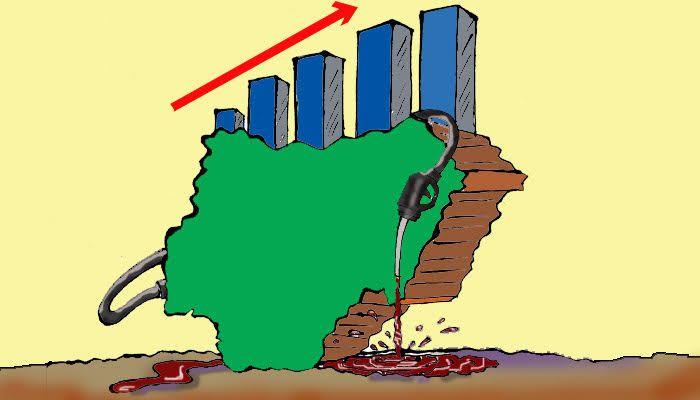
BusinessDay’s findings showed Nigeria’s petroleum challenge is shifting from inadequate refining capacity to insufficient crude availability.
“With domestic refining capacity expanding, the sector’s performance will increasingly depend on whether upstream production can meet three competing demands: refinery feedstock, export obligations and crude-backed financing commitments,” notes from PAC Research, a Lagos-based research firm, said on Tuesday.

It added, “The interaction between these pressures will shape fuel pricing, foreign-exchange demand, inflation and investor confidence over the next 12–18 months”.
The clearest sign came this month, when Dangote Petroleum Refinery, Africa’s largest single-train refinery, with 650,000 barrels a day of installed capacity, briefly abandoned the naira altogether.
On July 15, the plant began quoting petrol, diesel and jet fuel in dollars: 77.9 cents a litre for gasoline, $1.087 for diesel, 94.2 cents for aviation fuel.
Marketers and economists warned the move would strain the currency and push costs through the economy. Eight days later, Dangote reversed course, returning to naira pricing at a new gantry rate of N1,215 a litre.
It was the second time in two years that Nigeria’s naira-for-crude arrangement, introduced in October 2024 specifically to shield domestic refiners from currency swings, has buckled.
“The deeper issue is domestic, and it isn’t going away: Nigeria simply doesn’t pump enough oil to satisfy its own refining ambitions, let alone its export contracts and crude-backed financing deals,” Aisha Mohammed, an energy analyst at the Lagos-based Centre for Development Studies, said.
The math behind the reversal
Brent, the benchmark of Nigeria’s crude, currently retails at $83.87 a barrel as tensions in the Middle East ratchet up shipping and geopolitical risk premiums.
Nigeria’s own output, meanwhile, hit 1.56 million barrels a day in June, the highest since 2020, but still a fraction of what a fully built-out domestic refining sector will eventually demand.
Run the numbers on Dangote’s 650,000-barrel-a-day plant alone, operating at a realistic 85 per cent utilisation, and the refinery needs roughly 552,500 barrels of crude every day. That’s about 35 percent of everything Nigeria currently pumps out of the ground.
Subtract that from national output, and there’s an estimated 1.01 million barrels a day left to cover every other domestic refiner, existing export contracts and crude-backed financing deals combined.
That remaining volume is enough to keep the system running today. It isn’t enough to absorb a shock. Any slippage in production, a pipeline outage, a security incident in the Niger Delta, underinvestment upstream, or any new claim on that leftover barrel count is sufficient to reopen the same allocation dispute that produced this month’s pricing reversal.
“It is a workable margin today, but not a wide one,” PAC Research said, noting that any slippage in production, or any new claim on that remaining volume, is enough to reopen the same allocation dispute that forced July’s pricing reversal.
Reserves aren’t the issue
Africa’s biggest oil-producing country isn’t short on crude in the ground. The country holds 37.28 billion barrels of crude and condensate and 210.54 trillion cubic feet of proven gas reserves as of January 2025, both up slightly from a year earlier.
The constraint is what comes out of the ground each day, not what’s sitting beneath it.
That distinction is shaping how investors are being told to read the events of the past two weeks.
“From an investor’s standpoint, the key issue is no longer whether Nigeria possesses adequate refining capacity,” the PAC Research report stated. “Rather, the focus is shifting toward the sustainability of crude supply arrangements.
Who pays first
The transmission to consumers is faster than it used to be. With the downstream fuel market largely deregulated, pump prices track production costs and the exchange rate far more directly than in the subsidy era, when government intervention absorbed much of the shock.
A household burning through 120 litres of petrol a month would pay roughly N144,000 at N1,200 a litre, rising to about N156,000 if prices climb another N100, meaning every N100 increase adds close to N12,000 a month to that household’s fuel bill before transport and food costs are factored in.
Commercial transport operators consuming 250 litres a week face close to N100,000 in added monthly costs from a comparable move, a burden that typically lands on commuters through fares rather than on operators’ margins.
That cost cascades further because Nigerian businesses lean heavily on diesel generators for power, given the unreliability of the national grid. Transportation and energy costs feed into food prices and manufacturing costs alike, which is why a gantry-rate dispute at a single refinery can move the inflation needle nationally.
What comes next
PAC Research’s base case has national production climbing gradually to 1.7–1.8 million barrels a day over the next year, with refinery demand growing faster than the crude supply behind it. This means periodic dollar-based purchases and gantry disputes are likely to recur.
The firm assigns 55 percent odds to that path. It puts 25 percent odds on production reaching 1.9–2.0 million barrels a day, which would ease the crunch, and 20 percent odds on output slipping below 1.6 million barrels, which would deepen it.
The threshold that matters most, according to the firm, is sustained production near 2.0 million barrels a day.
Below that, an increasing share of national output gets absorbed by domestic refining, squeezing export volumes and keeping allocation disputes and currency pressure, a recurring feature of Nigeria’s oil market, rather than a one-off event. (BusinessDay)
-

 News5 hours ago
Abuja Workers Turn To Pick-Up Trucks Amid Rising Transport Costs
-
 Politics10 hours ago
Security Operatives Guard Tinubu’s Billboards Ahead Campaign Launch
-
 News5 hours ago
Ebola patient in Nigeria is Swiss, had not visited DR Congo – Foreign Ministry
-
Politics5 hours ago
Results With Discrepancies Won’t Be Uploaded On IREV – INEC
-
News23 hours ago
El Niño projected to cause 31,400 deaths in Nigeria
-
 News5 hours ago
Zamfara Community Fights Back
-
Politics5 hours ago
2027: You Can’t Hide Voters’ Register And Expect Trust – Atiku Tells INEC
-
Politics5 hours ago
South-East has better presidential options than Peter Obi – Umahi