Politics
2027 and the quiet return of Tinubu’s Muslim-Muslim ticket

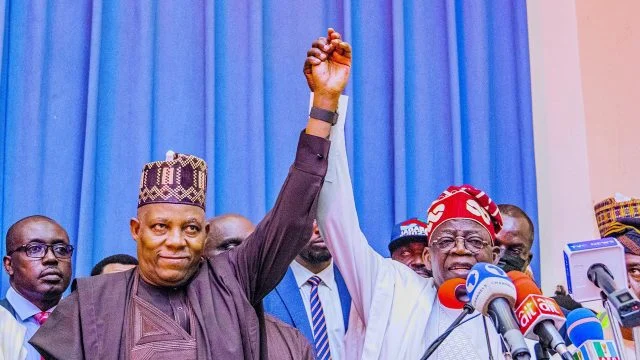
Four years after fierce opposition from churches, civil society groups and even members of his own party, President Bola Tinubu’s decision to retain Vice-President Kashim Shettima as his running mate for the 2027 election has attracted only muted criticism. In this analysis, DARE AKOGUN examines how incumbency, political realignments and changing public priorities have reshaped one of Nigeria’s most contentious political debates
In July 2022, Nigeria was gripped by one of the fiercest political controversies since the return to democratic rule after the presidential candidate of the All Progressives Congress, now President Bola Tinubu, announced former Borno State Governor Kashim Shettima as his running mate for the 2023 presidential election. The backlash was immediate and widespread.
Churches and Christian organisations condemned the decision. Civil society organisations warned of deepening religious divisions. Opposition parties also exploited the situation, describing it as evidence of exclusion.
The Christian Association of Nigeria described the ticket as insensitive to the country’s religious diversity. The Pentecostal Fellowship of Nigeria also warned that it could further polarise an already fragile nation.

Inside the APC, the resistance was even more dramatic, with prominent party members openly revolting against the Muslim-Muslim ticket.
Former Secretary to the Government of the Federation, Babachir Lawal, described the ticket as “a disastrous error” and declared it “dead on arrival.” Also, the former Speaker of the House of Representatives, Yakubu Dogara, led a coalition of northern Christian APC leaders who refused to campaign for the party’s presidential candidate. Then-Senator Ishaku Abbo also resigned from the APC Presidential Campaign Council, insisting he could not defend what he considered an unfair political arrangement.
The Peoples Democratic Party and the Labour Party also built significant parts of their campaigns around the controversy, portraying the same-faith ticket as a threat to national unity.
For months, newspapers, television stations, churches and social media platforms became battlefields over one central question: Could Nigeria, with its delicate religious balance, successfully operate under a Muslim-Muslim presidency?
However, four years later, that question appears to have lost much of its political potency. On July 10, Tinubu officially retained Shettima as his running mate for the 2027 presidential election, with little criticism from any quarter, especially from the vocal critics of 2022. The political earthquake, nationwide protests, emergency meetings by major Christian bodies and wave of resignations from the ruling party never came, even two weeks after Shettima was again announced as Tinubu’s running mate.
Beyond isolated social media reactions and a handful of political statements, the announcement passed with remarkable calm. The contrast between 2022 and 2026 has become one of the most striking developments in the country’s evolving political landscape.
Like 2022, unlike 2026: The reasons behind the silence
Perhaps the most significant difference between 2022 and today is that Tinubu and Shettima are no longer candidates asking Nigerians for an opportunity; they are incumbents seeking another term.
A political scientist, Femi Owolabi, while speaking with Sunday PUNCH, noted that incumbency fundamentally changes political calculations, arguing that this reality has naturally reduced public dissent within the ruling party. According to him, unlike in 2022, when party members could openly oppose the ticket without immediate political consequences, many elected officials, governors and party leaders now depend on the current administration for political survival.
“Open rebellion against an incumbent president carries considerably greater risks than opposing an aspirant seeking office,” he said.
A former Minority Leader of the House of Representatives, Farouk Aliyu, also stated that the fears expressed in 2022 had not materialised three years into Tinubu’s administration.
Speaking during an interview on ARISE TV monitored bySunday PUNCH, Aliyu said Christians had become “much more comfortable” with the arrangement because the predicted religious marginalisation never occurred.
According to him, President Tinubu has governed “as a Nigerian” rather than along religious lines.
That position reflects the central argument now advanced by the APC that governance over the past three years has largely neutralised the religious concerns that dominated public discourse before the 2023 election.
When economic hardship eclipsed identity politics
If religion dominated Nigeria’s political conversation in 2022, the economy dominates it today.
Since assuming office, Tinubu’s administration has implemented far-reaching economic reforms, including the removal of fuel subsidy and exchange rate liberalisation.
While the government insists the reforms are necessary to reposition the economy, millions of Nigerians continue to grapple with rising food prices, transportation costs and inflation. Political analysts believe these economic realities have fundamentally reordered voters’ priorities.
A political analyst, Dr Jide Aina, told Sunday PUNCH that the initial shock generated by the Muslim-Muslim ticket had largely disappeared because Nigerians have now lived under the arrangement for several years. He said the national conversation had gradually shifted from whether the ticket was appropriate to whether the administration had delivered on governance.
“That transition may explain why public discourse has increasingly focused on inflation, insecurity, unemployment and electricity rather than religious balancing,” he said.
The Christian appointments
Another factor identified by analysts is the administration’s pattern of political appointments. One of the major arguments advanced by critics in 2022 was that a Muslim-Muslim presidency would inevitably sideline Christians in key government positions.
While criticisms over appointments have continued in some quarters, the administration has appointed Christians to several prominent positions, including the Secretary to the Government of the Federation, ministers and heads of strategic agencies. The Senate President, Godswill Akpabio, is also a Christian. There are claims in some quarters that Tinubu’s administration is dominated by Christians.
Analysts believe these appointments have weakened claims that Christians would be systematically excluded from government. Whether that perception is accepted remains contested, but political observers agree that it has reduced the emotional intensity surrounding the same-faith ticket.
Interestingly, even some politicians who opposed the Muslim-Muslim ticket now frame the debate differently.
The presidential candidate of the Social Democratic Party in the 2023 election, Adewole Adebayo, recently dismissed renewed arguments over the same-faith ticket, insisting that competence and justice matter more than religion.
Adebayo described the Tinubu-Shettima combination as a “zero-zero ticket,” arguing that leadership should be judged by justice rather than religious identity.
“There is nothing like the Muslim-Muslim ticket. In Islam, what is expected of a leader is not the religion of that leader but justice,” he said.
Perhaps one of the most surprising interventions came from a cleric and politician, Pastor Femi Emmanuel. Speaking during an interview on TVC, Emmanuel criticised the way many church leaders approached the Muslim-Muslim ticket in 2022. According to him, many pastors misunderstood how political power operates, explaining that occupying the office of Vice-President does not automatically translate into religious advantage for Christians.
“What Christians are arguing for is that we want a vice-president; what would that bring to the church? Nothing. We are Nigerians,” he said.
The cleric urged Christians to engage more actively in political participation rather than relying solely on religious mobilisation.
Similarly, the Northern Christian Youth Forum commended Tinubu for retaining Shettima as his running mate, describing the decision as a demonstration of confidence in the Vice-President’s leadership and commitment to national unity.
Speaking on behalf of the forum, its President, Rev. Pinot Atuluku, said the organisation was pleased that the President resisted calls from some quarters seeking the replacement of the Vice-President.
“Shettima has remained one of the most prominent northern political leaders promoting inclusiveness, irrespective of religious affiliation,” Atuluku said.
He added that the Vice-President had consistently carried Christians along through what he described as strategic interventions aimed at promoting harmony and ensuring that no group felt excluded.
Atuluku said the group was confident that Tinubu’s decision to retain Shettima would further consolidate national unity and political stability ahead of the 2027 elections.
The opposition has different priorities
The opposition landscape has also changed considerably since 2023.
Four years ago, both the PDP and the Labour Party vigorously challenged the APC’s Muslim-Muslim ticket. Today, both parties are confronting internal divisions, leadership disputes and coalition negotiations ahead of the next election. They have largely remained silent about the President’s choice.
A political analyst, Abifarin Sunday, said arguments that focused on religion in 2023 have increasingly shifted towards identifying viable candidates capable of challenging the ruling party.
Without a coordinated opposition campaign centred on the same-faith issue, analysts believe the controversy has naturally lost momentum, according to Sunday.
“Although whether the relative silence amounts to acceptance remains a matter of debate, I think Nigerians have become more interested in governance outcomes than identity politics,” he said.
However, Awodele Emmanuel, while speaking with Sunday PUNCH, disagreed that Nigerians are more interested in governance outcomes, maintaining that the economic hardship in the country has merely pushed religious concerns into the background without resolving the underlying issues.
“Silence should not automatically be interpreted as approval; voter priorities often evolve with changing national realities. The dominant concerns today are food security, inflation, insecurity, youth unemployment and electricity, which are different from those that shaped political discourse in 2022,” he said.
Whether the silence surrounding Tinubu’s decision represents political maturity, resignation or simple fatigue remains open to interpretation. What is undeniable is that the country’s political conversation has changed dramatically within four years.
The issue that once dominated front pages, divided churches, fractured political parties and threatened to define an election has gradually been overtaken by concerns over economic survival and governance.
The Muslim-Muslim ticket has not disappeared from Nigeria’s political landscape; rather, it has been eclipsed by a more immediate national question. (Punch)
-

 Sports15 hours ago
Welbeck joins Chelsea on two-year contract
-
News18 hours ago
Police nab alleged kingpin behind N1bn luxury car scam in Lagos
-
News15 hours ago
Veteran journalist, ex-Oyo gov’s spokesman Lekan Alabi dies at 76
-
News18 hours ago
Army rescues abducted lieutenant colonel, civilian in Enugu
-
Metro20 hours ago
Suspects request photo with police spokesman after being caught with cocaine, pistols
-
News14 hours ago
You Lack Maturity – Presidency Tells Cardinal Onaiyekan
-
News18 hours ago
65 of 69 Nigerian ambassadors accepted as Reno Omokri remains unresolved
-
News13 hours ago
Obi backs Tinubu on flyovers, urges rehabilitation of decaying roads