Business
Dangote vs BUA’s Rabiu: The billionaires battling to build Nigeria’s industrial future

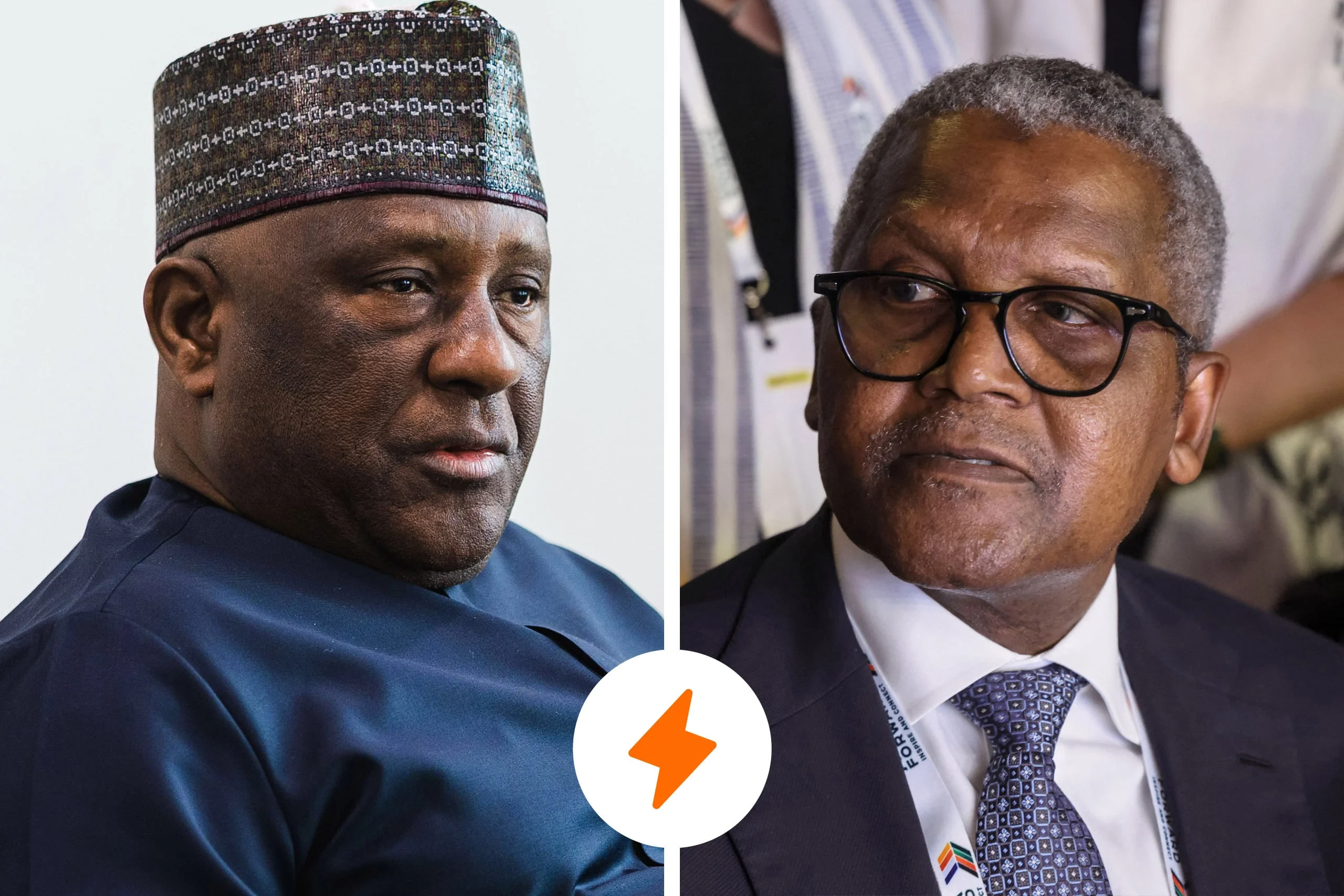
For years, Aliko Dangote has been Nigeria’s most ambitious factory builder and the entrepreneur most closely associated with transforming commodity trading into large-scale manufacturing.
Abdul Samad Rabiu, the founder of BUA Group, has increasingly emerged as Dangote’s most credible domestic industrial rival.
His net worth stood at $12.5bn on 27 July, making him Nigeria’s second-richest person after Dangote, whose fortune was estimated at $31.1bn, according to Forbes.
The two tycoons now compete across cement, sugar, flour, pasta, ports, logistics and infrastructure sectors.

Dangote builds at a scale designed to reshape regional markets. His businesses are increasingly continental, highly integrated, and concentrated in industries where the enormous cost of entry limits competition. By contrast, Rabiu has built BUA through acquisitions, consolidation, and the steady expansion of domestic manufacturing platforms.
Femi Adebiyi, country manager at CinderBuild, an Africa-focused platform for building materials, said the two industrialists often recognise the same opportunities but pursue them from different positions of strength.
They are — and will always be — rivals
“They play in popular markets,” said Ademola Adigun, chief executive of AHA Consultancies. “Their markets are mass markets, with mass products — items that people have to use.”
Despite occasional public displays of cordiality, he said competition would remain the defining feature of their relationship.
“They are — and will always be — rivals,” he told The Africa Report. “The struggle for market dominance and market share will always be there.”
Together, BUA Cement and BUA Foods accounted for more than 16% of the Nigerian Exchange’s equity market value as at 27 July, compared with about 12% for Dangote’s listed companies — Dangote Cement, Dangote Sugar Refinery and NASCON Allied Industries.
The clearest expression of the rivalry is cement.
Dangote Cement is Africa’s largest producer, with a capacity of about 55 million tonnes per year across 11 countries.
It plans to increase capacity to 80m tonnes annually by 2030. Its Itori plant, under construction in Ogun State, will be dedicated to exports.
BUA Cement, the second-largest producer in Nigeria, is pushing ahead with plans to increase its capacity from around 17m tonnes a year to 20m tonnes.
It signed an agreement with the Chinese engineering company CBMI in January for a new 3m-tonne-a-year production line in Sokoto, expected to be completed within 20 months.
Competing for the food system
BUA Foods was formed through the consolidation of the group’s sugar, rice, edible oils, flour and pasta businesses.
“BUA’s biggest growth driver is BUA Foods, which generates more revenue for him than the cement business, and that is what drives his expansion,” Adebiyi said.
Rabiu intends to turn BUA Foods into Nigeria’s largest indigenous food manufacturer. Its next expansion phase includes additional flour-milling and pasta capacity, a noodles business, completed edible-oils operations and an integrated animal-feed mill, he said earlier this month.
Last year, the company said it was investing more than $65m in reconstructing a terminal at the Rivers Port Complex, which is key to its industrial complex in Port Harcourt.
Dangote is also pursuing further growth.
Dangote Sugar Refinery has increased capacity from 600,000 tonnes to 1.44m tonnes per year. It has invested about $700m in projects across several states under the government’s backward-integration programme.
The company aims to produce 700,000 tonnes of refined sugar from locally grown cane within four years. It also targets 1m tonnes of rice annually and is building positions in tomatoes and other agricultural value chains.
Refining and fertiliser
The greatest gap between the two groups is in refining and fertiliser.
The 650,000-bpd Dangote refinery in Lagos has already transformed Nigeria’s downstream petroleum market and reshaped the continent’s fuel trade.
Dangote now plans to double its capacity to 1.4m bpd within three years, at an estimated cost of $10bn. It is also considering building a 700,000-bpd refinery in Kenya to serve East Africa.
In fertiliser, Dangote plans to invest $7bn to triple the Lagos plant’s capacity to 9m tonnes of urea per year and to establish another plant in Ethiopia, which would increase combined production to 12m tonnes.
BUA said last year that construction of its 200,000-bpd refinery in Akwa Ibom State was “progressing steadily”.
The company is also mounting a challenge in fertilisers. In January, Japan-based Toyo Engineering Corporation announced that its proprietary urea synthesis and granulation licence had been selected for a urea plant planned by BUA Chemicals.
Industrial policy and political power
Both empires have benefited from policies that encourage local production, including import restrictions, tax incentives, access to land and infrastructure, and backward-integration programmes.
Adigun said the state support they received should be weighed against their contributions to investment, employment and industrial development.
“It has been worth it,” he said. “Many people are patronised by the government and can’t turn it into something — like creating the wealth they’ve created.”
“They’re big employers of labour now. They bring a lot of capital and innovation into the country. So, one must credit them for that,” he said.
Both businessmen have maintained close relationships with successive governments, although the balance of access and influence has shifted between administrations.
“When you are wealthy at that level and run several large businesses, you generally have to pick a side or fund politicians”
“Dangote was the darling of the Presidents [Goodluck] Jonathan and [Muhammadu] Buhari regimes. BUA is the darling of Tinubu’s regime,” Adigun said.
Adebiyi said political engagement is almost unavoidable for business owners operating at such a scale.
“When you are wealthy at that level and run several large businesses, you generally have to pick a side or fund politicians,” he said. (The Africa Report)
-

 Metro17 hours ago
My wife miraculously woke up after six months in coma – Akpabio
-
Politics17 hours ago
Presidential Campaign Council: We don’t need your validation – OK Movement replies NDC
-
Politics17 hours ago
2027: Remo group warns sons against breaking Ogun zoning pact
-
Sports17 hours ago
Haaland Makes EPL Record As Manchester City Overcome Sunderland In 8-Goal Thriller
-
News23 hours ago
Tinubu Confirms Absence From UNGA, Asks Shettima To Lead Nigeria’s Delegation
-
News17 hours ago
Former Kogi governor Ibrahim Idris dies at 77
-
Politics17 hours ago
2027: I’ll Never Spend Holidays Abroad If Elected – Obi
-
News17 hours ago
Niger govt unaware of miners’ arrest before deaths in NSCDC custody — Bago