Business
Nigeria must turn economic stability into better living standards for citizens – UBA GMD


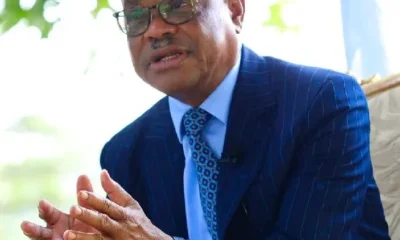
Oliver Alawuba, group managing director of United Bank for Africa (UBA), says Nigeria must turn recent economic stability into broader opportunities and improved living standards for citizens.
Alawuba, who is also chairman of the Body of Bank CEOs in Nigeria, spoke at the 19th annual banking and finance conference of the Chartered Institute of Bankers of Nigeria (CIBN) in Abuja.
He commended the federal government and the Central Bank of Nigeria (CBN) for the “increasingly effective coordination” between fiscal and monetary policy.
“Recent improvements in key economic indicators provide important milestones in Nigeria’s stabilisation journey,” Alawuba said, noting that the gains should now translate into wider economic opportunities and better living standards.

“Resilience must be deliberately designed into Nigeria’s policies, institutions, infrastructure, supply chains, energy systems, financial architecture and human capital,” he added.
“A resilient economy is not one that never encounters shocks, but one that can absorb, adapt and advance without transferring the full cost of every disruption to its most vulnerable citizens.”
Alawuba said the global economy continues to face structural disruptions, including geopolitical conflicts, volatility in energy and shipping markets and inflationary pressures.
He said Nigeria must therefore build systems capable of withstanding future shocks rather than responding only after they occur.
The UBA chief said the banking industry has a critical role in translating economic stability into sustainable growth, describing banks as the country’s “financial shock absorbers and growth partners.”
He said the N4.65 trillion mobilised by 33 banks during the recent recapitalisation exercise would strengthen the sector’s capacity to absorb shocks and finance larger projects.
According to Alawuba, the exercise would also strengthen capital adequacy, asset quality, balance-sheet transparency, and investor confidence.
He said investment in digital infrastructure, cybersecurity and operational resilience is also helping to strengthen the banking sector.
Alawuba said four leading banks invested more than N119 billion in technology in the first quarter of 2026, representing a 43.2 percent year-on-year increase.
He encouraged stakeholders to sustain collaboration between the public and private sectors to ensure that the resilience being built in the financial system translates into tangible economic opportunities for Nigerians. (TheCable)
-

 News14 hours ago
Mambilla project: Nigeria wins arbitration case at ICC as Tinubu hails Buhari, Obasanjo
-
Politics10 hours ago
2027: APC governors, Wike’s feud deepens
-
Business14 hours ago
Mafab Communications to sell $273.6m 5G Spectrum to MTN Nigeria
-
Politics10 hours ago
Toyin Abraham rejects inclusion in Lagos APC campaign council
-
Politics7 hours ago
Cracks In Wike’s Rainbow Coalition
-
Politics10 hours ago
I don’t tolerate godfathers so I won’t be one – Otti
-
News10 hours ago
NSCDC orders probe as illegal miners die in custody
-
Politics14 hours ago
No Agbaje, no progressives – Oyo APC leaders back Ibadan lawyer