
Politics
2027: Tinubu’s party woos the Lagos it lost

When the Lagos chapter of the ruling All Progressives Congress (APC) unveiled a new committee to court the state’s non-indigenes ahead of the 2027 elections, it was trying to wrest a weapon from the opposition’s hands.
Lagos is historically Yoruba land. But as Nigeria’s commercial capital, it is also home to millions whose roots lie elsewhere – and in a close race, their votes can decide the outcome. The APC needs them. It must also reassure its Yoruba base that courting them does not dilute the claims of those who regard Lagos as their ancestral home.
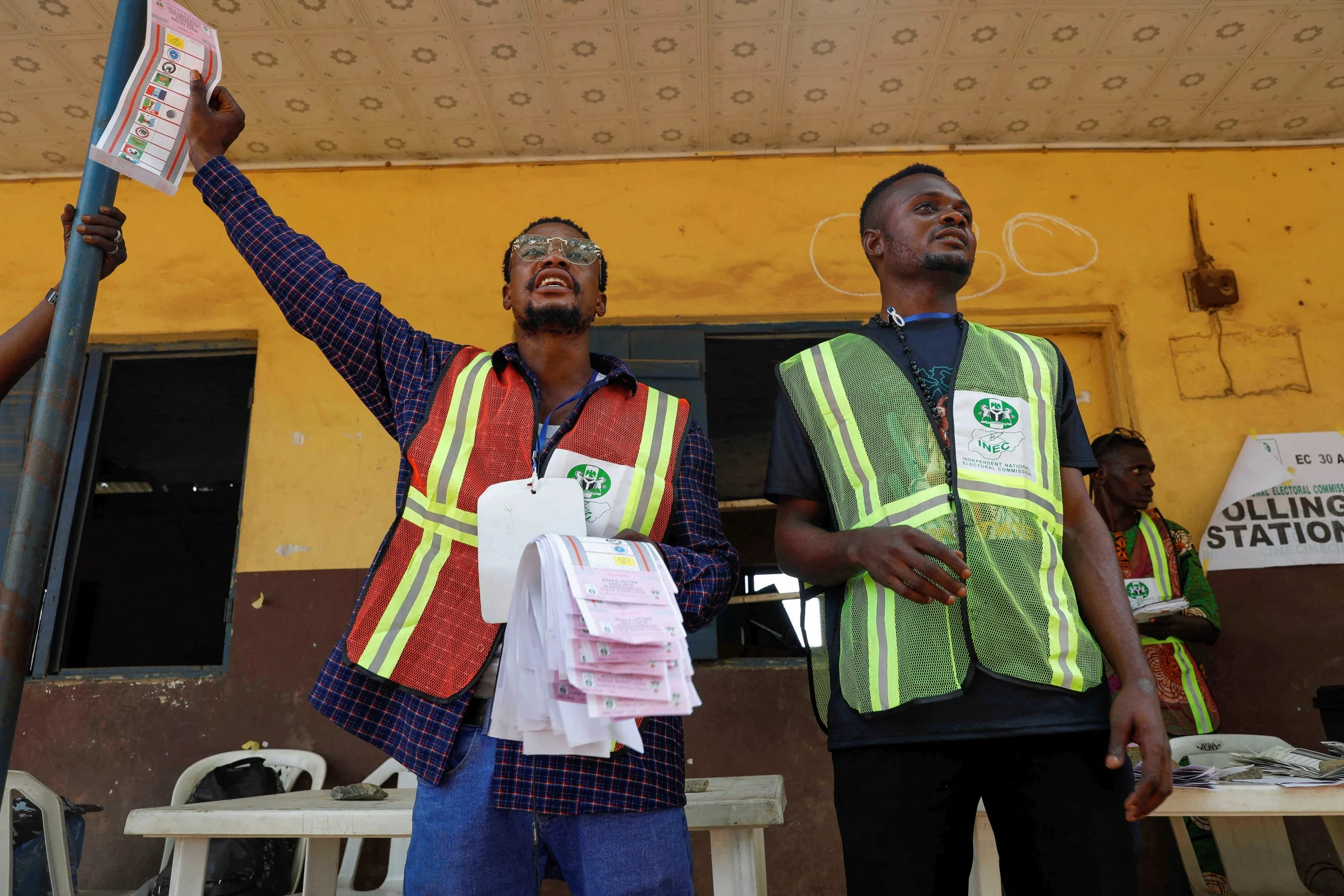
The risk became clear in 2023. In the presidential election, Peter Obi, then of the Labour Party and backed by a large Igbo population and urban youths, beat Bola Tinubu in the state Tinubu had governed from 1999 to 2007, by 582,454 votes to 572,606. Fewer than one in five of Lagos’ roughly 7 million registered voters turned out.
The arithmetic of 2023
The upset was presidential, not gubernatorial: weeks later, the APC’s Babajide Sanwo-Olu was comfortably reelected governor, with about 762,000 votes to some 312,000 for Gbadebo Rhodes-Vivour, Obi’s Labour Party ally.

Still, the defeat weighs on the APC. According to party insiders, Tinubu insisted earlier this year that anyone seeking the governorship ticket must guarantee victory in Lagos. In May, the ticket went to Sanwo-Olu’s deputy, Obafemi Hamzat.
The opposition has rearranged itself too. Obi is now the presidential candidate of the Nigeria Democratic Congress (NDC). Rhodes-Vivour is running for governor again, for the African Democratic Congress (ADC), and backing its presidential candidate, Atiku Abubakar. The alliance that delivered Lagos to Obi in 2023 has split.
“All the factors that played out to give Obi that victory do not exist anymore,” APC spokesman Seye Oladejo tells The Africa Report.
Idris Zekeri, a leading figure in Obi’s “Obidient” movement, argues that economic hardship under the APC leaves room for a repeat. “Their move to reach out to non-indigenes is a waste of everybody’s time,” he says. “There is an easy way to reach out to everybody, and that is by delivering good governance and they have failed spectacularly in this regard.”
Gbade Ojo, a professor of political science at the University of Ilorin, thinks both camps overstate the non-indigene factor. “No doubt, there are a lot of Igbo and Hausa in Lagos, but they do not outnumber the Yoruba,” he says. “If anything happens to the ruling party in Lagos, it would hardly be because of the Igbo or Hausa.” With turnout as low as it was in 2023, the contest may turn less on who lives in Lagos than on who bothers to vote.
The committee
The APC’s new contact and mobilisation sub-committee on ethnic nationality is chaired by Sam Egube, the Lagos deputy chief of staff and an indigene of Delta State, and includes representatives from the Hausa, Igbo, South-South and Nupe communities.
“By doing this work well, we can play a part in securing victory for President Tinubu, Dr Hamzat and other APC candidates in 2027,” Egube said at its inaugural meeting.
Who can claim the city?
The courtship touches an older question: who has the right to claim Lagos? As Nigeria’s former capital and economic hub, the city is home to millions of Igbo from the southeast and Hausa and Fulani from the north, who have settled and built businesses there.
In Nigeria, “indigene” status is tied to ancestry rather than residence, and shapes access to some state jobs and benefits. The city’s cosmopolitanism leaves Yoruba indigenes struggling to assert ownership, and the tension periodically spills into politics.
The taunt that Lagos is “a no-man’s land” is a recurring provocation – one Ojo dismisses as “bogus”. Prominent figures have, in turn, reinforced the sense among some non-indigenes that their welcome has limits.
On the eve of the 2015 governorship election, the Oba of Lagos, Rilwan Akiolu, warned that Igbo voters would “perish in the water” if they voted against the APC’s candidate. On polling day in 2019, Oluremi Tinubu, then a senator and now Nigeria’s first lady, drew criticism for joking to Igbo women: “We’ll invoke all the deities of Eko to chase the Igbo and inherit all your wealth.”
With three months to the presidential vote on 16 January, and four to the governorship poll on 6 February, the old tension is feeding into the campaigns.
The language test
Caught in it is Rhodes-Vivour. Born to a Yoruba father and an Igbo mother and educated abroad, he struggles with the Yoruba language, and his opponents question whether someone of his background can represent Lagos’ indigenous character. “Language is one of the gateways to understanding people,” Oladejo says. “It carries history, humour, values, idioms, traditions and ways of seeing the world.”
Adewole Ijaogbomo, an ADC chieftain in Lagos, accuses the APC of exploiting Rhodes-Vivour’s limited Yoruba to distract from its record. “Lack of fluency in Yoruba is not a crime or an offence,” he says. “What Lagosians are looking for is competence, a governor who can deliver, one who would not weaponise ethnicity and tribalism.”
Ojo points to precedent: a Hausa man who “could barely speak Yoruba” was elected to the state House of Assembly from Ibadan under Bola Ige, governor of the old Oyo State in 1979-1983. “So, the Lagos case is so much noise about nothing.”
Rhodes-Vivour says he now understands identity politics better, and has hired a Yoruba teacher. “I was not aware of this weaponisation of difference in Lagos as I’m aware of it now,” he has said. “It was a rude awakening.”
Governing as identity
Identity politics can cut against the APC too. The ban on commercial motorcycles, or okadas, and the demolition of shanties in pursuit of a “megacity” vision fall heavily on northerners; critics cast both as anti-northern. The closure of Igbo-dominated markets such as the Ladipo auto spare parts market and Computer Village in Ikeja, over sanitation and other breaches, has drawn similar charges.
Ojo accepts that enforcing policy in so diverse a state without appearing to target non-indigenes is hard, but adds that electoral considerations should not override law and order.
Oladejo says the party has no interest in excluding anyone. “Lagos is cosmopolitan, but that does not suggest that Lagos is a no-man’s land. Lagos being hospitable should not erode the respect for the owners of Lagos.” Non-indigenes served in the cabinet when Tinubu was governor, he adds, and Igbo lawmakers sit in the House of Assembly.
But the welcome comes with a condition: as long as non-indigenes treat indigenes with respect, Oladejo says, they will continue to enjoy the kindness of Lagos. For a party asking millions of them for their votes, the terms of that welcome may matter as much as the offer.
(The Africa Report)
-

 Politics16 hours ago
Coastal highway: Atiku challenges Tinubu over alleged $20bn loan plan
-
 Business24 hours ago
Deloitte helped in falsifying documents to evade tax on Abramovich’s wealth, BBC finds
-
News23 hours ago
BREAKING: Makinde’s chief of staff resigns
-
News7 hours ago
N267bn in education funds lie idle as 70% of Nigerian children can’t read
-
News16 hours ago
Alleged fake agency: FG files fresh charges against Adeyemi
-
News23 hours ago
Wale Fapohunda, 67 Others Elevated to Senior Advocate of Nigeria
-
Politics16 hours ago
Tinubu asked me to claim Adelabu as my ministerial choice, I refused — Makinde
-
Politics16 hours ago
Ebonyi indigenes threaten to sue Umahi over zoning, anti-Obi remarks