Metro
Otedola Bridge rapidly becoming Nigeria’s deadliest accident spot

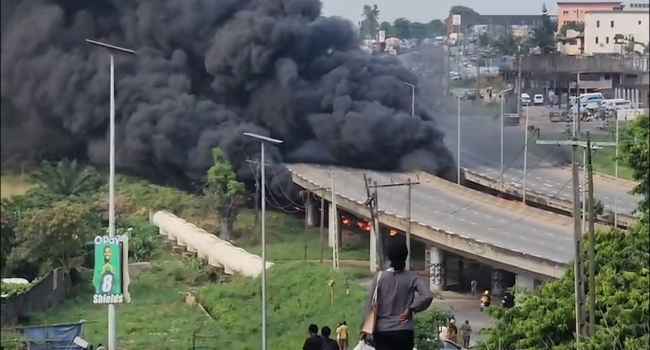
For years, the Otedola Bridge along the Lagos-Ibadan Expressway has served as a major artery for commerce and daily commuting, yet it carries a grim, terrifying reputation.
What should be a seamless drive in and out of Nigeria’s commercial nerve centre is instead a high-stakes gamble for motorists, regularly upended by heavy-duty vehicles’ catastrophic failures.
As recurring truck crashes continue to send shockwaves of panic, destruction, and loss of life through the corridor, the bridge has transformed from a vital transit link into a relentless danger zone, leaving commuters to wonder how many more lives it will take before a permanent solution is found.
The corridor has increasingly become one of Nigeria’s most perilous transit zones, plagued by repeated truck crashes, multiple-vehicle collisions, and tanker explosions that frequently result in tragic loss of life.

Despite safety interventions and emergency responses, crashes continue to occur along the corridor, raising concerns about enforcement gaps, vehicle roadworthiness, and infrastructure design.
For many commuters, the bridge is seen as a dreadful site for several fatalities and prolonged traffic due to the incidents that occur there.
The corridor’s history is punctuated by catastrophic disasters. In June 2018, a fire accident occurred on the Otedola Bridge at the Lagos end of the Lagos-Ibadan Expressway, where a tanker fully loaded with petroleum products fell, leaked, and exploded, leading to the transfer of flames to other vehicles approaching the lorry on the busy road.
According to the Federal Road Safety Corps (FRSC) and the Lagos State Government, a total of 12 persons were confirmed dead, and at least 67 vehicles were burnt, including the tanker, as a result of the incident.
Also, on October 23, 2019, a multiple vehicle collision involving five vehicles, including two buses and three trucks, occurred on the same bridge, killing one driver and injuring several others.
Other incidents include the May 21, 2020, accident where a petrol tanker carrying fuel rammed into a bus and a car on the bridge, leaving one female passenger dead and an infant injured, and the May 27, 2022 accident involving a 45,000-litre petrol tanker that collided with four other vehicles and overturned, causing a fire and the death of the tanker’s assistant, among other incidents.
This year alone, more accidents have occurred on the same bridge, causing significant damage and gridlock as other motorists scrambled to avoid the wreck.
The FRSC and Lagos Sector Command attributed the recent tanker crash and subsequent fire under the Otedola Bridge on the Lagos-Ibadan Expressway to speeding.
According to a statement issued by Elizabeth Jayeola, sector public education officer, FRSC Lagos Sector Command, the lone crash, involving a diesel-laden tanker, said the tanker plunged into the underpass beneath Otedola Bridge, triggering a fire.
“The incident underscores the potentially catastrophic consequences of excessive speed, particularly among operators of heavy-duty vehicles transporting petroleum products.
“Preliminary findings identified speeding as the reported cause of the incident, which involved a single tanker. Two adult male occupants sustained injuries and were taken to the Lagos State Accident and Emergency Centre for medical attention, while no fatalities were recorded in the initial crash report,” Jayeola said.
Experts said the recurring crashes at Otedola Bridge reflect broader systemic issues, heavy traffic, poorly maintained vehicles, weak traffic enforcement, and road design problems, showing that long-term rules and better infrastructure are needed to make the corridor safer.
Jubreel Odukoya, project management expert, in his research paper titled ‘Effect of Project Management Factors and Ethical Practices on Building Performance in Lagos State of Nigeria,’ explained that the Otedola Bridge’s recurring disasters are not coincidences but symptoms of structural negligence, noting that until the government subjects such critical infrastructure to independent performance audits, the bloodletting will continue.
Reports have also shown that many of the crashes recorded at Otedola Bridge are often linked to a mix of human, mechanical, and environmental factors, including speed violations, brake failure, and poor vehicle maintenance, particularly among heavy-duty trucks, as well as traffic congestion and design limitations along the corridor, which together increase the likelihood of multi-vehicle collisions.
According to road transport data by FRSC, speed violations topped the list of causative factors of road crashes in Nigeria in the first quarter of 2026, with 2,645 cases recorded across the country.
Kehinde Hamzat, corps commander, FRSC Lagos Sector, said that speeding remains a serious threat to road safety, particularly when heavy-duty vehicles are involved.
“A tanker carrying diesel or other petroleum products requires disciplined speed management, adequate following distance, sound vehicle maintenance and strict compliance with road safety regulations. Its considerable mass, braking requirements, and hazardous cargo can magnify the consequences of a loss of control or collision,” Hamzat said.
He cautioned tanker drivers against speeding, reckless manoeuvres and every other practice that compromises vehicle stability and roadworthiness.
“Drivers must recognise that the responsibility of operating an articulated vehicle extends beyond reaching a destination on schedule; it includes protecting lives, safeguarding property and preventing avoidable environmental and infrastructural damage.
“Fleet operators and tanker owners are equally urged to strengthen driver retraining, supervision, enforce realistic journey schedules, maintain effective vehicle inspection regimes and ensure that their drivers comply with prescribed speed limits and other applicable safety requirements. Commercial pressure must never take precedence over the preservation of human life,” Hamzat said. (BusinessDay)
-

 Metro4 hours ago
Child trafficking suspect admits receiving ₦250,000 per child
-
News24 hours ago
Where is NLNG dividend?
-
 News24 hours ago
Sanwo-Olu appoints Sanuth as new LAWMA MD
-
News18 hours ago
Abuja judge is Wike son’s relative, should recuse himself in $2 million land fraud suit – Businessman
-
Politics4 hours ago
2027: Tinubu campaign council creates new directorate, reshuffles teams
-
News4 hours ago
Ebola: Uganda seeks Nigerian woman’s travel history from FG
-
News4 hours ago
Abuja bizman arrested over alleged $120m fraud
-
Business4 hours ago
Transport, petrol prices soar in S’East amid fuel discount