Business
Kenya walks a tightrope in Dangote fuel supply deal amid exclusivity row, pipeline stake

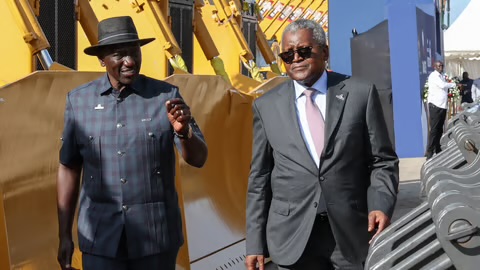
Kenya has yet to formalise a fuel supply agreement with Aliko Dangote, with government officials divided over whether to allow the tycoon to supply the entire domestic market or only a portion to preserve diversification of fuel sources.
As the government weighs the benefits of Dangote’s Lamu refinery, market exclusivity, ownership of strategic pipeline infrastructure and access to domestic crude are emerging as key criteria for the deal.
A supply agreement could reshape Kenya’s fuel market, particularly as Dangote seeks a stronger foothold across the country’s petroleum value chain following his recent acquisition of a 24.76% stake in the Kenya Pipeline Company (KPC).
Treasury Cabinet Secretary John Mbadi says that supply negotiations remain inconclusive but signals that Kenya could offer unlimited preferential access to the domestic market if Dangote delivers cheaper fuel.

“If monopoly is beneficial to this economy, what is the problem? If the monopoly will guarantee us access to cheap petroleum product, I think that is more important to the economy than any other thing,” Mbadi tells The Africa Report. “We have not reached such an agreement on supply.”
Exclusivity demands
Market exclusivity and other concessions were among Dangote’s demands before committing to the proposed 700,000 barrel-per-day (bpd) refinery in Lamu, arguing that without favourable “government policy and support”, the project would not be commercially viable.
Construction of the refinery is scheduled for completion in 2030.
President William Ruto, who also has an interest in Kenya’s Turkana crude through Gulf Energy, which was founded by his ally Francis Njogu, brokered the KSh43bn ($332m) deal under which Dangote acquired KPC shares from state agencies, according to people familiar with the matter.
Ruto had previously urged state institutions, including the National Social Security Fund (NSSF), the Unclaimed Financial Assets Authority (UFAA), the County Workers Pension Fund and the Public Servants Pension Scheme, to invest in KPC’s March 2026 initial public offering (IPO). They then offloaded their shares to Dangote eight months later, even before receiving their first dividend since the listing.
Dangote is set to earn KSh1.4bn ($10.8m) in dividends based on KPC’s recently declared payout of KSh0.32 per share.
Dangote’s 24.76% stake makes it KPC’s second-largest shareholder after the government and gives the company a seat on the board of the state-owned operator, which transports imported petroleum products across Kenya and into neighbouring markets.
The billionaire has also promised to invest $1.5bn to expand Kenya’s pipeline network. However, it remains unclear whether the planned investment will include a dedicated pipeline linking the Lamu refinery to Mombasa, where KPC’s existing infrastructure begins.
For the Energy and Petroleum Regulatory Authority (EPRA), the immediate case for domestic refining is supply security. Director-General Edward Kinyua says that local refining and storage would reduce Kenya’s exposure to shipping disruptions.
“If the Strait of Hormuz is impassable, you have the refinery, the feedstock, but you can’t produce it. We’ll be the first users of Dangote’s products,” Kinyua says.
He argues that Kenya will benefit whether it purchases Dangote’s fuel in the spot market or under a long-term contract.
Kinyua, however, defended the existing government-to-government (G2G) petroleum import arrangements, saying they had shielded Kenya from high spot-market premiums in the global market and from lengthy supply delays.
Contracted G2G suppliers are now sourcing fuel from South Korea, Europe and the United States if Middle East shipments are disrupted, he says.
But David Ndii, Ruto’s chief economic adviser, had previously hinted that Kenya would abandon the G2G deal once the Dangote refinery was operational, potentially granting the Nigerian billionaire immediate market access.
Exclusivity rights could nevertheless restrict competition and complicate Kenya’s existing supply model, which relies on contracts with international oil suppliers.
Powell Maimba, an energy expert and chief executive of Lexo Energy, still expects Dangote to press for further concessions, including “seeking limits on fuel imports because he needs guaranteed offtake”.
Turkana crude readies for export
Kenya’s domestic crude ambitions further complicate the refinery negotiations. According to EPRA’s Kinyua, the country will only sell crude to the highest bidder, meaning offtake by Dangote is not guaranteed at this point.
Oil from Turkana’s South Lokichar Basin, now under Gulf Energy following Tullow Oil’s exit in September 2025, is expected to begin flowing in December 2026, with the first exports potentially following in the first quarter of 2027.
KPC, now partially owned by Dangote, has already signed a 25-year contract for crude oil storage and handling with Ruto-linked Gulf Energy.
“By mid-November, they will be doing the spudding of the first well. You’ll have the first barrels flowing out of Turkana by 1 December. The drilling rig has just arrived,” Kinyua tells The Africa Report.
“It’s a willing buyer, a willing seller. Whoever gives us a good price, we take it there.”
If exploration yields commercially viable volumes, supplying a future Lamu refinery could retain more value locally. However, Kenya cannot assume that domestic crude will be committed to the refinery without commercially attractive terms. Further oilfield licensing and commercialisation are also expected in the Lamu basin.
Regional market and pipeline links
In September, Dangote broke ground on the proposed $16bn Lamu refinery, which is expected to be co-owned by Kenya and other East African countries.
He has offered the region a 30% stake in the project, with Kenya considering an initial $500m investment for a 10% holding. Its stake could increase if neighbouring countries decline to participate. Uganda, which is also developing its own refinery on a much smaller scale, has stated it will not invest in Lamu, while Ethiopia has formally expressed interest.
Kenya alone cannot absorb the refinery’s planned 700,000 bpd of refined output, so Dangote would need to export substantial volumes across the region and potentially beyond. The Lamu Port-South Sudan-Ethiopia Transport (LAPSSET) corridor offers a potential route to northern markets.
With Kenya’s own crude output insufficient to meet the refinery’s feedstock requirements, additional supplies are expected from South Sudan, West Africa, the Middle East and other neighbouring countries, including Somalia, which also has exploration ambitions.
The refinery will also need a reliable connection to Kenya’s existing petroleum pipeline network to reach major inland markets such as Nairobi, Kisumu and Eldoret, as well as neighbouring Uganda and potentially the Democratic Republic of Congo (DRC).
(The Africa Report)
-

 News13 hours ago
₦70,000 transport allowance: Federal pensioners decry exclusion, unpaid ₦25,000 palliative
-
News22 hours ago
BREAKING: ‘Absolute Nonsense’ – Obasanjo Blasts Tinubu Over Borrowing
-
Metro13 hours ago
Nigerian parents losing children in UK – Social workers
-
African News22 hours ago
Ebola outbreak not under control in Africa – CDC warns
-
Politics22 hours ago
2027: INEC has no preferred candidate, party — Amupitan
-
News14 hours ago
No light, no sleep as heatwave bites
-
World News22 hours ago
US midterm early voting hits record 48 million
-
Business13 hours ago
TotalEnergies sells 40% offshore stake to SAPETRO in Nigeria