Metro
Celestial leaders, members clash over ban on trousers, nose rings

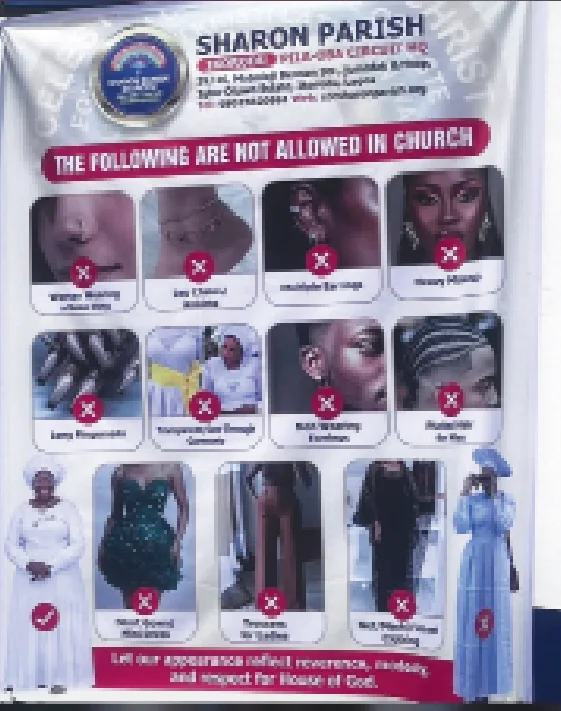
In this report, DANIEL AYANTOYE examines the controversy sparked by a notice issued by the Celestial Church of Christ banning female trousers, nose rings, artificial nails, heavy makeup and other fashion choices
For Tolu Ajila, a member of the Celestial Church of Christ in Ikorodu, Lagos State, what a worshipper wears to church should not become a test of faith, provided the person has a genuine relationship with God.
She believes that banning women from wearing trousers, fixing artificial nails, using nose rings or applying makeup places too much emphasis on physical appearance at the expense of the disposition with which worshippers approach God.
Ajila’s position followed a viral notice issued by the CCC, Sharon Parish, Ikorodu, listing several forms of dressing and adornment considered unacceptable in the church.

The notice, which has generated mixed reactions among members and social media users, prohibited women from wearing nose rings, leg chains or anklets, multiple earrings, heavy makeup, long fingernails, transparent garments, short gowns and trousers.
It also listed earrings for men, plaited hairstyles for men and net, mesh or fishnet clothing among the prohibited fashion choices.
Urging members to comply, the church said, “Let our appearance reflect reverence, modesty, and respect for the House of God.”
But the directive has reopened a debate within the white-garment church over the relationship between Christian holiness, personal appearance, cultural expectations and changing fashion trends.
Speaking on the controversy, Ajila said she disagreed with the restrictions, arguing that Christianity should place greater emphasis on the heart than on outward appearance.
She told Sunday PUNCH, “It is not about what we wear but our heart. They shouldn’t force us to remove our fingernails or ban us from wearing trousers. Are they going to say I should not wear trousers when I am going for national youth service?”
Another member of the church in Ikorodu who pleaded anonymity for fear of intimidation said restrictions on personal appearance were not new but argued that worshippers should be allowed to maintain their appearance while observing the church’s religious requirements.
The member said, “This is not the first time they would be saying that. We all have our white garment, but we should be allowed to make up and look good. These things happen abroad; it is only here. We just want to continue to live in the past.”
The disagreement has also played out on social media, where some users supported the church’s position while others questioned whether the prohibited fashion choices amounted to indecency.
A user on X, Kayode Philips (@Kayweezy11), expressed frustration with what he described as the church’s approach to personal appearance.
He wrote, “Recently, I just taya for my own CCC here. Piercings, men braiding their hair, I can’t even convince my fiancée who attends MFM to join me in fellowshipping at CCC… A lot of indecency.”
Another X user, Olamide (@vickky52160697), recalled being asked to remove her artificial nails during her first visit to the church.
“The first time I attended the church, I had my nails on, and I was politely told to either clean them off or leave if I couldn’t. It was communicated respectfully, though. At the end of the day, it’s your choice. If you understand that you’re not there for anyone,” she wrote.
However, another user, @KingJenerah, argued that some of the prohibited fashion choices were being wrongly characterised as indecent.
The user said, “Most of the image here is not an act of indecency. It’s just what people don’t like that they demonise and make it look odd, but what do I know.”
Odigbo Daniel also criticised the restrictions, arguing that the prohibitions were human interpretations rather than biblical commandments.
He wrote, “None of these is a sin. It’s a written sin by humans. Only fools will go there to worship.”
Ministers defend restrictions
While some worshippers consider the directive excessive, ministers of the church who spoke to Sunday PUNCH defended the need for moderation and decorum in places of worship.
A minister of CCC Orisun Parish, Ikorodu, Evangelist Emmanuel Babatunde, said the restrictions were necessary because some Christians had adopted dressing styles, he considered inconsistent with the values of the faith.
He stated that people should not use the belief that God looks at the heart to justify exposing their bodies or adopting appearances he described as inappropriate.
Babatunde said, “God created humans in His own image, but some people have recreated themselves. They turned themselves into animals.
“Any responsible person will not wear a transparent cloth because our body is not meant to be exposed. It is an attitude that we should not be seeing in the hands of a believer.”
The evangelist also expressed concern that some church leaders and their families were not setting good examples for members, adding that the conduct of ministers’ wives could influence the dressing choices of other worshippers.
Criticising young men who plait their hair and wear such hairstyles to church, the minister said he would not tolerate the practice in his parish.
Babatunde added, “You are a male child, and you plait your hair and bring that into the church? It cannot happen where I am. I will disgrace such a person in front of the people and the entire church. You won’t try such next time.”
Similarly, a minister at CCC Omo Alade Alafia Parish, Badejo Adeshina, said he supported the restrictions, and said that some worshippers had taken fashion and adornment beyond acceptable limits.
According to him, although Christians should look good, their appearance in church should reflect moderation and respect for the place of worship.
Adeshina said, “I am in total support of what the church did because many people have taken it to the extreme. Church is a place where we come to serve God, and we should respect God because everything we do in church, particularly when it comes to adornment, must be done in decency.”
He further stated that some women justified their appearance by arguing that God was not wretched and wanted them to look good.
Adeshina, however, maintained that such arguments should not be used to justify excessive makeup, jewellery or transparent clothing.
The minister added, “Inasmuch as we respect their opinion, there should be moderation. I used to tell them that coming to church in transparent white should not be encouraged, painting of faces and whatever jewellery they want to use must be light. I think the sensitisation is going on, and with time things will get better.”
Another minister of CCC Losi Oba Parish, Ikorodu, Samuel Oshin, said the belief that God judges the heart should not be interpreted as permission to dress irresponsibly.
He, however, advised church leaders against humiliating or sending away members who violated the dressing rules; rather, they should be corrected through preaching and counselling.
He said, “You cannot say because God is looking at the heart, then you should be dressing irresponsibly. You have to dress the way you want to be addressed.
“What the church can also do is that they shouldn’t send them out but preach to them to change them. That a person does not wear earrings does not guarantee that they would make heaven.”
CCC headquarter reacts
Speaking in a phone interview with Sunday PUNCH, Most Senior Evangelist Solomon Oshoffa, Personal Assistant to the Pastor and Spiritual Head of the Celestial Church of Christ Worldwide, Reverend Emmanuel Oshoffa, said the established tenet is that all Christians should dress appropriately when attending church.

He said, “If you are coming to the house of God, you should not dress as if you are going to a club or social gathering. Church is where you concentrate, communicate and commune with God. I personally believe that we should dress appropriately.”
Also commenting on this, the General Secretary of the Christian Association of Nigeria, Prof Samson Fatokun, also said that Christian holiness should be reflected in both inward character and outward appearance.

The Professor of Church History and Theology in the Faculty of Arts, University of Ibadan, noted that Christians should not use the argument that God examines the heart to disregard expectations of modesty in their appearance.
Fatokun said, “As far as the standard of the Bible is concerned, holiness is within and without. It is a pity that Christianity is turning into another thing these days, and one will wonder, is this the same Christianity that the early Christians laid down their lives for under persecution, where many were crucified like our Lord?”
He noted that there should be consistency between a person’s Christian profession and outward conduct, including dressing.
“You cannot dress like a prostitute to church and say that your Christianity is in your heart. Everyone who sees you outside carrying a Bible would tell you that there is a contrast between the way you dressed and the Bible that you are carrying.
“I don’t know where our youth get this plaiting of hair of a male from. Where is it in the Bible? It is not a Christian culture which Christianity is out to condemn,” Fatokun added.
Efforts to obtain the response of the pastor of CCC Sharon Parish, Ikorodu, Solomon Sofowora, were unsuccessful, as several calls and messages to his telephone were not answered at the time of filing this report.

(punch)
-

 Politics12 hours ago
As Elections Near, Darkness Tests Tinubu’s Record
-
African News12 hours ago
Ebola: DRC Records 10,668 Cases, 5,198 Deaths, Says WHO
-
Business12 hours ago
Between Peter Obi and Tompolo
-
Politics12 hours ago
Hope you’ll visit 33 other states after Akwa Ibom ‘sleep’ – Obi tells Tinubu
-
Politics12 hours ago
I Have Seen the Light – Okowa Gives Reason Why He Ditched Atiku
-
News12 hours ago
Gas Network Not Responsible for Drop in Electricity – NNPC Counters Power Minister
-
Sports12 hours ago
Nigeria’s Flamingos Win Historic 2026 U17 Women’s World Cup, Beat Japan 2-1
-
Opinion12 hours ago
Judiciary Must Protect This Democracy