
Politics
Tinubu’s re-election manifesto presents familiar promises, faces similar execution hurdles

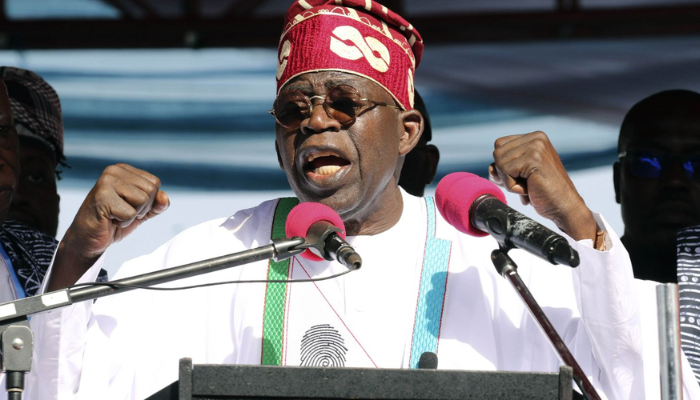
President Bola Tinubu has unveiled an ambitious second-term agenda promising cheaper food, reliable electricity, jobs, affordable homes, better schools and safer communities by 2031, but several of its commitments echo promises made in the 2023 manifesto.
The new 109-page manifesto, titled From Reforms to Prosperity Agenda 2027–2031, sets out measurable targets for the next four years, including annual economic growth of 6 percent, inflation below 8 percent, peak electricity distribution of 10,000 megawatts, 200,000 affordable homes and a halving of youth unemployment.
It also promises one million export-linked jobs for young Nigerians through talent and services exports by 2030, as well as an industrial hub in each of the country’s six geopolitical zones.
However, a comparison with the APC’s 2023 Renewed Hope: Action Plan for a Better Nigeria shows that many of these priorities are not new.

The earlier manifesto also promised affordable and reliable electricity, universal electricity metering, improved food production, job creation, stronger national security, accessible healthcare and affordable housing.
The difference is that the 2027–2031 document attaches more specific numerical targets, delivery timelines and accountability mechanisms to several of these longstanding commitments.
The manifesto recasts Tinubu’s original eight-point Renewed Hope Agenda into four delivery pillars: a secure and resilient nation; a better quality and more affordable life; energy, infrastructure and economic growth; and effective and accountable governance.
The document presents the next four years as the period in which the administration must demonstrate that the removal of fuel subsidy, unification of the foreign exchange market and tax reforms have translated into tangible improvements in household welfare.
It argues that the first term stabilised public finances and rebuilt investor confidence, while the second must make those gains visible in every state, local government, ward and community.
“Our foundations are undeniably firmer,” Tinubu says in the manifesto’s opening message. “The coming years must focus on tangible improvements: the food on our tables, the power in our homes, the security of our families, and the dignity of meaningful work.”
To support that promise, the APC says every commitment will carry a baseline, target, cost, named owner and reporting date, published in a public delivery tracker. It also promises public dashboards, independent verification and regular reporting to allow citizens to assess progress.
“Our offer is set out plainly,” the document states. “Our commitments are tied to clear metrics and regular public reporting, and we invite every Nigerian to hold us accountable to them.”
The manifesto cites foreign reserves of $55.3 billion in September 2026, up from $33 billion in May 2023, and says net reserves rose from about $4 billion to about $32 billion. It also points to inflation of 14.63 percent in September, down from a peak of 34.8 percent in December 2024, and second-quarter 2026 economic growth of 4.43 percent, up from 2.74 percent in 2023.
Experts say the manifesto’s 6 percent growth pledge is ambitious against Nigeria’s recent record, but achievable. The economy grew by 3.04 percent in 2023, 3.4 percent in 2024 and 3.87 percent in 2025, while the International Monetary Fund and World Bank projected about 4 percent growth for 2026. The economy expanded by 4.43 percent in the second quarter of 2026.
For Hadiza Bala-Usman, special adviser to the President on policy coordination, the 6 percent target is achievable if the administration sustains and improves coordination between fiscal and monetary authorities, infrastructure agencies, exporters and productive sectors.
“We are coming from a GDP growth rate of 2.73 percent in 2023, which had increased to 4.43 percent as of the second quarter of 2026,” the representative said. “Moving from this level to 6 percent by 2031 is achievable.”
Represented at the panel session to discuss the manifesto, she said the administration would need to sustain gains in external reserves, deepen exchange-rate reforms, reduce inflation and improve infrastructure delivery.
She also said Nigeria must raise domestic production and ensure that agricultural exports meet international standards, noting that some products had been rejected because they failed to meet required standards.
“Policy coordination is therefore essential to achieving the six percent growth target,” the official said. “For us in the Central Results Delivery Coordination Unit, our responsibility is to track these initiatives and monitor progress towards the administration’s objectives.”
Power, housing promises face familiar hurdles
Power is one of the manifesto’s most consequential commitments, and one of the clearest areas where the new agenda builds on the promises of 2023.
In its 2023 manifesto, the APC acknowledged that Nigeria had approximately 12,000MW of installed generation capacity but could distribute only about 4,500MW to consumers.
It promised to improve generation, transmission and distribution, encourage off-grid renewable energy and end estimated electricity billing by ensuring that all electricity bills were meter-based.
The new manifesto sets an ambition of at least 7,500MW of sustained average distribution and 10,000MW of peak distribution by 2031.
It also targets near-universal metering, stronger transmission and distribution networks and expanded clean-energy access in underserved communities.
The plan builds on the Electricity Act 2023, which decentralised power regulation to states and opened the way for subnational electricity markets.
Nigeria generated an average of about 4,022MW in the second quarter of 2026, with peak distribution of 5,800MW, according to the new manifesto. #
The country has installed capacity of about 13,000MW, but ageing plants, gas-supply constraints, transmission bottlenecks, distribution losses and payment challenges limit the electricity that reaches consumers
Bala-Usman said the 10,000MW peak-distribution target was ambitious but achievable if the government completed stalled transmission projects, improved coordination with states and addressed payment obligations across the electricity value chain.
“There is little value in generating electricity if the transmission system cannot evacuate it and deliver it to end users,” she said. “We must therefore prioritise the completion of transmission projects.”
According to her, several transmission projects were already 80 percent, 90 percent or even 95 percent complete but had remained at those levels for years. Completing them, she argued, could deliver significant gains without starting entirely from scratch.
Housing is another area where the manifesto seeks to turn policy into visible economic activity.
The new document promises to work towards 200,000 homes through the Tinubu Mass Social Housing Scheme, the Mortgage Refinance and Investment Fund, Federal Mortgage Bank of Nigeria mortgages and partnerships with licensed private developers.
The mass social housing component targets 200 units in each of the country’s 774 local government areas, amounting to 154,800 units. The wider 200,000-home ambition includes other housing delivery channels.
The manifesto also promises to complete and hand over more than 15,000 housing units already under construction across 14 sites, expand affordable mortgage financing and introduce digital land titles.
Abdulmumin Jibrin, chairman of the House Committee on Housing and Habitat, said real estate could contribute far more to economic growth because its value chain extends beyond building homes to cement, iron rods, aluminium, doors, windows, architects, lawyers, quantity surveyors and engineers.
Okey Ikechukwu, a policy and strategy expert, said the manifesto reflected serious work and policy continuity. He said the document was not a collection of disconnected promises, but an attempt to link security, quality of life, economic growth and governance within a common framework.
“The critical success factors are not simply government instructions or promises,” Ikechukwu said. “They include the machinery, policies, funding arrangements, monitoring and evaluation required to translate commitments into tangible results.”
Ikechukwu said the 6 percent growth target could be achieved, or even exceeded, if government deployed the right materials, locations, administrative structures and funding mechanisms.
He used housing to illustrate the point, arguing that construction costs could fall if Nigeria revisited technologies that reduce cement use, including hydroform block-making machines.
“A manifesto is a promise,” Ikechukwu said. “What matters is ensuring that the promise translates into impact and measurable performance.”
Olufemi Awoyemi, chief executive officer of Proshare, said his review of the manifesto found a credible roadmap and welcomed its continuity with the administration’s earlier agenda. He said the document’s policy coherence was important because it allowed government to build on existing reforms rather than begin again with every election cycle.
“One of the most important things the manifesto has achieved is policy coherence,” Awoyemi said. “Its designation as a continuation of the previous agenda, rather than an entirely new direction, is significant.”
Awoyemi said the next challenge was to ensure that Nigerians saw measurable improvements in 2027 and 2028, rather than waiting until the end of the proposed term.
He noted that the manifesto should focus on strengthening household purchasing power, affordable housing, reliable electricity and productive employment.
“Nigerians are not waiting until 2030 or 2039 to see results,” Awoyemi said. “They want improvements in 2027 and 2028.”
He argued that macroeconomic stability was important but not sufficient on its own. Nigeria, he said, was effectively running two economies: one reflected in national accounts, reserves and growth figures, and another experienced through food prices, electricity bills, rent, transport costs and wages.
“Macroeconomic stability is important, and the progress recorded in that area is measurable and commendable,” Awoyemi said. “But it does not automatically translate into improved household welfare.”
According to him, affordable housing would remain difficult if households did not have incomes sufficient to pay for homes. He also said the minimum-wage debate should focus on whether earnings cover the cost of living, rather than simply on the size of wages.
“The minimum wage debate should not simply be about how much workers earn,” Awoyemi said. “It should be about ensuring that income can adequately cover the cost of living.”
Awoyemi said electricity was central to the wider agenda because reliable power would determine whether housing, education, manufacturing and public services could expand. He said teachers in rural communities, for example, would need housing, security and electricity to remain in their posts and use technology effectively.
“You cannot effectively expand housing, improve education or deliver essential public services without reliable electricity,” he said.
The manifesto also promises to recruit and train 78,000 additional security personnel by 2031, including 28,000 military personnel and 50,000 police officers. It pledges to halve the number of out-of-school children, deploy 20,000 additional teachers, expand health insurance from more than 23 million enrollees to 40 percent of Nigerians, and ensure that at least 90 percent of primary healthcare centres are functional, up from 53 percent.
The manifesto says new priorities will be funded first by recovering public value lost through oil-revenue leakages, electricity-billing losses and incomplete projects, rather than relying primarily on fresh taxes or borrowing. It also pledges to review multiple taxes affecting small businesses and households.
The first 100 days of a second Tinubu term would include publication of baselines and owners for headline commitments, a quarterly cost-of-living basket, the opening of secured farm-to-market corridors, a Citizen Service Guarantee and an independent audit of unfinished or underused public assets.
Implementation remains the biggest test
Critics, however, say the promises will be judged against the administration’s record.
Bernard Mikko, a political scientist and former member of the House of Representatives, said the APC had been in power for 11 years, including the years before Tinubu’s presidency, and questioned the implementation of budgets presented between 2023 and 2026.
“Look at the budgets presented to the National Assembly in 2023, 2024, 2025 and 2026,” Mikko said. “How much of the budgetary provisions has the government actually implemented? Has it achieved even 20 percent of its commitments?”
Mikko said Nigerians deserved to know how much money had been released, spent and converted into tangible outcomes before another set of pledges could be assessed.
“It is therefore difficult to assess the credibility of another set of promises without first examining the government’s implementation record,” he said.
Peter Awah, an economist, said the manifesto’s projections were ambitious and desirable, but their credibility would depend on government capacity and commitment. He said successive governments had made ambitious promises but failed to translate them into tangible improvements in living standards.
“Ultimately, it is about implementation,” Awah said. “Given the prevailing economic realities, it is difficult to determine whether the president will deliver on the targets and projections contained in the document.”
Awah said the pledges would be welcome only if they produced measurable improvements in living standards. (BusinessDay)
-

 Metro10 hours ago
Court scolds EFCC, discharges Mompha over alleged N6 billion money laundering
-
Politics10 hours ago
Manifesto: Tinubu reforms will be difficult to reverse by 2031 – APC
-
Metro24 hours ago
Madonna University: 15 nursing students beg for expulsion, suspension reversal over TikTok video
-
News10 hours ago
FG raises the alarm over carbide-ripened fruits, paracetamol-treated meat in markets
-
Business10 hours ago
NERC Approves N30bn To Meter Band A, B Customers
-
Politics10 hours ago
Tinubu Can Go To Sleep, 2nd Term A Done Deal In North – Yari
-
News10 hours ago
Mambila, 21 dams to drive Nigeria’s 20,000MW power target – Minister
-
Politics10 hours ago
2027: ‘A Lie’ – Lamido Shoots Down Shettima’s Claim Of Backing APC