
Opinion
Keyamo, Heavens Don’t Fall in a Day

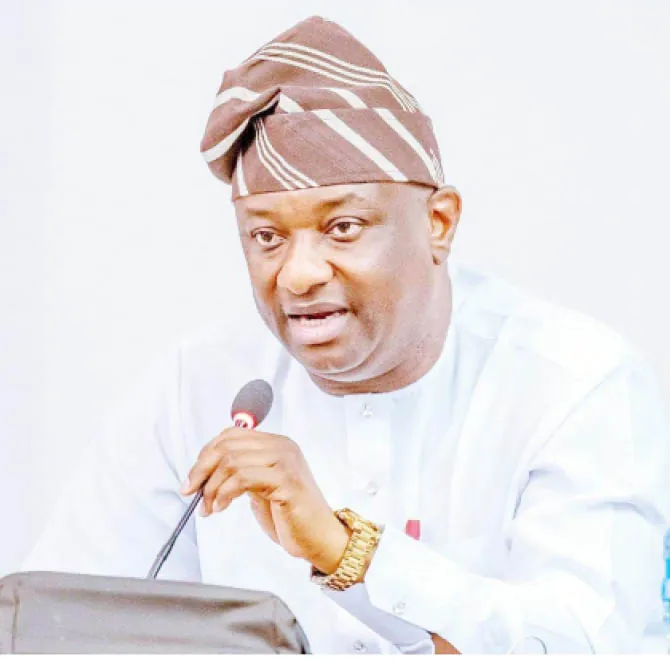
By Olusegun Adeniyi
In May this year, there was a viral video of a police officer warning Nigerians against recording him while on duty. He was later identified as an Assistant Superintendent of Police, Newton Isokpehi. Holding his rifle, he threatened that whoever gave citizens permission to film policemen would be the one to bury the victims. But once public outrage ensued, Isokpehi posted another video begging for forgiveness and saying he did not mean it. Even before the Anambra State Police Command arrested him and began disciplinary proceedings, I didn’t take that first video as a moment of madness. In his anger, Isokpehi said out loud what many people in uniform believe and many Nigerians have heard in one form or another: I can kill you and nothing will happen!
But this is not a police problem. Isokpehi only advertised on social media what has over the years become a general malaise in Nigeria. We hear the same language everywhere, including in the classroom: I can fail you and nothing will happen! It is the same language even in places of worship. For some spiritual leaders, their excesses are protected by a convenient reading of “touch not my anointed”. So, whatever may be their station, the language of power in Nigeria is less a threat than a confident claim that there will be no consequences: I can do this to you, and nothing will happen. And this brings me to the Minister of Aviation and Aerospace Development, Mr Festus Keyamo, SAN.
Last Thursday, Justice Peter Lifu of the Federal High Court, Abuja, ruled on a suit involving the African Democratic Congress (ADC). He nullified the David Mark-led national leadership of the party and every decision it took. That included the May presidential primary that produced former Vice President Atiku Abubakar as the party’s candidate. The next day, Keyamo reacted on his X handle. “You cannot abuse judges and blackmail the judiciary when it doesn’t go your way,” he wrote, before ending in capital letters: “Heavens WILL NOT FALL IF A CERTAIN ATIKU ABUBAKAR IS NOT ON THE BALLOT IN 2027.” To back his case, Keyamo pointed to Zamfara and Bayelsa, two states where the All-Progressives Congress (APC) lost hard-won victories at the Supreme Court without, according to him, attacking the judges.

The ADC has appealed, and the Independent National Electoral Commission (INEC) has said that Atiku’s name and that of his running mate, Chibuike Rotimi Amaechi, are still on their portal. The Court of Appeal will have the next word, and I am not going to pre-empt their decision. But here is the point: Nigerian politicians are fair-weather friends of the judiciary. On 2 July, Justice Musa Liman of the same Federal High Court dismissed a suit against the Mark-led leadership. Atiku praised the judiciary for showing “courage, independence, and fidelity to the constitution” and declared that the courts “cannot be hijacked.” Four months later, a judgment that went the other way has become, in the words of his camp, a plot by the ruling party.
The phrase Keyamo used has a history too. In July 2023, it was Atiku who told the Presidential Election Petition Court that the heavens would not fall if it removed President Bola Tinubu from office. His lawyers relied on retired Supreme Court Justice George Oguntade, who wrote in the 2007 case involving Amaechi that he (Oguntade) must do justice even if the heavens would fall. In that judgement, the apex court nullified the election of Mr Celestine Omehia as Rivers State Governor and declared Amaechi (who was not on the ballot) the rightful winner. In their reasoning, he (Amaechi) was the rightful Peoples Democratic Party (PDP) gubernatorial candidate whose name was unlawfully substituted by the then ruling party.
Keyamo is also right in the narrowest sense. Atiku turns 80 later this month and has contested the presidency more times than many voters can remember. If he is not on the ballot in January, the sun will still rise in Nigeria. But this was never about Atiku. It is about who gets to choose the president of Nigeria.
The comparison with Zamfara and Bayelsa does not hold. Both judgments came from the apex court, at the end of the appellate ladder. Accepting them was not magnanimity. There was simply nowhere left to go. What happened last Thursday was a judgment of first instance that will be appealed. It decides who should lead a political party, exactly the sort of internal dispute that Section 83 of the Electoral Act 2026 was meant to keep out of the courts. I made that argument on this page in May, in “The Judicial Route to Anarchy”. In two separate suits, two judges of the same court have now given opposite answers on the same party leadership within four months!
Then there is the judge himself. On 15 June, Justice Lifu ordered INEC to deregister the ADC and four other parties. He did so even though the Court of Appeal had, on 22 May, directed him to stay proceedings in the matter. The next day, the appellate court suspended Lifu’s judgment and described his conduct as “judicial rascality”. On 28 July, it set the judgment aside entirely. That is the same judge, dealing with the same party, less than 10 weeks before a general election.
I hold no brief for the ADC, and I am not saying that the latest judgment is wrong in law. That is for the Court of Appeal to decide, and I hope it does so quickly. My point is simpler. When a minister of the Federal Republic, and a respected SAN, tells critics to keep quiet about a judgment with this history, he is not defending the judiciary. He is defending a favourable judicial outcome. Keyamo is right that the heavens will not fall on the day Atiku’s name comes off the ballot. The heavens never fall in a day. They fall slowly, in pieces small enough for each to be explained away. Afterall, as the Yoruba adage says, “Ọmọ́dé bú ìrókò, ó bọ̀jú wẹ̀yìn, kò mọ̀ pé òojọ́ kò ní òlúwèrè n pa ní”. Crude translation: A child insults the Iroko tree and begins to look over his shoulder; he doesn’t know that òlúwèrè (the spirit being) doesn’t extract immediate revenge.
Those of us who followed the June 12 saga know this. The descent began, as I recalled in May, with Justice Bassey Ikpeme’s midnight injunction and a string of conflicting court orders that gave the military the excuse it was looking for. When the annulment of the 12 June election was announced on 23 June, the heavens did not fall. Markets opened and people still went to work. Then came the Interim National Government. Then General Sani Abacha took power on 17 November 1993, and Chief MKO Abiola was arrested the following June. Kudirat Abiola was murdered on a Lagos street on 4 June 1996, and her husband died in custody on 7 July 1998. Before then, all the five political parties decided to ‘adopt’ the military Head of State who was still a serving army general as their joint and sole presidential candidate. Heavens, of course, did not fall on any of those days but by the end, there was hardly any sky left.
Our democracy is not in that place, and I am not suggesting it is. But the pattern should disturb anyone who cares about the ballot. On 14 January 2020, the Supreme Court upturned a 4-1 appeal court judgement to declare as governor a candidate who had come fourth in the election. In his valedictory speech last week, Supreme Court Justice Uwani Musa Abba-Aji confirmed what has been whispered in Abuja for years: all the seven apex court Justices who delivered that infamous judgement, Imo and the Arithmetic of Injustice – THISDAYLIVE (as I put it then) remain under U.S. travel restrictions. The message is simple, a democracy where the decisive vote is cast in the courtroom, not the polling unit, is imperiled.
Every time a judge rather than the electorate removes a candidate from the ballot, every time a conclave of Judges decides to award the governorship of a state to the man who came fourth in an election, every time a ruling party cheers an opponent’s misfortune in court, a little more of the sky comes down. That is why Keyamo’s choice of words matters more than his argument. “Heavens will not fall” is the same as the “nothing will happen” that I started with. For the policeman, it is the citizen with a phone. Here, it is the voter who may be told on 16 January that the choice had been made for them some few weeks before in a courtroom simply because heavens will not fall.
What makes this hard to take is that it comes from Keyamo who incidentally happens to be my friend. He is a successful legal practitioner by any measure, and he earned his stripes as a pro-democracy activist. He began practising law in 1993 in the chambers of the late Chief Gani Fawehinmi, at the height of the campaign to restore the 12 June mandate. In 1994, he joined his principal and others in the campaign against military rule, and he was arrested and detained several times for it. Even under civilian rule, Keyamo was held incommunicado and without charge from December 2002 until he was granted bail in February 2003. At that time, Amnesty International declared him a prisoner of conscience. He is also a recipient of several awards, including the Global Human Rights Award in Washington DC.
In government, Keyamo was spokesman for President Muhammadu Buhari’s 2019 re-election campaign as a cabinet member and was retained in the same position for the Bola Tinubu campaign in 2023. In the middle of that campaign, Keyamo gave the Economic and Financial Crimes Commission (EFCC), Independent Corrupt Practices and Other Related Offences Commission (ICPC) and the Code of Conduct Bureau 72 hours to arrest Atiku. When they did not, he filed a case at the Federal High Court in Abuja to compel them. On 5 June 2023, the court dismissed the suit as frivolous. In April this year, Keyamo (who once described himself as a ‘political Nostradamus’) warned that the ADC might end up with no candidate in 2027 if its leadership dispute stayed in court. That ‘prophecy’ seems to be fulfilling itself.
I don’t know how the ADC will resolve its wahala, and there is a lot to say about buying a political platform from merchants without doing due diligence. But an election in which the strongest opposition candidate is edged off the ballot, whether by means fair or foul, cannot be described as credible. There is even a bigger issue here: Power is transient, and the precedents set by those who hold it today will be applied tomorrow, possibly to them. The policeman in that video learnt within a day that “nothing will happen” is a dangerous thing to say when the camera turns around. Those who speak the language of power from higher offices should learn the same lesson. Before the heavens come down on all of us!
Sleepwalking into AI Danger?
I was in the United States during their midterm election held last week Tuesday and one of the issues that determined the outcome in many states is that of locating data centres which happen to be the most critical infrastructure for Artificial Intelligence (AI). According to the Pew Research Centre Survey released shortly before the election, on 22 September, “More than half of Americans (54%) now say data centers are mostly bad for the environment, up from 39% in January.” In Texas, Ohio and a few other states, Democrat Party candidates performed well on the strength of their campaign on environmental issues, especially on data centres.
A report by Fox News, quoting a conservative AI safety group, states that Republican-leaning constituencies with large data centers or proposed projects were flipped by Democrats. “Humans First’s analysis, obtained by Fox News Digital, examined public election returns and data-center project records in 1,540 counties across 16 states,” the channel stated. “Across all counties examined, those hosting large data centers shifted an additional 2.2 percentage points toward Democrats compared with non-host counties in the same states. The pattern appeared in 14 of the 16 states and 25 of the 27 governor and Senate races examined.”
The biggest concern about data centres is their impact on renewable energy, especially water resources. A single data center is said to consume an average of over 300,000 gallons of water each day for cooling. That is more than what a thousand families require for a day. Considering reports that many African governments are giving up inland waterways to big tech companies that are looking for where to cite their data centres, there is an urgent need for caution. Even when the biggest security challenge we face in the Sahel can be located in the shrinking of Lake Chad from 25,000 square kilometers in 1963 to a mere 1,350 square kilometers today, it would seem that authorities in Nigeria and on the continent are not paying much attention to the issue of the environment as they sign for the construction of data centres with all their implications for the livelihood of our people.
• You can follow me on my X handle, @Olusegunverdict and on www.olusegunadeniyi.com
-

 News23 hours ago
Diezani’s suit seeking to reclaim forfeited assets stalled
-
Politics11 hours ago
2027: SWAGA vows grassroots mobilisation of votes for Tinubu, Hamzat
-
Politics12 hours ago
‘You will suffer for four years’ — Ibiyeomie warns Nigerians taking money to vote
-
Politics12 hours ago
VP Shettima vs Peter Obi: APC threatened, we’re here to win – NDC chieftain
-
Politics12 hours ago
2027: Obi pledges security, jobs, food for Nigerians
-
Opinion12 hours ago
Awujale succession: When money, ambition, blackmail threaten tradition
-
Politics12 hours ago
Campaign: Stop Following Tinubu Around, Focus On Grassroots – Orji Kalu Tells APC Leaders
-
Business12 hours ago
Nvidia Board Reportedly Moves to Oust CEO Jensen Huang Amid Growing Leadership Crisis