Uncategorized
Electoral Act Provision On Ballot Papers Sparks Fresh Debate

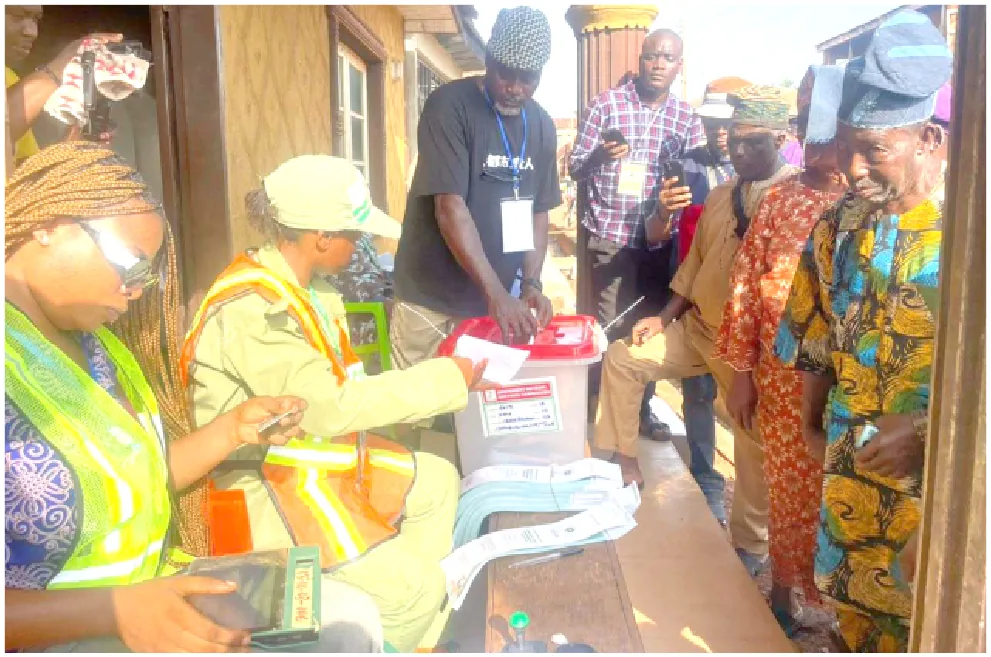
Fresh concerns have been raised over provisions of the Electoral Act 2026 governing the counting of ballot papers without the Independent National Electoral Commission’s (INEC) official mark and the accountability of electoral officials in election petitions ahead of the 2027 general elections.
The concerns centre on Sections 63(2), 137(3) and 138(2) of the Act, which lawyers and civil society organisations say could create difficulties in safeguarding ballot integrity, holding electoral officials accountable and challenging election outcomes where alleged irregularities involve violations of INEC guidelines.
Deputy Minority Leader, Abdussamad Dasuki, made a similar observation recently on the floor of the House of Representatives while urging the leadership of the House to allow a bill seeking to address perceived weaknesses in the Electoral Act 2026 to be debated.
Raising a matter of privilege during plenary in late October, Dasuki drew attention to a bill he co-sponsored with the Minority Whip, which he said was intended to address provisions threatening the integrity of the 2027 general elections.

He specifically identified Section 63(2) as a source of concern, arguing that it could allow electoral officials to accept ballot papers without the prescribed official marks or security features.
“Today, as we are talking, the 2026 Electoral Act has some credibility problems, and that is what we wanted to tackle,” he told the House.
Explaining his objection to the provision, Dasuki said: “Section 63, Subsection 2, Mr. Speaker, gave a polling unit officer, or the Presiding Officer, the opportunity to accept any paper that does not have the marks or any security feature.”
He likened the provision to accepting counterfeit currency simply because it was found among genuine banknotes.
Section 63(1) of the Electoral Act 2026 provides that a ballot paper without the official mark prescribed by INEC shall not be counted.
However, subsection (2) creates an exception, providing that where a returning officer is satisfied that an unstamped ballot paper originated from a book of ballot papers supplied to the presiding officer of the polling unit where the vote was cast, the officer shall count it despite the absence of the official mark.
The controversy gained national attention in April when Mike Igini, a former INEC national commissioner and Resident Electoral Commissioner, raised concerns about what he described as dangerous provisions in the new electoral law that could undermine the credibility of the 2027 elections.
Speaking on Arise Television’s The Morning Show, Igini identified Section 63 as one of the provisions that could expose the electoral process to manipulation.
He argued that the use of the expression “where the returning officer is satisfied” gives an individual electoral official considerable discretion to determine whether a ballot paper without the official mark should be accepted.
Igini warned that such discretion could be exploited through the introduction of unauthorised ballot papers, particularly if individuals with access to INEC’s ballot paper specifications or security features attempted to reproduce them.
He also questioned the effectiveness of relying on an officer’s satisfaction as the basis for establishing the authenticity of ballot papers during a highly contested election.
However, the controversy also generated a debate over whether the provision was actually introduced by the 2026 amendment.
A fact-check by Daily Trust established that the contested provision was not new, as it had existed substantially in the same form in the Electoral Act 2022, which governed the 2023 general elections.
The fact-check found that the difference between the two versions was largely textual, with the 2022 Act using the word “if” while the 2026 legislation uses “where” in introducing the exception.
The debate was further reinforced by Senator Ireti Kingibe, representing the Federal Capital Territory, who questioned the changes made to the electoral reform proposals before the final legislation was passed.
Kingibe, who said she participated in the Senate Committee on Electoral Reforms, alleged during an appearance on Arise Television’s Prime Time on April 27 that the final version of the legislation did not reflect the document developed through extensive consultations involving lawmakers, INEC and civil society organisations.
She said the reform process lasted about two years and was intended to produce a framework that would strengthen the conduct of free, fair and credible elections.
Kingibe also expressed concern about the security features of INEC ballot papers, questioning the absence of what she considered adequate safeguards against the use of unauthorised ballot papers.
Earlier in August, Dasuki, who represents Sokoto State in the House of Representatives, also called for the removal of Section 63(2), warning that it could create an avenue for the use of fake or unauthorised ballot papers during the 2027 elections.
The lawmaker argued that the exception under subsection (2) could undermine the protection provided by subsection (1), which expressly prohibits the counting of ballot papers without the official mark.
Other contentious provisions
Another provision, Section 137(3), has raised questions about the accountability of electoral officials in election petition proceedings.
The section provides that where a petitioner complains about the conduct of an electoral officer, presiding officer or returning officer, it shall not be necessary to join such officials as respondents, irrespective of the nature of the complaint.
Instead, INEC is required to be made a respondent and is deemed to be defending the petition on its own behalf and on behalf of the officials concerned.
Igini criticised the provision, arguing that it could weaken direct accountability for electoral officials whose actions form the basis of election petitions.
He expressed concern that where allegations of misconduct are made against individual officials, the arrangement could make it more difficult to subject their conduct to direct scrutiny during the proceedings.
He also questioned the implications of Section 138(2), which provides that an act or omission contrary to an instruction or directive of INEC, or an officer appointed for an election, but which does not violate the provisions of the Electoral Act, shall not, on its own, constitute grounds for questioning an election.
Igini argued that the provision could weaken the enforcement of INEC’s regulations and guidelines, particularly where alleged misconduct by election officials does not amount to a direct violation of the Act.
He warned that the combined effect of the provisions could undermine electoral accountability and make it more difficult to challenge certain irregularities in court.
Under the 2026 Act, Section 138(1) permits an election to be questioned on grounds that it was invalid because of corrupt practices or non-compliance with the Act, or that the declared winner was not duly elected by a majority of lawful votes cast.
However, the Commission’s Deputy Director of Publicity, Wilfred Osilama Ifogah, said ballot papers allocated to polling units must be properly checked by presiding officers before being issued for voting.
He explained that the Commission also conducts checks at Registration Area Centres (RACs) on the eve of elections to ensure that all sensitive and non-sensitive materials are in proper order and supplied in the correct quantities.
“First of all, a ballot paper not bearing the official mark is not a normal occurrence but an error in printing. Therefore, every ballot paper allocated has to be properly verified or checked before issuing by the Presiding Officer to avoid its use in the process,” he said.
He added that all election officials scrutinise the materials at the RACs a night before election day to identify possible errors or irregularities.
“That’s why at the RACs, a night before election day, all officials scrutinise every election material, both sensitive and non-sensitive, to ensure they are in the proper order and right quantity,” he said.
Lawyer, CSO urge INEC to introduce safeguards
A legal practitioner, Hamza Nuhu Dantani, urged INEC to introduce strict regulations to prevent possible abuse of contentious provisions of the Electoral Act 2026 ahead of the 2027 general elections.
Dantani said Sections 63(2), 137(3) and 138(2) could collectively weaken ballot integrity, electoral accountability and the ability of candidates to challenge election results.
He described Section 63(2), which allows returning officers to count ballot papers without INEC’s official mark if satisfied that they originated from booklets supplied to polling units, as particularly problematic.
“The official mark is the anti-counterfeit control. It is INEC’s stamp, serial number, watermark and security feature that proves the ballot came from INEC. Removing it as an absolute requirement weakens the chain of custody,” he said.
He argued that the provision replaced an objective requirement with subjective discretion because the Act did not clearly define what should satisfy a returning officer or the evidence required to establish the origin of such ballot papers.
On Sections 137(3) and 138(2), Dantani warned that removing the requirement to join individual electoral officers in election petitions and restricting challenges based solely on breaches of INEC directives could weaken accountability.
He explained that several operational requirements, including accreditation, electronic transmission of results and counting procedures, were contained in INEC guidelines rather than expressly reproduced in the Electoral Act.
“The combined effect is that Section 63 gives discretion, Section 137 removes the officer from the petition, and Section 138 removes the guideline breach as a ground. Together, they narrow both the ability to challenge and the ability to pin responsibility,” he said.
Dantani, however, acknowledged that Section 63(2) might have been intended to protect genuine votes where presiding officers inadvertently failed to stamp ballot papers, but said the law lacked adequate safeguards to distinguish administrative errors from deliberate manipulation.
With the Act already in force, he urged INEC to use its regulatory powers to establish clear procedures for verifying unstamped ballot papers, including checking their serial numbers, security features and records of ballot papers supplied to polling units.
He also recommended that every unstamped ballot accepted should be separately documented, sealed and preserved, with the reasons for its acceptance and evidence relied upon recorded in the presence of party agents.
The lawyer further called for mandatory training of electoral officers, post-election audits of polling units where unstamped ballots were counted and disciplinary or criminal action against officials found culpable.
Also, the Civil Society Legislative Advocacy Centre (CISLAC) warned that contentious provisions of the Electoral Act 2026, particularly Sections 63(2), 137(3) and 138(2), could create loopholes for electoral manipulation, weaken accountability and undermine public confidence in the 2027 general elections.
The organisation said the provisions raised concerns over the acceptance of ballot papers without INEC’s official marks, the accountability of electoral officers accused of misconduct and the enforcement of the commission’s administrative guidelines.
Its Executive Director, Auwal Musa Rafsanjani, said allowing ballot papers without official marks to be accepted based on the discretion of electoral officers could create opportunities for ballot stuffing and fraudulent substitutions.
He also expressed concern that the provisions could encourage institutional protection for electoral officers implicated in misconduct and weaken consequences for breaches of INEC’s administrative guidelines.
“Electoral discretion must never become a licence for fraud, and institutional protection must never translate into immunity for electoral offenders,” he warned.
On measures to safeguard the 2027 elections, he called on INEC to introduce strict and transparent procedures for verifying disputed ballot papers, ensure full reconciliation of election materials and establish clear accountability mechanisms for electoral officials.(Daily trust)
-

 Politics9 hours ago
Imposing Tinubu in 2027 will trigger crisis — Ex-APC spokesman
-
Business9 hours ago
FG settles ₦1.23trn electricity debt, says Power Minister
-
Business9 hours ago
How High Cost Of Feed Is Killing Poultries – Report
-
News9 hours ago
More deaths, abductions in Zamfara, Sokoto
-
News9 hours ago
Igbokoda Crash: NAF recovers black box, holds memorial November 26
-
Business9 hours ago
EXPLAINER: The Difference Between FG’s Newly Secured $500m And Fresh $500m Loan Request
-
Politics9 hours ago
I’m running to complete South’s remaining 4 years — Makinde
-
Politics9 hours ago
Thugs attack Kwankwaso’s convoy in Kano