
News
Gridlocks, shutdowns: Costs of ‘presidential movements’

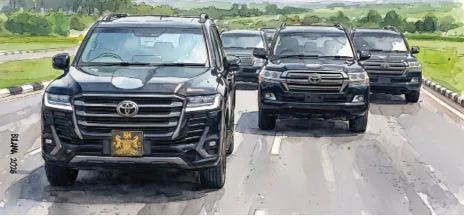
The closure of major roads during ‘movements’ of Nigeria’s presidents across the country’s cities under successive administrations is raising concerns. Some citizens have expressed concerns over the infringement of their fundamental rights, economic losses and the hardship imposed on commuters, workers, businesses and people seeking emergency medical attention.
While lawyers have warned that arbitrary and prolonged restrictions could violate the constitutional right to freedom of movement, security experts said while it is important to protect the president, it should not translate into unnecessary disruption of citizens’ daily activities, insisting that alternative executive protection measures can achieve the same objective.
The concerns have also brought into focus the economic cost of the practice, with commercial drivers losing daily income, traders recording lower sales, workers missing appointments and students, in some instances missing classes.
Scurity experts, who acknowledged the need to guarantee the president’s safety as Commander-in-Chief of the Armed Forces, called for better coordination, targeted road restrictions, advance public announcements and a review of existing protocols to minimise the burden on Nigerians.

The sound of sirens, security vehicles and instructions to stop traffic for hours have become familiar experiences for motorists and commuters along major roads in Abuja, the country’s capital, Lagos and other parts of the country whenever there is a presidential movement.
While respondents said they had no issues with the provision of adequate security for the president as the number one citizen of the country, they lamented that the persistent shutdown of roads and the attendant gridlock that follows each time the president is moving around needed to be looked into.
Abuja
On November 19, following President Bola Ahmed Tinubu’s visit to the Body of Benchers at Jabi for a book launch, roads along the Lugbe/Airport Road axis were closed, leaving many commuters and motorists stranded for hours.
Similarly, on November 13, during the president’s visit to Shehu Shagari Central Mosque at Area 1 in Garki for Jumat prayers, security restrictions reportedly affected worshippers’ movement, while parts of Wuse 2, Maitama and the Central Area were also affected.
Residents who spoke about the disruptions said the restrictions were sometimes imposed across multiple roads, making it difficult for commuters to find alternative routes or avoid the congestion.
Along the Lugbe–Airport Road axis, around the Federal Secretariat and Eagle Square, and across parts of Wuse 2, Maitama, Garki and the Central Area, motorists are often forced to wait as security operatives restrict movement to allow presidential convoys to pass.
For commuters, what should ordinarily be a short journey can turn into hours of waiting, with vehicles held in long queues, passengers abandoning commercial buses to trek, workers arriving late at their destinations and business owners losing valuable time.
For some, the inconvenience is merely a frustrating delay. For others, the consequences have been more distressing, particularly when the restrictions coincide with medical emergencies, examinations, job interviews and other important appointments that cannot easily be postponed.
At Airport Junction, a commercial driver, Paul Ayemere, who has spent nearly 20 years on the road, recalled an occasion when he had a pregnant woman in labour in his vehicle when security operatives shut down the road for a presidential convoy to move.
The experience, he said, left him helpless as he watched the woman struggle without being able to get her to a hospital promptly.
“I carry pregnant woman wey dey labour for inside motor… we come dey find other means but, no way. I feel so bad and pity for these people. If to say I go use my motor turn to plane make I fly rush her to hospital, I for do am, but there is no way,” he said.
Ayemere said the woman eventually had to leave his vehicle; and he did not know what happened to her afterwards. He said the incident was not the only instance of people suffering during such disruptions as other commuters were also affected, with some arriving late at work and facing queries, while others allegedly lost their jobs.
“Just because of that hold-up… some people even lose their jobs,” he said.
For Ayemere, the consequences of the restrictions are not limited to the inconvenience of being stuck in traffic but extend to the livelihoods and responsibilities of people whose movements are suddenly interrupted.
Another commercial driver, Kingsley Levi, recalled a Thursday when traffic was held from 1pm to 4pm, forcing some of his passengers to abandon his vehicle and trek to their destinations.
“Because of one person, they block many people. It’s unfair,” he said.
The experience, according to residents, has become particularly frustrating because they often have little information about how long the roads would remain inaccessible or when traffic would be allowed to move again.
Some said they were left waiting after being told that the president was about to pass, only to spend a considerable time in traffic before the convoy eventually arrived or the restrictions were lifted.
A motorist, Njoku Ifeoma, criticised the continued closure of roads even when the president’s convoy was yet to arrive, saying commuters were sometimes made to wait for hours based on announcements that the president was about to pass.
“Sometimes when you are going home you get stuck in traffic because they say the president is about to pass. It is not even that he has passed; they say he is about to pass, and he is still very far away. We spent two to three hours on the road before getting home,” she said.
She called on government officials to recognise that ordinary citizens also deserve consideration and should not be subjected to unnecessary hardship because of the positions held by public officeholders.
Hana Aisha recalled being caught in traffic while travelling to sit for an examination at the University of Abuja because the president was heading to the airport. The delay left her distressed as she worried about the possibility of missing the examination before learning that it had been cancelled.
“I felt so devastated, but luckily for me, the exam was cancelled. Imagine if it wasn’t,” she said.
The prolonged delays have also affected people who rely on public transportation and have limited money for unexpected expenses. Fareedah Bala said she had to walk from Mabushi to Wuye bridge after transport fares increased during one of the traffic disruptions. She said she had already calculated her transportation expenses for the day and did not have additional money to cover the sudden increase in fares.
For commuters like Bala, the disruption creates an additional burden as they are forced to either pay more to get to their destinations or find alternative means of moving when the roads are affected.
Some residents said the restrictions also extended to pedestrians. Queen Esther recalled an occasion when people walking along the road were reportedly asked to stop. According to them, various experiences suggest that the restrictions affect more than motorists as pedestrians, passengers, workers and other road users are also caught in the security arrangements.
The consequences, however, can be more troubling for people seeking medical attention. A resident, Mary Faith, said she spent four hours in traffic while going to a hospital for treatment during a presidential visit to the Economic and Financial Crimes Commission (EFCC) near the Federal Medical Centre, Jabi.
Another resident, Gabriel Sunday, described the road closures as a source of hardship for ordinary Nigerians, recalling an incident involving a friend’s wife who was reportedly delayed while being taken to Gwagwalada Hospital for emergency treatment.
“Thank God she survived. What if there is an accident and someone needs to be rushed to the hospital for emergency treatment but the road is blocked? It can lead to the death of a patient,” he said.
He urged the authorities to reconsider the timing of the restrictions, suggesting that motorists should be allowed to move until shortly before the president’s convoy approaches.
Similarly, another resident, Mr Sam Eze, said the restrictions could create difficulties for people facing emergencies, particularly when ambulances are caught in traffic.
He said the practice affected Nigerians generally, questioning whether the arrangements sufficiently considered the needs of people who might require urgent assistance. “I don’t know whether the leaders are out to lead us or rule us. There’s a difference between a ruler and a leader. There’s a difference between ruling and leading. They are just ruling us the way they want, they are not leading us.
“I have also seen an ambulance caught in traffic during a road restriction; hence medical personnel also face such difficulties. The government needs to rethink, change many things and learn many things. We are not going forward. The government needs to change their character and attitude towards Nigerians,” he said.
Another commercial driver, Eze Ifeanyi, said his daily earnings were affected whenever there is such movement. He recalled an occasion when he carried only one passenger throughout the day. He said the disruption prevented him from making the number of trips he ordinarily would have made, leaving him with little income to take home.
Henry Kesiena also complained about the practice, saying he missed an appointment after arriving late because of a road closure.
The economic consequences, particularly for commercial drivers and people who depend on daily earnings, were also raised by Mrs Goodness Moses, who questioned why thousands of road users should be made to bear the consequences of the movement of one individual.
At Airport Junction, an older cab driver, Osagede Vincent, who is almost 60, attributed the heavy security surrounding political leaders to what he described as lack of confidence in the people they govern.
He contrasted the situation with places he had visited, including Turkey, where, according to him, public officials could visit restaurants without attracting the kind of security seen in Nigeria.
“Even local government chairmen go everywhere with sirens because they are afraid of the people,” he noted.
However, not all residents consider the restrictions unnecessary. Some defended them as security measures required to protect the president in a country facing security challenges.
Around the Secretariat and Eagle Square, some respondents said presidential movements were accompanied by stringent security protocols in many countries, including restrictions on roads and airspace.
One respondent referenced the assassination of a former military head of state, General Murtala Mohammed in 1976, saying the incident partly explains the security precautions surrounding presidential movements in Nigeria.
At Lugbe, Comrade Ibrahim Husseini, a driver and unionist with 15 years of experience, said the president, as the country’s number one citizen, deserved security protection, describing road restrictions as a necessary “brief” that could last about an hour but sometimes extend to two or three hours.
Husseini said he was not particularly bothered by the delays, but expressed concern over how people facing medical emergencies were affected. “Health matter is very important; that is the area I want the federal government to look at,” he said, urging security operatives to consider allowing ambulances and vehicles conveying people with genuine medical emergencies through after proper communication with personnel on the ground.
Another resident, Amanyi Awulu, who said he had lived in Abuja for over 15 years, described the restrictions as a familiar security practice that had continued under previous administrations.
He said roads were usually blocked shortly before the president passed and reopened afterwards, but acknowledged that the restrictions could affect people with emergencies, including sick persons and pregnant women in labour.
Awulu suggested that residents should be informed ahead of presidential movements through radio and television announcements to enable them plan their journeys.
“Let there be an announcement via radio or television a day before the president is travelling,” he said.
Other residents proposed alternative transportation arrangements for the president, including the use of helicopters, arguing that such arrangements could reduce the hardship experienced by commuters.
Minister Ozijdike, who said he had experienced similar disruptions during the administrations of former Presidents Goodluck Jonathan and Muhammadu Buhari, as well as the current administration, urged the president, vice president and state governors to consider alternative means of transportation when travelling to airports.
Some also urged security operatives to allow controlled movement on service lanes instead of completely shutting down roads.
Lawal Moyo said allowing motorists to move through designated lanes, even at a reduced speed, could ease the hardship without necessarily compromising security.
The residents said they understood the need to protect the president and other public officials, but insisted that security arrangements should be better managed to reduce the disruption of daily activities.
Students miss exams, businesses grounded during Maiduguri visit
President Bola Ahmed Tinubu’s visit to Borno State for the All Progressives Congress (APC) presidential zonal campaign rall during the week, brought political excitement, but it also disrupted ordinary residents, with students missing terminal examinations and business owners lamenting hours of lost sales due to security restrictions,. Weekend Trust gathered.
Ahead of the visit, major routes spanning from the Muhammadu Buhari International Airport to the campaign venue and the palace of the Shehu of Borno, were completely shut down for hours.
The restricted major routes include the Airport Road, Kashim Ibrahim Road, Bulumkutu, the International Conference Centre, Shehu’s Palace and Dandal Roundabout.
While the Borno State police command had issued a travel advisory the night before listing the inaccessible routes, no official directive or circular was issued by the State Ministry of Education to close schools for the day. This created a dilemma for parents and academic institutions alike.
Parents residing along the affected routes voiced frustration after their children were blocked by security operatives from reaching their schools, resulting in missed terminal examinations in some instances.
Malam Modi Bashir, a resident with four children in primary and secondary schools, said none of them were able to attend classes.
“I called the school but they insisted that my children should be at the school to write exams because there was no circular from the State Ministry of Education for a break.
“My children missed the exams and we are now struggling to see that a make-up exam is conducted for them,” he said
Another parent from the Bulumkutu area, Musa Barrister, went to some lengths to ensure that his children did not miss out. Having anticipated the restrictions, he left his home as early as 6:00am to beat the security blockade.
“Many of my neighbours forfeited the school run, but I called my children’s principal to know if there was any break and he said no. That was why I decided to leave my house very early,” Barrister explained.
He, however, noted that the children returned home exhausted because they went out early and returned long after the school closure. Also, business owners, particularly at Kasuwar Jagwal and local fruit vendors, reported losses in sales as movement was grounded.
“We had to close down our businesses for the whole day because most of the customers decided to stay away from the streets,” said Auwal Muhammad, a local trader.
While political stakeholders described the campaign visit as a success, residents are calling for better coordination between security agencies and educational authorities during high-profile visits to prevent students and pupils from bearing the brunt of security lockdowns.
Lagos
Just like Abuja and Maiduguri, residents of Lagos have also complained of being stuck in traffic, especially along the Murtala Mohammed Airport in Ikeja while the convoy of President Bola Ahmed Tinubu moved in or out of the airport during his visits.
Weekend Trust reports that the president usually visits Lagos during special festivities like Eid-el-Kabir and other celebrations. A motorist who identified himself as Johnson Okebukola recalled being in traffic during one of such presidential movements.
“I was there when his convoy was moving. Both sides of the road were blocked. They had to stop vehicles from moving so the president and his convoy could pass,” he said.
Asked how he felt about his movement being hindered because of the president’s convoy, he said he had no choice but to abide because the president was involved.
“He is our president. We have no choice, and there is nothing we can do about it,” he added.
Another motorist, Bernard Uzor, said it was not right to tie people down for the president’s movement.
“Why is the president causing holdup? Things like this should not be happening. It is not right to keep people in traffic just because you want to move.
“How can Tinubu’s passing be causing us delay. We cannot meet our target for the day. Is that good? This is not the way Nigeria is supposed to be,” Uzor said.
Road closures may violate citizens’ rights, lawyers warn
A lawyer, Victoria Adaji, has warned that prolonged restrictions on movement during presidential movements could amount to a violation of citizens’ fundamental rights if security agencies failed to provide adequate notice and alternative routes.
Adaji said temporary traffic diversions for presidential security purposes were not automatically unconstitutional but could become unlawful when their duration, purpose or implementation became disproportionate and arbitrary.
She explained that section 41(1) of the 1999 Constitution, as amended, guarantees every Nigerian citizen the right to move freely throughout the country.
The lawyer also cited Article 12(1) of the African Charter on Human and Peoples’ Rights (Ratification and Enforcement) Act, which reinforces the protection of freedom of movement.
According to her, security agencies must balance the president’s security requirements with the constitutional rights of other citizens.
She said: “Constitutionally, temporary traffic diversions for presidential security do not automatically violate citizens’ rights unless the duration, aim or lack of advance notice makes the restriction disproportionate and arbitrary.”
Adaji warned that shutting down major roads for several hours without prior notice or alternative routes could cross the boundary of permissible security arrangements.
“When security operatives shut down major arterial routes (such as the Murtala Muhammed Airport corridor) for hours without notice or alternative routes, the measure crosses from permissible security protocol into an actionable infringement of fundamental rights,” she said.
Another legal practitioner, Atabo Favour Ojoarome, also warned that prolonged road closures during presidential movements in Abuja could violate citizens’ constitutional rights, particularly freedom of movement.
Ojoarome said although the president was entitled to adequate security protection, such operations must not impose excessive and avoidable restrictions on residents and commuters.
He made the submission in a legal appraisal of movement restrictions affecting communities along Abuja’s Airport Road, Lugbe and adjoining areas.
Ojoarome argued that security considerations did not give the authorities unrestricted powers to shut down public roads for extended periods.
“Public road is not a private corridor reserved for the powerful. It is a shared civic space,” he said.
He explained that section 41(1) of the 1999 Constitution guarantees every Nigerian citizen the right to move freely throughout the country, while section 45 permits restrictions only when they are reasonably justifiable in a democratic society.
According to him, presidential security can constitute a legitimate public-safety concern, but restrictions must have a lawful basis and remain proportionate to the security threat.
He said a brief traffic hold to allow a presidential convoy to pass could be justified, but shutting down major roads for hours without clear information or alternative arrangements raised serious legal concerns.
”The constitution does not require the state to eliminate every inconvenience; it does require the state to avoid turning a temporary security measure into an excessive burden on the public,” he said.
The lawyer also warned that prolonged restrictions could affect workers, schoolchildren, patients, traders and passengers travelling to the airport.
He noted that blocking emergency access could also raise concerns under section 33 of the constitution, which protects the right to life.
Ojoarome also cited the Police Act 2020, which assigns the police the responsibility of maintaining public safety while facilitating free passage and movement on public roads.
He said the law did not permit security personnel to treat traffic obstruction as an end in itself. To address the situation, he recommended shorter closure periods, clearly defined security corridors, advance public announcements, alternative routes and uninterrupted access for ambulances and other emergency services.
He also urged relevant authorities, including the police, Federal Road Safety Corps, Federal Airports Authority of Nigeria and the FCT Administration, to coordinate presidential security operations in ways that minimise disruption to residents.
Retired police officer advocates targeted road closures, public notices
A retired Assistant Inspector-General of Police, Wilson Inalegwu, has called on security agencies to adopt more coordinated and targeted traffic management measures during presidential movements to prevent unnecessary hardship for residents and motorists.
Inalegwu said while the security of the president remained paramount, measures taken to protect him should be organised in a way that would allow citizens to go about their lawful activities with minimal disruption.
He spoke against the backdrop of complaints by residents and motorists over prolonged traffic restrictions during recent presidential movements in Abuja, including the president’s attendance at a book launch along the airport road, which reportedly left commuters stranded for hours.
The retired police chief said security agencies should restrict movement only around specific locations and junctions along the president’s route rather than impose blanket closures that affect large sections of the city. He explained that motorists approaching affected areas should be properly directed to alternative routes to enable them continue their journeys without necessarily passing through the presidential convoy’s corridor.
“For instance, if you are coming from Gwarinpa, they should tell you to use Jabi so that you can go to the airport and bypass where the president is,” he suggested.
Inalegwu, who has experience in police operations, said presidential movements required careful security planning because any breach could endanger the president and other people.
He, however, stressed that effective coordination among security personnel could help reduce the period roads remained closed to traffic.
According to him, security teams should deploy vehicles ahead of the presidential convoy to strategic junctions, control traffic and ensure that motorists are kept informed of the restrictions.
He said traffic should be allowed to flow again immediately after the president’s convoy had passed, rather than keeping roads shut longer than necessary.
“The moment the president has passed, you open the road. Those on the opposite side also have to know that the president is passing. They can stop, but the moment the president has passed, they should reopen the road; it is not more than one or two minutes,” he said.
The retired AIG also advocated advance engagement with business owners and residents around areas expected to be affected by presidential movements.
He said security agencies should give affected communities and businesses at least three or four days of notice, explaining the expected restrictions and their duration.
According to him, such engagement would enable business owners, commuters and other road users to make alternative arrangements ahead of time.
Inalegwu also cautioned against what he described as inadequate understanding of the procedures involved in managing presidential movements, noting that security operations require specialised planning and coordination.
On suggestions that the authorities should leave one side of a major road open to traffic while the presidential convoy uses the other, he said such arrangements might not always be safe, depending on the security assessment of the route.
He also dismissed the use of helicopters as a straightforward alternative to road transportation for the president, arguing that air transportation carries its own security risks.
Inalegwu said the priority should be to improve the planning and coordination of road movements, provide timely information to the public and ensure that restrictions were lifted promptly after the convoy had passed.
Also speaking, an expert in security risk management, intelligence and national security solutions, Dr Kabir Adamu, stressed the need for security team attached to President Tinubu to strike a balance between providing security for the president and respecting citizens’ rights of freedom of movement.
Adamu, who is the Managing Director, Beacon Security and Innovations Limited, said although the president required adequate security protection as Commander-in-Chief of the Armed Forces and the country’s number one citizen, such measures should not undermine citizens’ fundamental rights in a democratic society.
The security expert said there was a need to strike a balance between security priorities and the human rights of citizens, particularly the constitutional right to freedom of movement.
“In a democratic setting, there is always a need to balance security priorities with human rights and human security. Where security priorities are infringing on human rights and human security, then it goes almost completely against democratic norms,” he said.
Dr Adamu described the practice as reminiscent of the military era when roads were routinely blocked during movements of top government officials, noting that it could generate anger and resentment towards the president.
“What is going on at the moment is reminiscent of the military era when that used to be the practice. Unfortunately, we saw how it generated a lot of grievance and anger towards the president,” he said.
He, however, acknowledged the importance of providing maximum protection for the president, stressing that security consideration must be balanced with the rights of other citizens.
Adamu said there were several options in executive protection that could ensure the president’s safety without subjecting residents to prolonged restrictions on their movement. He added that he could not prescribe specific alternatives without knowing the security intelligence available to the president’s protection team.
The expert, however, said if the restrictions were the result of an elevated security threat, the authorities should communicate the reasons to Nigerians to enable them understand the situation.
According to him, security operations could be conducted at different levels, including low, moderate and elevated threat levels, with each requiring different protective measures.
Adamu also raised questions about whether the restrictions were connected to the 2027 general elections, asking why similar security arrangements were not being extended to other major presidential candidates.
He urged the authorities to be more transparent about the security considerations behind the restrictions, saying the current approach is creating avoidable grievances. He maintained that protecting the president should not come at the expense of the freedom and convenience of ordinary citizens.(Daily trust)
-

 Politics4 hours ago
2027 alliance: Atiku or Obi?
-
News4 hours ago
N78.8b cash transfer queries spark legal battle at ECOWAS Court
-
Business4 hours ago
Dry Season: Farmers Face Rising Cost Of Cultivation, Insecurity
-
News4 hours ago
Schoolchildren battle killer heat
-
Politics4 hours ago
You Can’t Win Sympathy Through Blackmail – Kano Govt Replies Kwankwaso
-
News5 hours ago
UK rejects 84% Nigerian student visa interviewees
-
Politics4 hours ago
Furore over ‘rig and die’ slogan
-
Politics4 hours ago
Election Riggers Should Not Be Killed – Fashola