News
REVEALED: Truth Behind Badaru’s Shock Resignation as Defence Minister

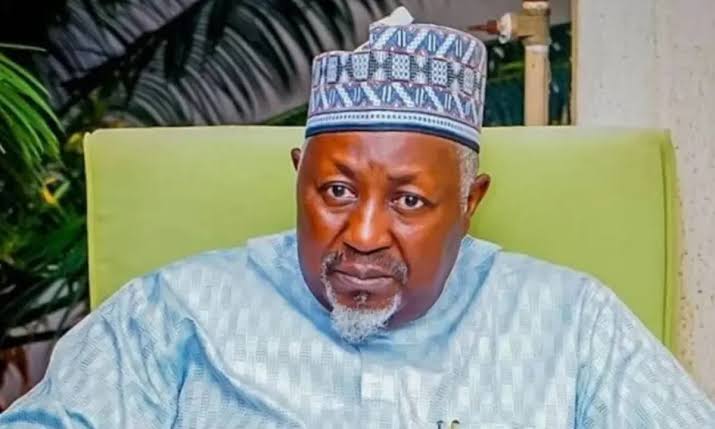
Fresh information has surfaced on why former Minister of Defence, Badaru Abubakar, abruptly left office after two years in the job.
Although his exit was officially linked to health issues, new details obtained by POLITICS NIGERIA indicate that the resignation was far more complicated than the statement released earlier in the week.
Badaru stepped down on Monday, citing health challenges. Shortly after his resignation, President Bola Tinubu administered the oath of office to retired Chief of Defence Staff, General Christopher Musa, who now heads the Defence Ministry.
The President’s Special Adviser on Information and Strategy, Bayo Onanuga, announced the change and stated that the former minister quit due to “poor health.”

However, investigations show that the former minister had been entangled in a long and increasingly tense clash with the Minister of State for Defence, Bello Matawalle.
The disagreement, which had been carefully shielded from the public, reportedly created unending friction within the ministry for several months.
Badaru, who joined the federal cabinet on August 21, 2023, after completing his second term as governor of Jigawa State, was brought into the defence sector partly because of his administrative background and political reach in the North West—an area battling persistent banditry.
He was expected to lead major reforms, including military modernisation, improvements in intelligence systems, and stronger counter-terrorism efforts.
Matawalle was appointed the same day to support him, but insiders within the defence establishment said the working relationship between the two men never recovered from early power tussles.
According to senior officials who spoke confidentially, both ministers maintained a polite front during public engagements but struggled behind closed doors.
One official said the unease between them was an open secret in the ministry. According to him, “Matawalle and Badaru had a frosty relationship for most of the period he was minister, although they appeared cool with each other in public. But it is a known fact here that they had something against themselves.”
He added that the tension affected coordination across departments, especially communication and media operations.
Another senior source said Matawalle’s close ties with the Presidency gave him significant influence in the ministry, which often placed Badaru in a weaker political position.
Some party figures within the APC reportedly viewed Matawalle as a strong political asset for 2027, partly because of his dominance in Zamfara politics.
The source said that while Matawalle enjoyed the confidence of key power brokers, Badaru “does not actually reckon with the Presidency when it comes to power play and politics.”
These internal tensions intensified around the same period Nigeria recorded a spike in bandit attacks, mass abductions of schoolchildren, and renewed public anger over insecurity.
Several analysts publicly questioned the ministry’s performance and demanded a change in leadership.
The situation worsened when Nigeria’s security environment drew negative international attention, especially after the United States—under the Trump administration—re-designated Nigeria as a Country of Particular Concern over alleged violations.
Under these mounting pressures, Badaru eventually submitted his resignation on December 1.
By then, the relationship inside the ministry had grown so strained that top officials believed his exit was unavoidable.
Renewed Calls for Matawalle’s Removal
Following Badaru’s withdrawal from the cabinet, fresh voices have emerged demanding that Matawalle also step aside.
Civil society groups, activists, and political commentators argue that the minister of state shares responsibility for the country’s deteriorating security landscape.
The calls are not entirely new. Matawalle, a former Zamfara governor, has been under recurring pressure from critics in his home state.
In September 2024, Governor Dauda Lawal openly asked him to resign over alleged links with bandit groups—claims Matawalle has always insisted are false.
The APC Akida Forum also demanded that he be suspended pending investigations into alleged connections with criminal networks.
More recently, in November 2025, the Good Governance and Accountability Monitoring Group urged President Tinubu to dismiss him for “complicity” and “poor performance,” arguing that insecurity continued to worsen under his watch.
Despite these strong criticisms, sources within the Defence Ministry and the Presidency say Matawalle may remain in office.
Senior officials says that he is considered part of the administration’s broader strategy to tackle banditry, especially in the North West.
They also pointed to his recent involvement in Kebbi State after the abduction of 24 students from Government Girls Comprehensive Secondary School, Maga—a case that ended with the students’ release following joint security operations.
Interestingly, Matawalle was not present on Friday when Gen. Musa (retd.) formally assumed duty at the ministry in Abuja. As of press time, there was no official statement explaining his absence.
Gen. Musa Begins With Major Reforms
The new Minister of Defence, Gen. Christopher Musa (retd.), has already outlined an ambitious plan for restructuring Nigeria’s defence architecture.
During his first briefing at the ministry on Friday, he announced a full review of all theatre commands and inter-service structures.
According to him, the aim is to improve unity among the military services, close operational gaps, and align strategy with field activities.
He stressed that welfare would be treated as a core security priority. Musa highlighted allowances, accommodation, medical care, prompt supply of kits, and support for wounded personnel and families of fallen soldiers as areas requiring immediate attention.
He said, “We must also confront a critical truth: welfare is not administrative; it is strategic… Anyone who risks his or her life for Nigeria deserves nothing but utmost respect.”
Musa emphasised that Nigeria must abandon fragmented security operations and adopt a more unified approach involving the Army, Navy, Air Force, and other security agencies. He said that under his stewardship, the ministry would operate on three major pillars: operational effectiveness, unified action, and strategic foresight.
He pledged zero tolerance for corruption, indiscipline, or complacency. He also promised to expand the use of technology, data-driven planning, and intelligence-led operations while strengthening alliances with Nigeria’s foreign and domestic partners.
Musa added that the country can no longer delay meaningful reforms as insecurity continues to affect farmers, students, and entire communities.
He vowed that the ministry would pursue both kinetic and non-kinetic strategies to restore peace.
-

 Business17 hours ago
Dangote Refinery Cuts Fuel Prices Again, signals further moderation
-
News17 hours ago
MAN IN THE NEWS: Adeniyi Adeyemi, self-styled DG at centre of ‘presidential council’ scandal
-
News10 hours ago
US Withdraws Troops Deployed To Nigeria
-
Business10 hours ago
Despite xenophobia, S’African investors pour nearly $1bn into Nigeria
-
News10 hours ago
Security agencies calm fears over barricades in Abuja
-
Business17 hours ago
Oba Otudeko’s Honeywell Group acquires 14% stake in Ikeja Hotel
-
News10 hours ago
Lagos to receive first state-funded HIV medicine August
-
News18 hours ago
How FG approved recruitment of 300 staff members for ‘fake’ presidential council – Report