News
Senate panel criticises Tinubu administration over ‘budget overlapping’

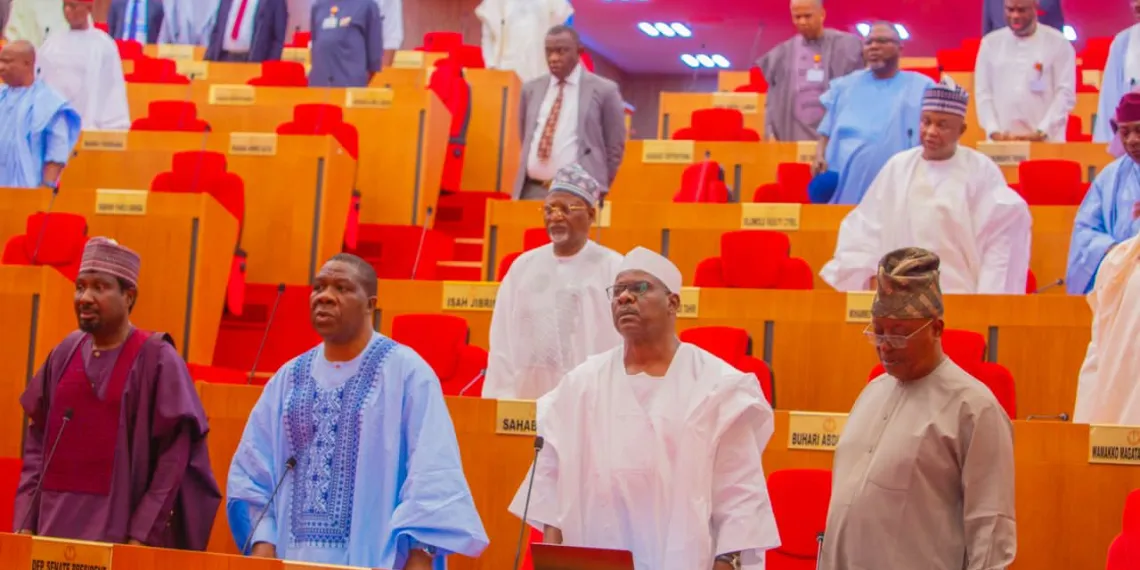
Members of the Senate Committee on Finance on Monday criticised the administration of President Bola Tinubu for operating multiple budgets within a single fiscal year, particularly through repeated extensions of capital components.
The lawmakers expressed their displeasure during an interactive session organised by the committee on the 2026–2028 Medium Term Expenditure Framework (MTEF) and Fiscal Strategy Paper (FSP).
Their concerns followed continued extensions of budget implementation by the Tinubu administration, especially capital expenditures meant for a single fiscal year but rolled over into subsequent years, often with the approval of the National Assembly.
The practice dates back to 2024, when Nigeria effectively operated three budgets simultaneously: the ₦21.8 trillion 2023 budget, the ₦2.17 trillion 2023 supplementary budget, and the ₦28.7 trillion 2024 budget.

The trend continued in 2025, as the capital component of the 2024 budget, originally scheduled to expire in December 2024, was extended twice, first to June 2025 and then to December 2025.
As a result, the country is currently running two budgets simultaneously: the extended 2024 budget and the 2025 budget of about N54.2 trillion, which lawmakers raised by N7 billion from the president’s initial proposal.
In a recently issued abridged budget circular widely reported in the media, the federal government directed ministries, departments and agencies (MDAs) to roll over 70 per cent of their 2025 capital allocations into the 2026 fiscal year.
During the session, the senator representing Gombe Central, Danjuma Goje, described the implementation of multiple budgets within a fiscal year as unacceptable, insisting that the practice must end.
“This ugly situation we found ourselves on multiple budget implementations should please end by this year. It is not acceptable. Things must be normalised Oyewumi Olalere, urged the government to present realistic figures and projects in the budget rather than proposing targets that are unattainable and subsequently require extensions.
The senator representing Anambra Central, Victor Umeh, and his counterpart from the Federal Capital Territory (FCT), Ireti Kingibe, questioned why revenue shortfalls could not be covered by the foreign and domestic loans approved by the National Assembly since the beginning of the year.
Chairman of the committee, Sani Musa, however, assured lawmakers that the January–December budget cycle would be restored in 2026, with improved oversight of federal government spending.
Mr Musa, who represents Niger East Senatorial District, also announced that a three-member ad hoc committee would be constituted to liaise with the Minister of Finance and Coordinating Minister of the Economy, Wale Edun, as well as the Accountant-General of the Federation, on the payment of local contractors for projects executed in 2024 before the budget’s expiration on 31 December.
Nigeria’s revenue outlook
Addressing the committee on federal revenue performance, Mr Edun disclosed that only ₦10 trillion had been realised out of the ₦40 trillion projected revenue for the 2025 fiscal year.
The minister explained that the shortfall necessitated the rollover of capital components of the 2025 budget into 2026.
“Funding for the capital components of the 2024 budget has been met through realisation of the total projection of N26 trillion revenue but that of 2025 have not been met .
“Out of projected N40 trillion revenue for 2025 fiscal year, only N10 trillion have been realised, leaving a shortfall of N30 trillion and consequently, making the federal government roll over 70 per cent of capital projects captured in 2025 fiscal year to 2026,” he said.
However, the committee chairman challenged the Executive Chairman of the Federal Inland Revenue Service (FIRS), Zacch Adedeji, to work towards achieving a ₦35 trillion revenue target for the 2026 fiscal year.
The Minister of Budget and Economic Planning, Atiku Bagudu, and the Minister of State for Petroleum Resources, Heineken Lokpobiri, in their submissions, defended the parameters of the proposed ₦54.4 trillion 2026 budget.
The framework proposes an oil benchmark price of $64 per barrel, an exchange rate of ₦1,512 to the dollar, and daily oil production of 2.6 million barrels per day. However, a more conservative production estimate of 1.8 million barrels per day will be adopted for budgeting purposes.(Premium Times)
-

 Politics22 hours ago
‘I’ve never stolen government money’ — Dino Melaye reveals how he became rich
-
Metro22 hours ago
Builders unearth €9m gold loot sealed in walls of Belgian property
-
Business22 hours ago
NUPRC moves to introduce domestic crude, gas swap arrangement
-
News13 hours ago
Lakurawa terrorists kill four soldiers in Sokoto
-
News22 hours ago
Abiodun completes 108-unit Buhari estate in Ogun
-
Politics13 hours ago
Osun poll: APC, Accord wage N20,000-per-vote war
-
Sports13 hours ago
Gala reject £111m, insist Osimhen not for sale
-
Metro22 hours ago
How kidnappers murdered woman after collecting $98,700, N30.5m ransoms – Police