News
FG misses 2025 revenue target by N30trn – Finance Minister

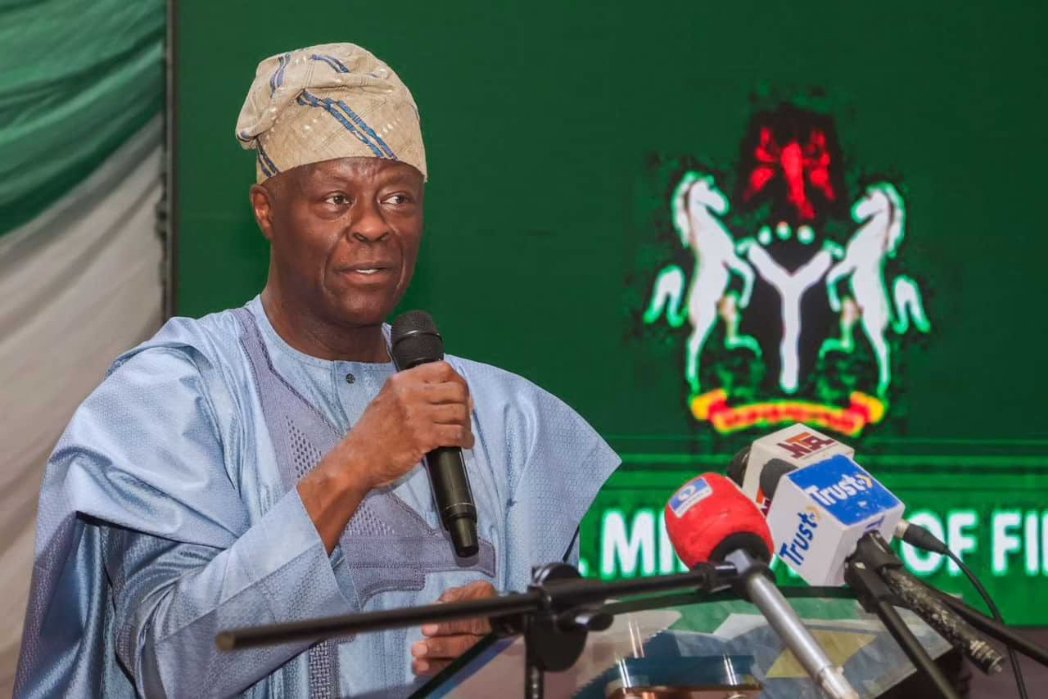
The federal government has recorded a wide revenue shortfall in the 2025 fiscal year, raising fresh concerns about the sustainability of Nigeria’s public finances, the Minister of Finance and Coordinating Minister of the Economy, Wale Edun, has said.
Mr Edun stated this on Tuesday during an interactive session with the House of Representatives Committees on Finance and National Planning.
The session was convened to discuss the 2026–2028 Medium Term Expenditure Framework (MTEF) and Fiscal Strategy Paper (FSP).
The appearance followed the transmission of the MTEF and FSP to the House by President Bola Tinubu last Wednesday for legislative consideration and approval.

According to the minister, the federal government had projected ₦40.8 trillion in revenue for 2025 to finance the ₦54.9 trillion “budget of restoration,” which was designed to stabilise the economy, secure peace, and rebuild prosperity.
However, he said actual revenue performance had fallen significantly short of expectations, with total inflows for the year now projected to close at about ₦10.7 trillion.
“The current trajectory indicates that federal revenues for the full year will likely end at around ₦10.7 trillion, compared with the ₦40.8 trillion that was projected,” Mr Edun told the lawmakers.
He attributed the shortfall largely to weak oil and gas revenues, particularly lower-than-expected collections from Petroleum Profit Tax and Company Income Tax paid by oil and gas companies.
The minister also cited underperformance across several non-oil revenue subheads, compounding the pressure on government finances.
Mr Edun disclosed that the government had borrowed about ₦14.1 trillion during the year in an effort to bridge the funding gap created by the revenue shortfall.
Even with the additional borrowing, he said, combined inflows remained far below the level required to fully fund the 2025 budget, increasing the strain on treasury operations and fiscal planning.
The revenue challenge, he noted, underscored the vulnerability of Nigeria’s public finances to oil price fluctuations, production shortfalls and structural weaknesses in revenue mobilisation.
Despite the revenue squeeze, the finance minister said the government had continued to meet its key obligations through what he described as prudent and disciplined treasury management.
He told lawmakers that salaries, statutory transfers to subnational governments and critical domestic and external debt service obligations had been paid as and when due.
This, he said, was achieved through careful cash management and the creative sequencing of available resources to prioritise essential expenditures.
Capital spending performance
Providing an update on expenditure performance, Mr Edun said capital releases to Ministries, Departments and Agencies in 2024 stood at ₦5.2 trillion out of a budgeted ₦7.1 trillion, representing about 73 per cent performance.
He added that when multilateral and bilateral-funded projects were included, total capital expenditure amounted to ₦11.1 trillion out of ₦13.7 trillion, or approximately 84 per cent.
The figures, he said, reflected the government’s efforts to sustain investment in critical infrastructure despite fiscal headwinds.
Warning on oil-dependent spending
The minister cautioned against rigid expenditure commitments tied to oil revenues, urging lawmakers and fiscal planners to adopt a more flexible approach to budgeting.
He warned that over-reliance on optimistic oil projections had repeatedly created budget implementation challenges in recent years.
“We must be ambitious, but given the experience of the past two years, spending linked to these revenues must be based on what actually comes in, not what we hope to earn,” Mr Edun said.
Revenue assumptions and fiscal outlook
Also addressing the committees, the Minister of Budget and National Planning, Atiku Bagudu, said the 2026–2028 MTEF and FSP were developed after extensive consultations with government agencies, the private sector, civil society organisations and development partners.
Mr Bagudu acknowledged internal debates within the Economic Management Team over revenue assumptions, noting a tension between conservative projections based on historical performance and more ambitious targets aimed at compelling revenue-generating agencies to improve collections.
He explained that while the government retained an oil production target of 2.06 million barrels per day for the 2026 budget, it adopted a more cautious production assumption of 1.84 million barrels per day for revenue calculations.
According to him, the revised assumption was intended to reduce the risk of revenue shortfalls and improve the credibility of fiscal projections.
Mr Bagudu also urged revenue-generating agencies to intensify efforts to expand collections, improve compliance and block leakages.
Lawmakers urge fiscal discipline
Earlier, the Chairman of the House Committee on Finance, James Faleke, said the fragile state of the economy required rigorous scrutiny of fiscal assumptions to avoid inflated budgets detached from economic realities.
He emphasised the importance of critical analysis of revenue and expenditure projections to inform policy decisions and ensure that limited resources are deployed efficiently.
Mr Faleke said lawmakers would closely examine the MTEF and FSP to ensure that fiscal targets were realistic and aligned with Nigeria’s current economic conditions.(Premium Times)
-

 Entertainment22 hours ago
Diddy thrown into solitary after VIP prison life exposed
-
Politics22 hours ago
Osuntokun accuses Atiku of affront, disrespect to Tinubu in Oct. 1 speech
-
News22 hours ago
Troops rescue 10 NYSC members, kill 16 terrorists, recover weapons
-
Entertainment21 hours ago
Celebrity boxing : Phyna knocks out Nkechi Blessing in round 4
-
News22 hours ago
CNG application: States fail to implement Tinubu’s low fare directive
-
Entertainment22 hours ago
Skales cries out over rising begging culture
-
News21 hours ago
Workers begin three-day warning strike
-
News22 hours ago
Tinubu, Akpabio, Sanwo-Olu, others attend national premiere of MKO documentary