Opinion
OPINION: How Governor Adeleke Repositioned Osun Civil Service By Seyi Adeniyi

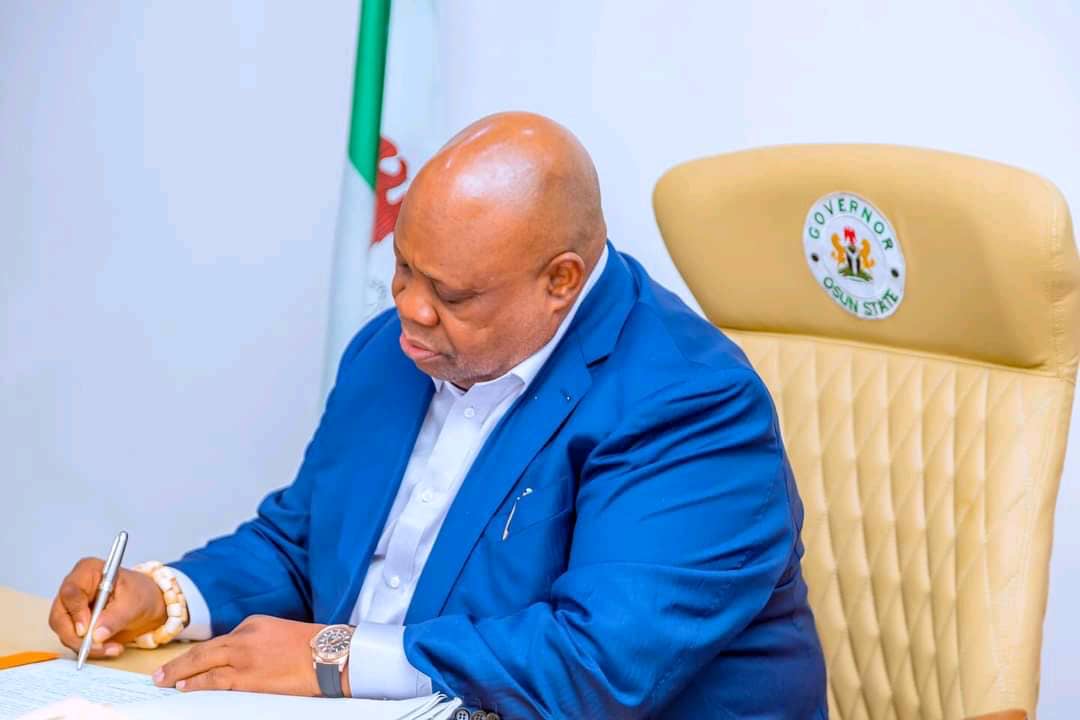
The Osun State Government, under the leadership of Governor Ademola Adeleke, has taken a bold and historic step towards repositioning the state’s civil service for greater efficiency, transparency, and productivity. In a move widely applauded by stakeholders, the Governor has successfully dismantled long-standing bureaucratic barriers that for years hindered effective service delivery in the state.
For decades, the Osun civil service has been weighed down by systemic challenges, delayed promotions, stagnation, lack of clear structures, and politicized career progression. These issues weakened morale, slowed productivity, and created a culture of frustration among workers. Governor Adeleke’s reform agenda is a deliberate response to this long-standing malaise. His administration has chosen strategic collaboration with critical stakeholders as the foundation for real and lasting change.
Unlike previous cosmetic adjustments, this restructuring is anchored on a clear policy framework aimed at modernizing and strengthening the civil service. Governor Adeleke understands that no government can thrive without an efficient, motivated, and well-structured workforce. Through wide consultations and inclusive planning, his government engaged civil servants, labour unions, and administrative heads to identify and address fundamental obstacles.
The outcome of this approach is a reform process that enjoys broad acceptance and is practical in implementation, a rare feat in public sector reform in Nigeria.

** Restoration of Merit and Professionalism:
Promotions and appointments are now based on qualifications, performance, and years of service rather than political patronage or favoritism. This has restored confidence in the system and encouraged healthy competition among workers.
** Prompt Promotions and Career Growth:
Civil servants who had spent years stuck on the same grade level now have a clear pathway for advancement. This single step has boosted morale, improved motivation, and reignited commitment to duty.
** Removal of Bureaucratic Barricades:
Administrative red tape that slowed down decision-making has been dismantled, ensuring faster processing of files, approvals, and policy implementation. Efficiency is gradually replacing the culture of unnecessary delays.
** Strengthened Government–Labour Relations:
The administration’s emphasis on constructive engagement rather than confrontation has fostered mutual trust. Labour leaders now see government as partners, not adversaries.
Labour unions and civil servants have commended Governor Adeleke’s inclusive leadership style, describing the reforms as “long overdue.” Many believe this is a turning point for the civil service. According to labour representatives, the Governor’s willingness to listen, consult, and act decisively demonstrates genuine commitment to workers’ welfare.
This positive relationship has created an enabling environment for the smooth implementation of policies that directly impact service delivery. Workers now feel seen, valued, and respected, a crucial element in building an efficient public service.
Governor Adeleke’s civil service restructuring is not just an administrative reform; it is a legacy project. Beyond constructing roads and bridges, his administration recognizes that strong institutions and a well-motivated workforce are the backbone of sustainable development.
By removing obstacles and empowering civil servants to perform effectively, the government is laying a solid foundation for a more responsive, accountable, and people-centered public service. Osun State is, once again, setting an example for other states to follow.
The repositioning of the civil service reflects a firm commitment to efficiency, fairness, and good governance. With bureaucratic bottlenecks cleared and a transparent system in place, the future looks brighter for civil servants, and for the people of Osun State who depend on their services.
In the end, true governance is not measured by political rhetoric but by the strength of the institutions that serve the people. On this front, Governor Adeleke’s administration is making a bold and commendable statement.
Seyi Adeniyi is a media aide to Governor Ademola Adeleke of Osun State.
-

 News21 hours ago
The dramatic landing of a Bombardier Challenger CL-601 on a concrete road under construction in Ogwashi-Uku, Delta State, has triggered intense public scrutiny. However, the Nigerian Civil Aviation Authority’s (NCAA) subsequent disclosure that the flight crew consisted of a 75-year-old pilot and a 70-year-old co-pilot has exposed a fascinating layer of international aviation law. While Nigerian civil aviation regulations strictly prohibit commercial pilots over the age of 65 from commanding flights, the NCAA has clarified that the crew of the aircraft (registration N989BC) committed no offence regarding their age under Nigerian law. Under the Chicago Convention on International Civil Aviation, the “State of Registry” holds primary jurisdiction over the licensing of the flight crew, not necessarily the country whose skies the plane is traversing. Because the Bombardier Challenger is registered in the United States (indicated by the “N” prefix in N989BC), it remains an extension of U.S. regulatory territory regarding airworthiness and crew compliance, BusinessDay’s findings show. The pilots hold U.S. Federal Aviation Administration (FAA) licenses and operate under FAA Part 91 and Part 135 regulations. Unlike Nigeria’s rigid cap of 65 years, U.S. regulations do not have a hard upper age limit for non-commercial or certain private charter operations, provided the pilots can pass the FAA’s stringent, bi-annual First-Class Medical certifications. Related News Fayose casts vote, predicts APC’s Oyebanji will win Ekiti guber poll INEC BVAS malfunctions, fails to capture 90-year old voter EIB, Lagos sign €170m deal to develop water transport network “The pilot is not overaged in America,” explained Don Spiff, NCAA’s Director of Operations, Licensing, and Training in a recent TV interview. “These guys are not flying with a Nigerian licence, and because it’s American-registered, the pilots hold American FAA licences. It is not a breach,” he clarified. “Aviation is a very dynamic field. It is in the Civil Aviation Act, yet to be implemented, that after 65, a Nigerian pilot can actually fly private, as long as he passes his first-class medical,” Spiff added. He, however, noted that for the pilot to have taken off, it was not allowed because he did not obtain any clearance for takeoff. “He did a kamikaze (suicide mission) action. There will be penalties. So far, the NCAA has suspended their commercial certificate, which is called a PNCF.”
-
News13 hours ago
I’ve Started Counting My Days In Office – Sanwo-Olu
-
African News21 hours ago
Africa’s largest nation gets $1bn BRICS funding boost to tackle infrastructure crisis
-
News13 hours ago
Angry youths burn down Ekiti Police station
-
Business21 hours ago
Africa’s second-richest man Abdul Samad Rabiu adds $81m Bombardier Global 8000 to fleet
-
News20 hours ago
Beyond bullets, negotiations and ransom: Yorubaland in the grip of terrorists
-
Metro17 hours ago
Helen Prest appeals judgment recognising Adenike as Tosin Ajayi’s sole widow
-
News14 hours ago
Widow Of General Rabe Reveals Harrowing Ordeal After Husband’s Death