News
2026: N1.07bn Voted For Tinubu, Shettima’s Residences’ Renovation

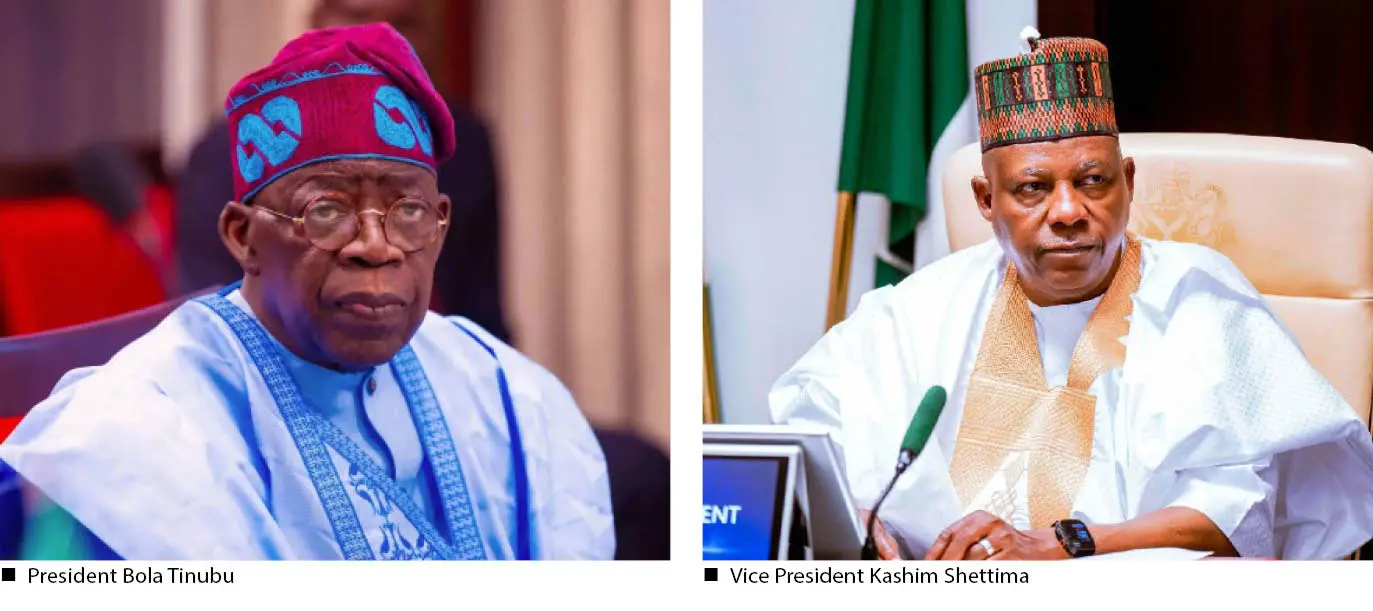
The federal government has appropriated a sum of N1.07 billion for the repairs of the residential buildings of President Bola Ahmed Tinubu and Vice President Kashim Shettima in the 2026 budget, pushing the amounts allocated for the renovation of the duo’s official residences and quarters in three years to N18.4bn, Daily Trust can report.
This is as the Economic and Financial Crimes Commission (EFCC), whose expenditure is captured under the presidency section of the budget, proposed to spend N3.2bn on cleaning and fumigation services as well as meals and refreshments this year.
President Tinubu had presented the 2026 appropriation, titled “Budget of Consolidation, Renewed Resilience and Shared Prosperity,” to a joint session of the National Assembly on December 19. He had earlier written to the Senate and the House of Representatives, requesting a repeal and reenactment of the 2024 and 2025 appropriation acts to a total expenditure of N43.56 trillion and N48.32 trillion, respectively, to ensure full implementation by March 31, 2026.
The current appropriation bill comprises a total expenditure of N58.18trn, including N15.52trn for debt servicing, and projected revenue of N34.33trn, leaving a deficit of N23.85trn to be financed through domestic and foreign loans.
A budget document posted on the Budget Office of the Federation website last week revealed that the State House earmarked N459.4m and N615.5m for the “rehabilitation/repairs of residential building” of the President and Vice President, respectively.

In the previous year, N1.53bn, comprising N879.3m for the rehabilitation of the president’s residential building and N656.4m for that of the vice president, was allocated, while N1.3bn (N500m and N633m, respectively) was budgeted in 2024 for the same purpose.
Also, the federal government set aside N300m for the renovation of the vice president’s quarters at the State House, Abuja, in 2024, followed by a budget sum of N466m in 2025 and N326.8m in the current fiscal year.
Recall that Tinubu, in the 2023 supplementary budget he presented to the National Assembly shortly after he resumed office, sought approval for the renovation of residential quarters for the President at the sum of N4bn; renovation of (vice president’s) Aguda House at a cost of N2.5bn; renovation of Dodan Barracks, the official residence of the President, at N4bn and renovation of official quarters of the Vice President in Lagos at N3bn. The request, which came some months after the administration of the late former President Muhammadu Buhari budgeted N333m for the rehabilitation of the Vice President’s residential building, drew widespread public criticism.
In June 2024, President Tinubu, alongside the Federal Capital Territory Minister, Nyesom Wike, inaugurated the new official residence of the Vice President. The project, which cost a whopping N22bn, was implemented by the FCT administration.
Speaking at the event, Tinubu, who was represented by Shettima, explained that the completion of the official residence represents the government’s respect for those in leadership positions, assuring Nigerians that his administration would continue to prioritise their well-being and build a nation they could be proud of.
Meanwhile, the 2026 budget document has revealed that the EFCC would spend over N5bn as part of recurrent expenditure on cleaning and fumigation services, N278.6m; motor vehicle fuel cost, N1.02bn and fuelling of generators, N1.2bn.
The anti-graft agency budgeted N722m for refreshment and meals, N170.5m for drugs & medical supplies, N376.5m for vehicle/transport equipment maintenance and N46m for maintenance of office furniture. It also planned to spend N1.5bn to maintain the office building and residential quarters and N159.8m for the maintenance of office/IT equipment.
Concerns over repetitive budget lines
Public affairs analysts have expressed concerns over the repetition of the same items, such as the rehabilitation of the presidential buildings every fiscal year, lamenting that such budget lines create room for wastage.
The Executive Director, Centre for Anti-Corruption and Open Leadership (CACOL), Comrade Debo Adeniran, said Nigeria runs a system where many public officials don’t bother about the interests of the masses who vote them to power.
“We have always been complaining that the system we are operating is bad because of its penchant for profligacy. Politics is the quickest way to getting instantaneous affluence, whereby people become billionaires overnight. We advocated for system change, but what we have been getting is regime change. Democracy should be a government that takes care of the needs of the majority of the people. And that is where the security and welfare of the people come in. But what we are operating now is more like a plutocracy, where government officials find every means to create avenues within the budget to take care of their own comfort and convenience.
“That is why the same items on the budget keep repeating themselves. Why is it that a renovated residence cannot be sustained for at least four years? They have to renovate houses and offices, even one as sensitive as that of the EFCC, every year and buy a new set of furniture. MDAs repeat the same budget line year in, year out,” he said.
Adeniran maintained that the repetition could serve as a conduit through which money would flow into private pockets, lamenting that the National Assembly has failed to effectively perform its oversight function because “they are also beneficiaries of this profligacy.”
“Basically, it is the system we are operating and that is why some people are calling for revolution for power to change hands from those who want to pillage our common wealth to those who want to prudently utilise it for the good of the majority,” he added.
Recall that a lawmaker representing Kaduna North Federal Constituency, Bello El-Rufai, had voiced a similar concern on repetitive budget lines in a video that went viral in December 2024, accusing Ministries, Departments and Agencies (MDAs) of spending public funds on frivolous items.
Speaking at a plenary session, El-Rufai, who is a member of the ruling All Progressives Congress, urged Speaker Tajudeen Abbas to prioritise reducing the budgets of MDAs, noting that Nigerians are increasingly concerned about the yearly rise in government spending.
“Nigerians are tired of every agency buying forks and knives every year; we should show them we are serious and make these drastic cuts. We need to cut down on costs. The recurrent expenditure issue exists in every budget. Even as a young person like myself, I see that we budget for vehicles every year, utensils every year. To open more revenue streams or block loopholes, we need to scrutinise these ministries’ budgets. If they bought vehicles last year, they should hold off because vehicles do not expire.
“Since I was a boy, every year’s budget includes new computers and furniture, yet these items do not expire. We should cut them out entirely. We cannot implement a tax reform bill to strengthen the fiscal position of this country while, as leaders, if we fail to cut costs,” he said.
A political scientist, Dr Kabiru Sa’id Sufi, observed that the national budget appears to be recycled annually with few adjustments made. He said there is a need to take the budget process seriously by scrutinising and prioritising the items to plug loopholes that can give a chance to corruption.
He said, “The assessment people are making about the budget is that overhead is increasingly taking a large chunk of the money, which shouldn’t be. We need to cut down on unnecessary expenditure. The budget sometimes appears to be a recycled document with few adjustments. This not only applies to the presidency. If you look at MDAs, you will keep seeing the same thing being repeated almost annually in their budgets, with only differences in figures. It means that most of those things budgeted are not really needed.”
Dr Sufi also frowned at the poor implementation of budgets in recent years, citing the 2025 appropriation which about 70 per cent of the allocation has not been released. He explained that such a scenario makes budgeting a futile exercise: it raises hopes of MDAs and the populace at the beginning of a fiscal year and dashes them when funds are not released.
“You then come back to it [the budget] the following year. This is confusing; it’s either that these things are not well thought out, or the exercise is being reduced to mere paper. Let’s give the budget exercise the attention it requires. Let’s scrutinise it before taking it to the legislature for vetting. Let us also ensure that all the things budgeted are needed and be careful not to include bogus expenditure. It gives room for corruption.
“We should check the expenditure that has been recurring year in, year out. It means either those things are not being done or they are not needed. We need to check these and ensure we plug all loopholes. The budget shouldn’t just be an annual exercise that does not really impact. Let’s look at the implementation; otherwise, we will be making a mockery of the whole process. It’s a mere formality where we mention big figures to show that we have a large economy without impacts from the budgetary allocation,” he added.
The analyst also urged the National Assembly to do more by strengthening the National Budget Review Office to vet the budget and make vital inputs.
“It is not only for the press and analysts to be bringing out these issues; there are institutions that are charged with the responsibility, and they should live up to expectation,” he added.(Daily trust)
-

 Sports17 hours ago
Salah To Leave Liverpool After Nine Years
-
Metro17 hours ago
ECWA Pastor Abducted In Jos
-
Politics17 hours ago
Ordeal: I Can’t Rule Out Political Undertone, Says Malami
-
Business17 hours ago
No more dollar payments as CBN directs IMTOs to open naira settlement accounts
-
Politics17 hours ago
Parties Move Against Electoral Act
-
News8 hours ago
Nigerian Population Commission Faces Scrutiny Over N129.5billion Funds Released For Census That Never Held
-
News9 hours ago
Court dismisses cyberbullying charge against Sowore, releases passport
-
Business13 hours ago
BREAKING: Court nullifies CBN’s sack of Union Bank’s board, restores core shareholders