Politics
Explosive Godfatherism Fallout Of Fourth Republic

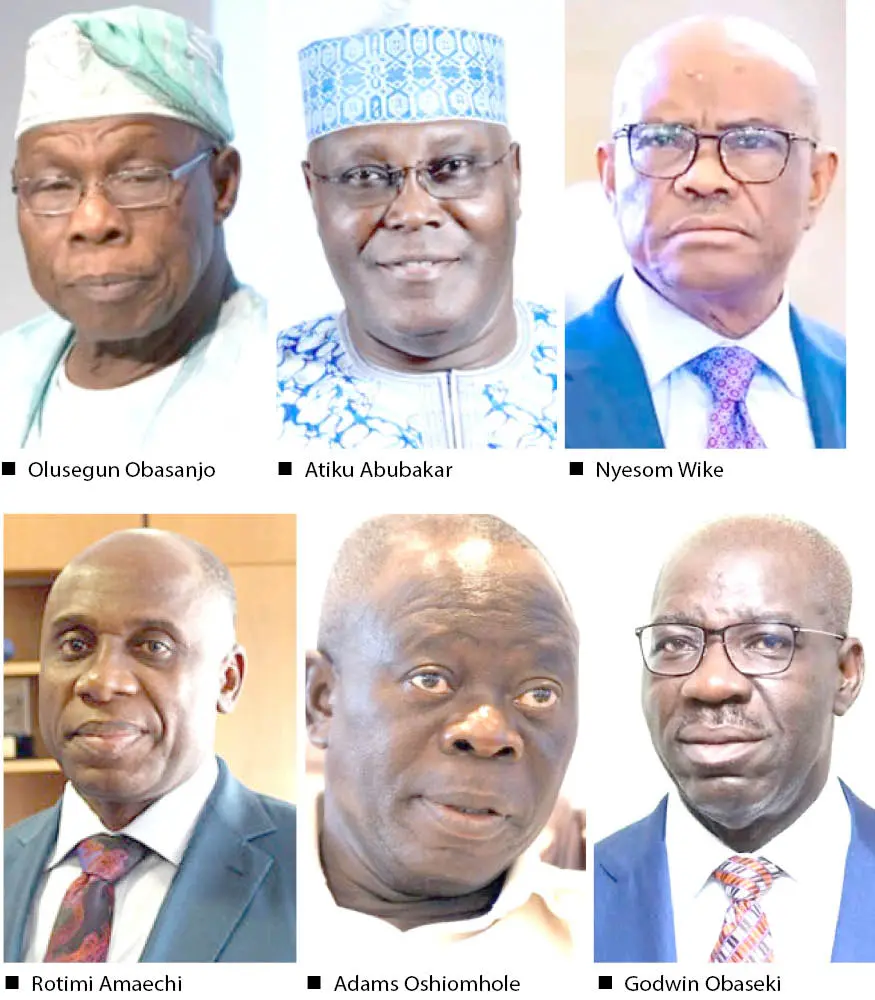
Of intriguing moments that have defined Nigeria’s democracy since its return to civil rule in 1999, rifts between political godfathers and their protégés rank high as power struggles turn strong allies to bitter foes. In most cases, diatribes and violence take the centre stage, heating the polity and disrupting governance.
From the collapse of a cordial ‘boss-subordinate’ relation between former President Olusegun Obasanjo and ex-Vice President Atiku Abubakar to the breakdown of ‘mentor-mentee’ intimacy between the Federal Capital Territory Minister Nyesom Wike and Governor Siminalayi Fubara of Rivers State, raging power tussle has ceaselessly revved up Nigeria’s political space in the past two decades.
Obasanjo/Atiku rift
Obasanjo’s relationship with Atiku purportedly started in the 1990s, before the former head of state was imprisoned, but it became public knowledge after Atiku’s Peoples Democratic Movement (PDM) backed Obasanjo to become the Peoples Democratic Party (PDP) presidential candidate. Following the PDP Jos convention, Obasanjo picked Atiku, the then governor-elect of Adamawa State, as his running mate in the 1999 presidential election. They won on the joint ticket and were reelected in 2003.

As they say in politics, no permanent friends, no permanent enemies but permanent interests. The going between Obasanjo and Atiku was good until 2006, when a clash of interest pitted boss against subordinate. Speculations were rife that Obasanjo wanted a third term in office and was ready to go the whole hog to influence a constitutional amendment to get it. Meanwhile, Atiku was gunning to succeed his boss and vehemently resisted the retired General’s move. Verbal slugfests ensued. At the peak of the fight, Atiku defected to the defunct Action Congress (AC) led by former Governor of Lagos State, Bola Ahmed Tinubu, to pursue his presidential ambition. This prompted Obasanjo to consequently declare the Waziri of Adamawa’s seat vacant.
“It has come to my attention that President Olusegun Obasanjo has declared my office vacant and has also announced the withdrawal of my rights and privileges as the Vice President of Nigeria. The president claimed to have based his unconstitutional action on my emergence as the presidential candidate of the Action Congress [AC],” Atiku wrote in one of the letters to the National Assembly leadership and the ex-Chief Justice of the Federation, Salihu Modibbo Belgore.
Though time appears to have healed open hostility, a cold relationship still lingers. For instance, despite Atiku’s visit to Obasanjo’s Hilltop residence in Abeokuta, Ogun State, in the buildup to the 2023 general elections, the former President did not support his presidential ambition. Rather, he declared that “I am with Peter Obi,” who was contesting under the Labour Party, “till the end.”
Kwankwaso/Ganduje breakup
For eight years, Senator Rabiu Musa Kwankwaso and ex-Governor Abdullahi Ganduje had a great working relationship, first as the Kano State governor and deputy between 1999 and 2003, and again from 2011 to 2015 when Kwankwaso passed the baton to Ganduje, his once beloved mentee. Their harmonious relationship hit a rock when Ganduje asserted his independence barely a year after he succeeded his ‘benefactor.’ Among others, disagreement over the composition of the state and federal cabinets, as well as board appointments, led to the breakup.
The fractured loyalty would degenerate into crises within the All Progressives Congress (APC) and the Kwankwasiyya Movement, designed to reinforce Kwankwaso’s political ideals. In August 2016, policemen sealed the guest house headquarters of the movement and Kwankwaso eventually left the APC for Ganduje. The war of words between the godfather and his erstwhile protégé intensified in the 2019 governorship election in Kano. In what has become one of the most keenly contested and controversial polls in Nigeria’s history, Kwankwaso-backed candidate, Abba Kabiru Yusuf, lost to Ganduje, who was seeking reelection.
The two leaders did not only slug it out in words, but also in actions that created a domino effect. Ganduje, in his second term, dethroned the 14th Emir of Kano, Muhammadu Sanusi II, over alleged insubordination, and replaced him with Aminu Ado Bayero as the 15th Emir. The simmering rivalry between the two political heavyweights grew more intense in the 2023 elections. This time, it was Kwanwaso’s anointed candidate, Yusuf, who triumphed over Ganduje’s favourite, Dr Nasiru Yusuf Gawuna. With Kwankwaso in the background, Governor Yusuf removed the 15th Emir and restored Sanusi.
What is more? The battle between the erstwhile master and his loyal mentee is far from over as the next general elections draw near. And if the rumoured discord brewing between Kwankwaso and Governor Yusuf, who is reportedly set to dump the New Nigeria People’s Party (NNPP) for the APC, turns out to be real, Senator Kwanwaso may be up against two estranged political ‘godsons’ at the 2027 polls.
Rotimi Amaechi vs Nyesom Wike
The rise and fall of the political bond between former Rivers State governors Rotimi Amaechi and Nyesom Wike is another historic power struggle of the Fourth Republic. Once close allies, their relationship later dissolved into a bitter rivalry that has lasted nearly 15 years. Amaechi and Wike bonded in the early 2000s, challenging the old PDP guard under ex-Governor Peter Odili. Wike stood stoutly behind Amaechi to reclaim his mandate at the Supreme Court after the 2007 governorship election.
Amaechi would reward loyalty by appointing Wike as Chief of Staff upon assumption of office in October 2007. The mutual relationship continued in 2011. Wike supported Amaechi’s re-election campaign and after his victory at the polls, he rewarded his loyalist again, nominating him as a minister.
The camaraderie faltered after Wike became Minister of State for Education and began to actively pursue his own governorship ambition, aiming to succeed Amaechi. Amidst the political realignment at the time, Amaechi defected to the APC while Wike stayed back in the PDP to contest the Rivers governorship election. Before long, the estranged allies began to exchange verbal missiles that charged the political climate and heralded violent elections in the state. Wike won the 2015 governorship poll, defeating Amaechi-backed Dakuku Peterside. Their hostility worsened in 2019 when Wike sought a second term in office.
To date, both have not failed to throw jabs in public at any slight opportunity to assert who is superior to the other. Wike claimed, “I made him (Amaechi) governor.” Amaechi, appearing on Arise TV in June 2025, fired back, calling Wike a “child.”
“I’ve said it several times: he was my subordinate. I was once his boss, whether he likes it or not. I hired him. I could have said no. Just because we’ve both held certain positions doesn’t mean we’re equals… Yes, I was a governor. He became a governor. I was a minister. He became a minister. But I was also a Speaker,” he quipped.
Wike/Fubara battle
As his long-standing supremacy battle with Amaechi continues, Wike has also fallen out with his godson, Governor Siminalayi Fubara. Wike-Fubara rift emerged a few months after the March 2023 gubernatorial electoral victory cemented years of a cordial master-mentor relationship. Wike had handpicked Fubara, who served as the accountant-general under his administration, to succeed him. The governor acknowledged the gesture in his inaugural speech, saying, “A billion thanks are insufficient to express my gratitude to my boss and our indomitable leader. My family lacks the words to thank you. The Opobo Kingdom cannot thank you enough. Only God can reward you in commensurate terms.”
The speech was delivered on May 29, 2023. By October of that year, the obeisance had morphed into tumultuous power play. The governor’s cabinet, comprising commissioners and aides, was dominated by Wike’s loyalists reportedly imposed on the administration. The feud exploded on October 29 when pro-Wike lawmakers attempted to impeach Fubara, but the impeachment was truncated after a section of the State House of Assembly Complex went up in flames and was demolished.
President Tinubu intervened, but the mediation was short-lived due to the alleged failure of the governor to honour the agreements reached. The crisis degenerated, climaxing with Tinubu’s declaration of a state of emergency and suspension of the governor, his deputy and the state assembly for six months in the wake of oil infrastructure bombings in the state.
Many thought Wike and Fubara had finally buried the hatchet following their meeting with the President last September and the restoration of the governor and other suspended officials. But in December, shortly after Fubara announced his defection from the PDP to the APC, the cracks resurfaced. Among others, the governor is believed to be seeking reelection, a move Wike said breached their latest agreement. Consequently, pro-Wike lawmakers made a fresh attempt to impeach the governor.
Oshiomhole vs Obaseki
Like several other political godfathers, Adams Oshiomhole gleefully oversaw his succession by Godwin Obaseki as the Edo State governor under the APC, only for their alliance to fracture midway through the latter’s first term administration.
Oshiomhole governed Edo from 2008 to 2016 during which Obaseki served as chairman of the Edo State Economic Team and a key cabinet member. Obaseki earned his boss’ trust, leading to full endorsement of his governorship candidacy in 2016 by Oshiomhole. He won the election convincingly and things went well between him and his ‘benefactor’ in the first two years of the administration.
Ripples surfaced in 2019 as Obaseki pushed independent policies and clashed with Oshiomhole over the APC governorship primary in the state. Obaseki wanted reelection. Oshiomhole, who was then the APC National Chairman, insisted on a replacement of ‘disloyal’ Obaseki.
The rift deteriorated in June 2019 when the Edo State House of Assembly inaugurated nine out of 24 members-elect. The act was widely seen as an attempt to prevent Oshiomhole’s loyalists among the members-elect from taking control of the legislature. The inauguration was rejected by the national leadership of the APC and the affected lawmakers went to court. Barely two weeks later, on July 4, 2019, Obaseki sacked eight commissioners allegedly loyal to Oshiomhole.
As the disagreement climaxed, Oshiomhole was suspended by the APC in Edo State following a vote of no confidence passed by 18 chairmen of the local government area chapters. Efforts to reconcile the warring parties by committees set up at the zonal and national levels of the party failed. Obaseki insisted that Oshiomhole remained suspended, but if “he comes back remorseful and apologetic, we will consider taking him back”.
By December 2019, the Edo House of Assembly had ‘sacked’ 12 out of the 15 lawmakers-elect initially excluded from its inauguration. The matter came to a head in February 2020. Obaseki called for Oshiomhole’s arrest in a petition submitted by his deputy, Philip Shuaibu, to Muhammed Adamu, the then Inspector-General of Police and Yusuf Bichi, ex-Director General, Department of State Services. Oshiomhole was accused of “consistently” breaching the peace of Edo State by ignoring lawful orders of constituted authorities.
Obaseki was disqualified from the APC governorship primary on the grounds of alleged inconsistencies in his academic credentials. He defected to the PDP and was reelected, defeating Oshiomhole-backed APC candidate, Osagie Ize-Iyamu.
Godfatherism in Nigerian politics has evolved over the years as an instrument of power control by politicians who seek to be at the helm by proxy, well after leaving office. When it faces resistance, the fallout is often dire, destabilisng governance and stoking confusion in the polity. (Daily trust)
-

 Politics20 hours ago
Oyo 2027: Makinde moves to name successor
-
Politics20 hours ago
Obidients mobilise for #OccupyINEC protest
-
Politics20 hours ago
Talks intensify as Bauchi gov delays ADC defection
-
Business19 hours ago
Bakare announces full repayment of N4bn Wema Bank loan
-
News20 hours ago
FG hikes 2026 borrowing plan by N11tn
-
News12 hours ago
Fire Service CG’s Massive Convoy Sparks Reactions
-
Metro19 hours ago
PHOTOS: Policemen Murdered By Boko Haram Laid To Rest
-
Politics20 hours ago
No secret deals with factional chair – ADC