News
Coup Plot: Inside the case against General Sadiq

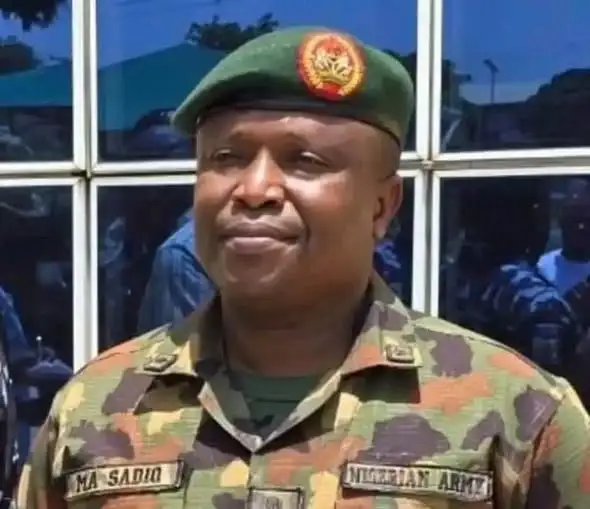
Mr Sadiq was among the 16 military officers arrested and detained for an attempted coup last year in October. The coup plot, according to our sources, contributed to the government’s decision to cancel the 1st October Independence Day parade.
Fourteen of the 16 officers are from the Nigerian Army. The remaining two are from the Navy and the Air Force. Subsequently, more officers and civilians were arrested in connection with the matter.
Military authorities were initially reluctant to admit the coup and claimed that the officers were being investigated for “indiscipline and breach of service regulations.”

Following the coup attempt, the president sacked service chiefs, retaining only Olufemi Oluyede and Emmanuel Undiendeye.
While Mr Oluyede, formerly the Chief of Army Staff, was appointed as Chief of Defence Staff, succeeding Christopher Musa, Mr Undiendeye retained his position as Chief of Defence Intelligence.
However, amid the tension of Christian genocide claims by US President Donald Trump, Mr Musa was called back and appointed as Minister of Defence. He replaced Muhammed Badaru, who said he resigned on health grounds.
In a statement on 26 January, the Defence Headquarters said that an investigation into the allegations of a coup attempt against the suspects has been completed.
It said it found “a number of the officers with allegations of plotting to overthrow the government.”
Their conduct, the military said, is “inconsistent with the ethics, values and professional standards required of members of the Armed Forces of Nigeria.”
“Accordingly, those with cases to answer will be formally arraigned before appropriate military judicial panel to face trial in accordance with the Armed Forces Act and other applicable service regulations,” the military stated.
The case against General Sadiq
Despite being described in some intelligence briefs as a suspected leader of the plot, officials familiar with the investigation insist that the core allegation against him centres on prior knowledge and failure to act, rather than direct involvement.
Military sources who spoke to this newspaper in confidence described Mr Sadiq’s role as that of an “accessory” rather than an active participant.
Our sources said that information available to investigators revealed that Mr Sadiq was “informed” of the coup plot by those directly involved in its planning.
While he is not accused of participating in the execution of the plot, security sources say he failed to report the information to the relevant authorities, choosing instead to keep it to himself.
“This, investigators argue, constitutes a serious breach of military conduct and forms the basis of the case against him,” one source told our reporter.
Who is this general?
Born on 3 January 1974, Mr Sadiq is a serving brigadier general with service number N/10321.
He was trained at the Nigerian Defence Academy (NDA) as a cadet between 14 August 1992 and 20 September 1997 and is a member of Regular Course 44. An indigene of Nasarawa State, he belongs to the infantry corps.
Mr Sadiq rose steadily through the ranks of the Nigerian Army, attaining the rank of colonel in 2015 and becoming a brigadier general four years later.
Over the course of his career, he has held several strategic command positions, including Commander of the 3rd Brigade in Kano and Garrison Commander of the 81 Division of the Nigerian Army in Lagos.
The general’s record
This is not the first time the senior officer has come under scrutiny.
In October 2024, he reportedly made headlines after being detained over allegations of gross misconduct, including the diversion of rice palliatives and the sale of military equipment such as generator sets and operational vehicles to scrap yards.
Those allegations, while separate from the current coup-related investigation, have resurfaced in news pages as part of a broader review of his service record.
Military authorities have not issued a formal public statement on the case’s status, but sources say investigations are ongoing and that due process will be followed. Mr Sadiq is yet to publicly respond to the allegations. (Premium Times)
-

 Sports4 hours ago
Salah To Leave Liverpool After Nine Years
-
Politics21 hours ago
It’s Not Yet Time To Remove Red Cap – Kano Governor Tells Supporters
-
Metro4 hours ago
ECWA Pastor Abducted In Jos
-
Business4 hours ago
No more dollar payments as CBN directs IMTOs to open naira settlement accounts
-
Politics4 hours ago
Parties Move Against Electoral Act
-
Politics4 hours ago
Ordeal: I Can’t Rule Out Political Undertone, Says Malami
-
News21 hours ago
Cleric Who Hosted Me In Kaduna Has Been Arrested, Peter Obi Raises Alarm
-
News21 hours ago
How DSS Operative Shunned El-Rufai’s Wife’s Request At Court Entrance