Business
Dangote now supplies 92% of petrol as FG pauses imports

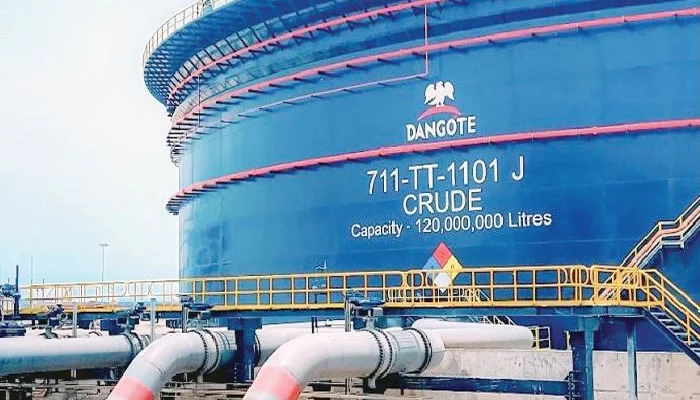
The Dangote Petroleum Refinery accounted for about 92 per cent of Nigeria’s daily petrol supply in February, as the Federal Government has paused the importation of Premium Motor Spirit (petrol).
This came as filling stations on Tuesday retained petrol prices at above N1200 per litre despite a N100 reduction in the gantry price by the Dangote refinery.
Multiple sources at the Nigerian Midstream and Downstream Petroleum Regulatory Authority and among major fuel-importing companies confirmed to The PUNCH on Tuesday that no licences had been issued for fuel imports this year.
According to sources at the NMDPRA, the country does not need to import petrol now, as local refining can meet the country’s daily fuel needs.

“It’s correct that we’ve not issued import licences this year. It is obvious that the local production has met national requirements. So, there’s no need for importation,” an impeccable source at the NMDPRA, who spoke to one of our correspondents in confidence due to the lack of authorisation to speak on the matter, stated.
Figures released in the February 2026 fact sheet by the NMDPRA show that local refineries supplied 36.5 million litres per day of petrol in February 2026, while imports contributed just three million litres per day.
This brought the total national daily supply for February to 39.5 million litres, with domestic refining accounting for roughly 92 per cent of the volume, a sharp shift from the long-standing dependence on imported fuel. The data indicates a drastic drop in imports compared with the previous month.
Currently, the Dangote refinery is the only plant that produces petrol, as other modular refineries basically refine crude for the production of Automotive Gas Oil (diesel).
In January 2026, petrol imports by oil marketing companies and the Nigerian National Petroleum Company Limited averaged 24.8 million litres per day, while domestic refineries supplied 40.1 million litres per day, pushing total daily supply to 64.9 million litres.
The NMDPRA noted that the sharp reduction in imports caused overall supply to decline significantly in February. The regulator’s report stated, “PMS supply in February 2026 reduced by 25.4 million litres per day due to a significant drop in imports.”
The trend signals a major restructuring of Nigeria’s fuel supply chain, with local refining—particularly output from the Dangote facility—beginning to dominate the market.
Earlier data in the fact sheet show that imports historically accounted for a substantial portion of the petrol supply in Nigeria. For instance, in December 2025, imports averaged 42.2 million litres per day, compared with 32.0 million litres per day from domestic refineries, resulting in a total daily supply of 74.2 million litres.
In the early months of 2025, total daily supply hovered between 43.7 million litres in January and 57.1 million litres in May, with domestic refineries contributing a modest 18 to 25 million litres per day, representing about 32 to 47 per cent of the market.
Imports filled the gap, peaking at 38.6 million litres per day in May 2025 as demand pressures mounted. September 2025 recorded the lowest total supply of 39.7 million litres. Dangote supplied 17.6 million litres daily, while 22.1 million litres were imported each day. The NMDPRA said there was a low petrol supply in September, prompting the granting of licences for importation.
However, a recovery began in October with a total of 46 million litres per day, out of which Dangote supplied just 17.1 million litres daily. November 2025 recorded huge petrol imports. Total supply jumped to 71.5 million litres per day, driven largely by a surge in imports to 52.1 million litres per day – the highest import volume in the dataset. The Dangote refinery domestically supplied a paltry 19.5 million litres per day in the 11th month.
Dissatisfied, the President of the Dangote Group, Aliko Dangote, accused the former Chief Executive of the NMDPRA, Farouk Ahmed, of economic sabotage, saying he issued “reckless” licences even while his tanks were full.
By December 2025, the Dangote refinery’s influence became evident: domestic supply doubled to 32 million litres per day, pushing the total to a peak of 74.2 million litres per day, even as imports eased slightly to 42.2 million litres per day.
However, the steady ramp-up of local refining capacity has begun to reverse that trend. The January and February figures showed that the Dangote refinery has overtaken importers to dominate the petrol market, especially under the new leadership of the NMDPRA.
The surge in domestic supply in late 2025 and early 2026 is significantly reducing Nigeria’s reliance on imported petrol. While many stakeholders said the development could reshape the downstream sector by reducing foreign exchange demand for fuel imports and altering the role of traditional fuel importers, some feared that it could promote monopolistic tendencies.
But the Dangote refinery said it had hit its full capacity of 650,000 barrels per day, supplying over 50 million litres of petrol to the domestic market daily.
However, an operator, who sought anonymity due to the sensitive nature of his position, expressed concern over the development, saying Nigerians may be at the receiving end.
“The NMDPRA has not issued any licence for petrol imports this year. Dangote is gradually enjoying a monopoly in the downstream, and we all know that this is not healthy for any sector.
“The price of imported petrol was lower than the locally produced petrol from the refinery, and this was captured by MEMAN in their last report. This tells you that it won’t be right to allow a monopoly in the downstream. It won’t be in the interest of the country.”
Amid the ongoing tension in the Middle East and its attendant fuel price hikes, Dangote assured Nigerians of a sufficient fuel supply.
The February data showed that the country’s average daily supply of petrol dropped to 39.5 million litres per day, down from 64.9 million litres per day in January 2026, due to a lack of imports. The figures indicate a decline of 25.4 million litres per day, representing a 39.1 per cent drop month-on-month.
NMDPRA said oil marketers imported an average of three million litres of petrol per day in February, amounting to 84 million litres for the 28-day period, compared with an average daily supply of 36.5 million litres from domestic refineries, which translated to about 1.022 billion litres within the same period.
A breakdown of the statistics shows that PMS imports plunged from about 24.8 million litres per day in January to just 3.0 million litres per day in February, representing a drop of 21.8 million litres daily or about 87.9 per cent.
N1,200 petrol price
The Dangote refinery on Tuesday slashed its petrol gantry price by N100, from N1,175 to N1,075 per litre, but filling stations refused to slash their pump prices. Despite the N100 reduction, prices have yet to drop at filling stations as of the time of filing this report.
On Tuesday evening, many filling stations still sold petrol between N1,200 and N1,250 per litre in Ogun and Lagos states. Also, petrol prices at several retail outlets in the Federal Capital Territory remained unchanged as of Tuesday evening.
Findings from a price survey conducted by one of our correspondents at filling stations along Airport Road in Abuja showed that many marketers were still dispensing petrol at rates above N1,250 per litre, with some stations selling as high as N1,330 per litre.
At Shafa Filling Station and AA Rano, petrol was dispensed at N1,330 per litre, while Afdin sold the product at N1,310 per litre. Similarly, Shema offered petrol at N1,300 per litre, while NIPCO sold the product at N1,285 per litre.
Other stations such as Bovas and Optima dispensed petrol at N1,270 per litre, although Optima recently reduced its price from N1,330 per litre following the refinery’s gantry price adjustment.
Matrix Energy continued to sell petrol at N1,330 per litre, one of the highest rates recorded during the survey. Dangote’s price reduction followed a slump in the global oil prices as Brent dropped below $90 per barrel, down from over $100 earlier on Monday.
The Dangote refinery has reportedly blamed global crude for the repeated price hikes occasioned by the US-Iran war. Since last week, the Dangote refinery has hiked the petrol gantry price three times, forcing petrol pump prices to jump from around N820 to N1,300 on Monday.
In a statement, the refinery said, “Under the revised pricing structure, the gantry price of PMS has been reduced from N1,175 to N1,075 (N100) per litre, while the coastal price has been lowered from N1,150 to N1,028 (N122) per litre. The price of diesel has also been reduced from N1,620 to N1,430 (N190) per litre.”
The company said the decision was intended to assure Nigerians that the pricing mechanism remains responsive to global market dynamics and indicative of its fair pricing system.
“As responsible corporate citizens operating in a high-governance code and ethical environment, we believe it is imperative to reduce the price of our products as a reflection of the decline in global crude oil prices. All our crudes are priced on the global benchmark price plus a $3 to $6 additional premium.
“Our forex is paid at the prevailing market rate of the day with no subsidy in either crude or forex. For the avoidance of doubt, the crude supplied under the Naira-for-Crude arrangement is priced according to the global benchmark price plus a premium, which is then converted to naira using the prevailing market exchange rate,” it explained.
Amid complaints by Nigerians, the refinery recalled that in 2025, it reduced the gantry price not less than eight times while increasing it only twice.
“This is borne out of a sense of economic patriotism and a duty to the people of Nigeria. We affirm our commitment to setting prices of refined products by passing on the benefits to all Nigerians across the 36 states of the federation and the Federal Capital Territory,” the statement added, noting that the refinery is fully committed to strengthening national energy security while remaining mindful of the economic realities faced by Nigerians.
According to oilprice.com, Brent oil prices witnessed a dramatic reversal on Tuesday, plunging nearly 27 per cent from the previous day’s high of $119 per barrel to as low as $87 per barrel.
Earlier, the Independent Petroleum Marketers Association of Nigeria said the surge was temporary, saying prices would normalise immediately when the war ends. “The price of fuel would come down once Brent crude comes down immediately after the war,” IPMAN spokesman Chinedu Ukadike said.
Reuters reports that oil prices plunged over 13 per cent on Tuesday after soaring to their highest levels since 2022 in the previous session after US President Donald Trump predicted the war with Iran could end soon, lowering expectations of prolonged oil supply disruptions.
Brent futures fell $12.46, or 12.6%, to $86.50 a barrel at noon, while US West Texas Intermediate crude fell $12.24, or 12.9%, to $82.53.
Both crude benchmarks surged to more than $119 a barrel on Monday to their highest since June 2022 as supply cuts by Saudi Arabia and other producers stoked fears of major disruptions to global supplies. This prompted Dangote to hike the petrol price to N1,175.
Oil prices later retreated late on Monday and so far on Tuesday after Trump and Russian President Vladimir Putin reportedly had a call and shared proposals aimed at a quick settlement to the war.
In a statement on Tuesday, the Executive Director of the International Energy Agency, Fatih Birol, said he hosted a meeting of G7 Energy Ministers in Paris. The meeting was chaired by Minister Roland Lescure of France, who holds the G7 presidency.
At the meeting, Birol provided an update on the IEA’s view of the situation in global oil and gas markets, which have been significantly affected by the conflict in the Middle East.
“In oil markets, conditions have deteriorated in recent days. In addition to the challenges of transit through the Strait of Hormuz, a substantial amount of oil production has been curtailed. This is creating significant and growing risks for the market.
“We discussed all the available options, including making IEA emergency oil stocks available to the market. IEA member countries currently hold over 1.2 billion barrels of public emergency oil stocks, with a further 600 million barrels of industry stocks held under government obligation,” he stated.
Given the conditions in oil markets, he said, IEA members are in close contact about the situation with energy ministers from key energy producers and consumers around the world. (Punch)











-

 Politics12 hours ago
CAN petitions Sanwo-Olu over alleged marginalisation of Christians in Surulere politics
-
African News12 hours ago
‘Maintain low profile’ — FG issues advisory to Nigerians in South Africa after protests over ‘Igbo king coronation’
-
Politics12 hours ago
Ex-Kano Deputy Gov Gawuna Resigns From APC, ‘To Meet Kwankwaso’
-
News12 hours ago
Military gets N2.3tn special funding amid security crisis
-
Politics12 hours ago
HURIWA asks DSS to arrest Igboho over threats
-
News12 hours ago
Tinubu Appoints New CAC Chairman, Fills Vacant Positions At Population Commission
-
Politics12 hours ago
Kwankwaso: Our Database Experienced Surge Within 24 Hours – ADC
-
News12 hours ago
3 Killed, Houses Set Ablaze As Bandits Raid Zamfara Community