News
IGP C’mttee Recommends Transfer Of 60% Personnel To State Police

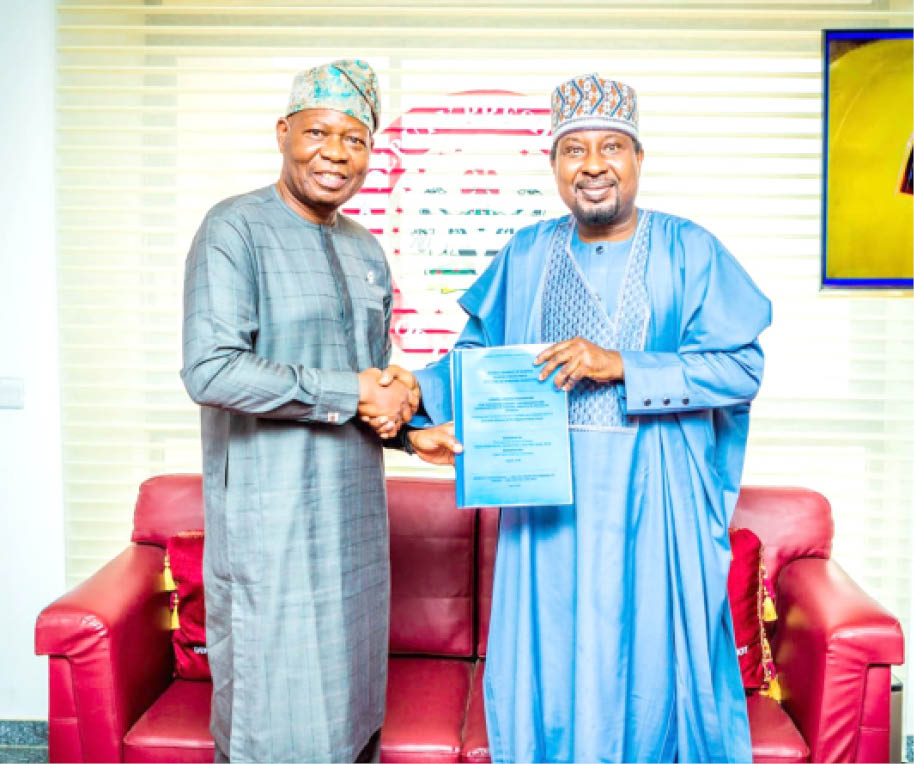
The committee on the framework for the establishment of state police set up by the Inspector-General of Police, Tunji Disu, has recommended the deployment of at least 60 per cent of the Nigerian Police officers to the state police services.
But security experts express mixed reactions over the recommendation and other proposals in the report.
Nigeria, with an estimated 200 million population, currently has a police strength of about 370,000 officers, representing one officer to 600 citizens – a far cry from the United Nations-recommended ratio of one police officer to 450 citizens. This implies that about 222,000 police officers will be moved to the state police if the committee’s recommendation is adopted.
The seven-man steering committee set up by the Force had, on Thursday, submitted its report to the senate committee on the review of the 1999 Constitution, chaired by Deputy Senate President Barau Jibrin.

The chairman of the committee, Professor Olu Ogunsakin, who submitted the 75-page document titled “A comprehensive framework for the establishment, governance and coordination of federal and state police,” on behalf of the Inspector-General of Police, Tunji Disu, said it contains professional insights and recommendations from the police on the proposed creation of state police.
Police sources privy to the content of the framework told Daily Trust that some of the key recommendations in the report include a two-tier policing architecture, which proposes the creation of a Federal Police Service (FPS) and 37 State Police Services (SPS) across the states of the federation and the Federal Capital Territory.
The FPS, which will replace the Nigeria Police Force subject to constitutional amendment, will focus on national security, terrorism, interstate crime and federal law enforcement, while the SPS handles local criminal offences, domestic violence, homicide, armed robbery and community policing “as their primary mandate.”
Notably, the framework proposed that the FPS will retain about 40 per cent of officers for national roles, while the remaining 60 per cent will be redeployed to state police services.
“There will be a Voluntary Transfer Programme (VTP) which allows federal police officers to transfer to their home-state or preferred State Police Service. Officers can opt to transfer to their home-state or preferred State Police Service. The committee recommended a three-month salary Transfer Facilitation Grant, a transition training programme, and a guaranteed Pension Continuity certificate,” a source said.
The committee also recommended the establishment of a National Police Standards Board (NPSB), an independent 13-member federal board that will set the minimum national standards covering recruitment, training, conduct, accountability and funding across all police services. The board will also monitor and enforce the standards and publish annual compliance ratings for every state service.
“The report places community policing at the philosophical and operational heart of the state police model, recognising that the erosion of trust between Nigerian communities and the police is not merely a reputational problem but a fundamental operational liability. Every State Police Service must maintain a dedicated Department of Community Policing, with Community Policing Forums established at every Local Government Area — comprising police officers, traditional leaders, women’s groups, youth organisations, and religious leaders. Community Liaison Officers will be assigned to specific communities, expected to speak local languages, and evaluated partly on community forum ratings,” another source said.
A brief of the document cited by our correspondent noted that the establishment of state police requires amendments to Section 214 of the 1999 Constitution and the Second Schedule to allow SPS co-exist with the FPS and move the former from the Exclusive List to the Concurrent Legislative List.
“A new Section 214A would constitutionally establish a National Police Standards Board,” the report added.
Addressing the widespread concern that state police could be weaponised by governors, the report recommended constitutional prohibitions on partisan deployment, constitution of independent State Police Service Commissions insulated from executive interference, criminal sanctions for officials who issue unlawful orders, and a Federal High Court fast-track review of politically-motivated deployments.
“Oversight is deliberately layered to prevent capture by any single political interest, encompassing: State Police Service Commissions (independent appointment and discipline), State Police Ombudsmen (independent complaints handling), NPSB inspections, State House of Assembly standing committees, mandatory Body-Worn Cameras with secure cloud storage, and public performance dashboards showing use-of-force statistics and community satisfaction data,” it stated.
The framework prescribed dedicated funding through a constitutionally-backed State Police Fund (SPF) that will receive a 3% statutory federal allocation from the Federation Account distributed by population, land area, security need and fiscal capacity, as well as a minimum of 15% contribution from each state government’s security budget.
The document further recommended a 60-month phased implementation of the state police, with the first 12 months scheduled for the constitutional and legal foundations.
“Establishment of state services and VTP launches (Months 13–24), initial operations and FPS withdrawal from local policing (Months 25–42), and full consolidation with an independent evaluation and legislative review (Months 43–60),” it added.
Security experts differ on report
A security consultant and former Director of the Department of State Services, Mike Ejiofor, faulted the proposed integration of 60% of the Nigeria Police operatives into the state police, insisting that the latter should have its own newly recruited men to be trained by the federal police.
“They should operate independently instead of sharing 60%. Besides, some officers posted to the state police will not like it. What I can partly agree with is if the Nigeria Police will share 60% of its workforce to their states of origin, but they should be operating independently of the federal police,” he said.
The security expert also punctured the exemption of state police from fighting terrorism and banditry, saying with the level of current insecurity across the country, “they can check banditry and every crime.”
“But when it comes to prosecution, if they arrest bandits or terrorists, the suspects should be handed over to the federal police for prosecution. They can prosecute minor offences such as burglary. However, the federal government is foot-dragging on the issue of state police and there are a lot of bureaucracies and protocols. I expected that by now the state police would have taken off considering the President’s body language,” he added.
On the proposed National Police Standards Board, Ejiofor said it amounts to tying the state police to the apron strings of the federal police. “We are operating federalism, so why does the board have to set standards for them?” He queried.
However, a managing partner at the security, peace and development institute, Nextier SPD, Dr. Ndu Nwokolo, said the NPSB could enhance public confidence on existing concerns around political abuse of the state policing system.
“The board is to further guide against problems that may emerge if you allow the sub-national governments (state governments) to totally be in charge, then if you are using the federal board to solve the issue of lack of scrutiny, political interference, and overbearing attitude of the state chief executive, you may be solving some of the major arguments against the establishment of state police in Nigeria,” he said.
Similarly, a security analyst, Senator Iroegbu, said the impact of the board depends on whether it is advisory or supervisory, noting that it might be a compromise between proponents and critics of state police, “by addressing fears of abuse by governors or regional interests. Clarity on the board’s mandate is, however, key.”
The Managing Director of Beacon Consults, Dr Kabiru Adamu, said the report by the IGP’s committee only represents the police hierarchy’s perspective, noting that while its overarching objective is to meet the presidential directive and modernise law enforcement in Nigeria, it contains critical gaps that could determine whether the system stabilises the country or creates new tiers of instability.
He said, “Furthermore, the framework inadequately addresses the stark fiscal disparities between states. Without a federal equalization fund or structured grants-in-aid, the nation risks creating a two-tiered security reality where wealthy states with highly equipped, professional officers and economically disadvantaged states with underfunded forces become highly susceptible to corruption and inefficiency.
“Operationally, the proposal also struggles with defining clear boundaries and standards, particularly regarding interstate coordination and federal-state relations. The lack of a definitive conflict resolution mechanism for jurisdictional clashes could lead to dangerous physical standoffs between federal and state officers on the ground.
“Additionally, the framework is worryingly vague on the logistics of cross-border crimes and ‘hot pursuits’, potentially allowing criminals to exploit bureaucratic gray zones by simply jumping state lines. Compounding these logistical hurdles is the absence of mandated, unified national standards for training, use-of-force protocols, and a centralized firearms registry.”
He warned that without resolving these architectural flaws, the transition to state policing might simply decentralise the current challenges of the Nigeria Police Force rather than engineering a genuinely safer nation.
N’Assembly will create accountable state police – Senate Leader
Meanwhile, the Senate Leader, Senator Opeyemi Bamidele, says the National Assembly has started working on a decentralised police model that will be anchored on accountability and discourage abuse of the police by the political class.
Bamidele, who doubles as Vice Chairman, Senate Committee on the Review of the 1999 Constitution, added that the parliament “is committed to crafting a framework for a decentralised police model that will serve the interests of all regardless of their status.”
He made these remarks in a statement he issued on Sunday to celebrate the 74th birthday of President Bola Ahmed Tinubu.
Amid security challenges confronting the federation, key stakeholders had pushed for a decentralised police model that would reflect the country’s federal character as a measure to effectively protect lives and property across the federation.
Bamidele commended Tinubu for building synergy with the National Assembly to arrest the spate of insecurity in the country, noting that the President had been looking beyond traditional approaches to address the roots of terrorism and armed attacks.
He said the essence of the state police model “is to devolve policing powers to the sub-national authorities with a view to ensuring effective governance even in the remotest part of our land. This is one request that the National Assembly has been treating with priority.”
The senate leader added that the new police framework under consideration “will incorporate accountability mechanisms that will prevent the abuse of power by the political class; reinforce justice administration; discourage the culture of impunity and set guardrails for the preservation of fundamental human rights.” (Daily trust)
-

 News7 hours ago
Though Challenging, Tinubu’s Reforms Laying Foundation For Progress – Northern Govs
-
Politics7 hours ago
This Is Your Final Year In Office – ADC Tells Tinubu
-
News7 hours ago
Tinubu Donates Salaries To Wounded Soldiers, Families Of Fallen Heroes
-
News7 hours ago
AEDC Increased Tariff Without Consulting Us – Abuja Residents
-
Metro7 hours ago
Suspected Kidnappers Of Police Applicant Arrested In Plateau
-
 Sports7 hours ago
CAF Moves To Restore Confidence With Reforms In Statutes, Officiating
-
Business7 hours ago
Debt, gas challenges spur urgency for N501bn power bond
-
Politics7 hours ago
PDP convention: Wike bloc installs new NWC in Abuja