Politics
Renewed Hope: Slogan, Policy Or Campaign?

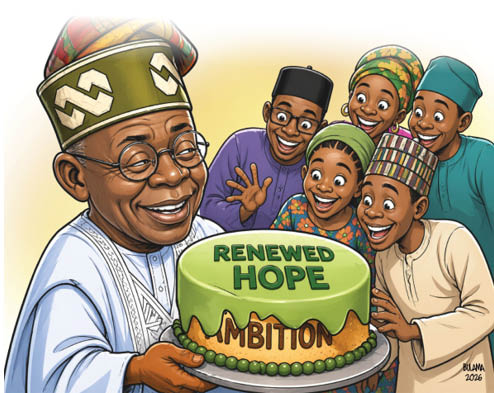
The official campaign slogan for the Bola Tinubu/ Kashim Shettima campaign, in the build up to the 2023 presidential elections, was ‘Renewed Hope.’
Apart from the emilokan statement by the then presidential aspirant to assert that it was his turn to be president of Nigeria, the Renewed Hope became the most popular catch-phrase then.
After Tinubu won the election and assumed office as president on May 29, 2023, the slogan, rather than wane, assumed a life of its own as the wife of the president, Senator Remi Tinubu, labelled her pet project using the theme of the campaign slogan.
As Nigerians were beginning to understand where and when to draw the line between the campaign slogan and the First Lady’s pet project, various initiatives and programmes of the federal government also borrowed from the nomenclature with various projects labelled as Renewed Hope with various sub themes.

Checks by our correspondents revealed that the projects so labelled include those under various government agencies which enjoy funding and are backed by the government.
The obfuscations have led to insinuations that the retention of the slogan could be deliberate to associate projects done by the government as being in line with earlier campaign promises.
Analysts have raised concerns over how the line between the government funded projects and personal interventions have become blurry.
An analyst, who preferred not to be named, said it is important the government makes it clear which ones are being sponsored through the interventions by First Lady and others with the ones that are normal projects covered by the federal government’s budget.
A renowned political scientist, Prof Jibrin Ibrahim, recalled that originally, the Renewed Hope agenda was part of the campaign programme of Tinubu and it was part of what was used in developing the manifesto for his election.
“What happened subsequently was that when they formed government and the First Lady started this project, it was more like a personal project of the First Lady. And what disturbed me was that there was no information on where the money for the project was coming from. Is it government money or is it her personal money? Then as you’ve observed in recent years, it’s become somehow merged with government projects.
“You have projects all over the country that are based on this Renewed Hope. And the problem with what’s going on is that we still don’t have any information on who is funding it. Because the important thing is that you have to separate private projects from public projects,” he stated.
A source familiar with the federal government’s ‘Renewed Hope’ projects said the name is being used because it forms the administration’s flagship project, noting its role in the current political landscape.
“Honestly, this is the administration’s flagship project, and I see nothing wrong with it being used for a campaign. It is the norm for those in power to showcase their achievements through such projects,” the source said.
He said the project was named Renewed Hope because it is the administration’s campaign initiative to reflect all the developmental project of the present administration.
There are also concerns that fully funded government projects are being used to campaign for President Tinubu who is expected to run for a second term.
Investigations by our correspondent have shown that apart from First Lady’s Renewed Hope Initiative, so far, there are the Renewed Hope Agenda; Renewed Hope Ward Development Programme; the Renewed Hope Ambassadors and Renewed Hope Infrastructure Development Fund.
There’s also the Presidential Infrastructure Development Fund (PIDF) which the president said should be absorbed into the new Renewed Hope Infrastructure Development Fund (RHIDF) and the 2026 -2030 Renewed Hope National Development Plan.
The new Renewed Hope Ambassadors is led by Governor Hope Uzodimma of Imo State, while the Minister of Budget and National Economic Planning, Abubakar Atiku Bagudu, handles the Renewed Hope Ward Development Programme which he described as a core part of the Tinubu administration’s drive to build a $1 trillion economy and ensure no Nigerian is left behind by 2030.
He said the Renewed Hope Ward Development initiative involves economic mapping of all 8,809 political wards across the country to identify unique local opportunities for job creation, investment, and community development.
Weekend Trust was informed that the Renewed Hope Projects are a Nigerian federal government housing initiative under the Renewed Hope Agenda, aiming to build 50,000 affordable housing units nationwide through Public-Private Partnerships.
It is planning to build various house types with amenities like schools, clinics, and markets, with projects already underway in states like Abuja, Kano, Oyo, Katsina, Ebonyi, and Lagos and lower/medium-income housing in Abuja, Lagos, Katsina, Yobe; Gombe; Sokoto; Benue and Kano as well as, Abia, Akwa Ibom, Delta, Osun, Oyo, Benue, and Nasarawa.
The projects, our correspondent learnt, are funded by the Federal Ministry of Housing, Federal Mortgage Bank of Nigeria, FMBN, and the private sector.
How far the Renewed Hope Initiative has gone
The Renewed Hope Initiative of the First Lady, Oluremi Tinubu, commenced in 2023, and has according to available information cumulatively mobilised and disbursed over N100bn in the past three years.
The figure, which includes direct disbursements, donations and multi-year pledges, rose from N9.4 billion to N12.9 billion reported in mid-2025.
The donations include pledged interventions and direct cash payouts targeting women, displaced persons, orphans of fallen military heroes, senior citizens and Nigerians in diaspora communities.
Launched shortly after the inauguration of President Bola Tinubu in June 2023, the initiative began with targeted welfare interventions, including N250, 000 grants to 57 flood-affected families in Abuja’s TradeMore Estate, amounting to N14.25m.
In July 2023, it donated N500m to victims of insecurity in Maiduguri and N427.75m to widows and orphans of fallen servicemen, with each of the 1,709 beneficiaries receiving N250,000.
In November 2023, the First Lady launched the “Every Home a Garden” contest, offering a N20m prize to first-time female farmers nationwide to bolster domestic food production.
On August 26, 2023, Mrs Tinubu announced 43 scholarships among others.
The Renewed Hope Cities and Estates Programme
The Renewed Hope Cities and Estates Programme is a flagship initiative of the federal government of Nigeria under President Bola Ahmed Tinubu’s administration, designed to address the nation’s 17-20 million unit housing deficit.
The initiative aims to deliver 100,000 housing units nationwide, with 50,000 units targeted in the first phase. The Renewed Hope Cities is centered on communities with at least 1,000 units each in major urban centres, featuring 1-3 bedroom flats, terraces, and duplexes. This is in addition with Renewed Hope Estates which is a m-sized project of 250-500 units in state capitals for middle-income earners. The third one is the social housing targeted at the most vulnerable, featuring 100 affordable homes in each of Nigeria’s 774 Local Government Areas.
Speaking at the ground breaking of the Renewed Hope Cities and Estates programme in February 2024, the then Minister of Housing and Urban Development, Ahmed Musa Dangiwa, said the funding for these projects will come from a mix of sponsors comprising the Federal Ministry of Housing and Urban Development’s budgetary allocation, the Federal Mortgage Bank of Nigeria (FMBN), and Public Private Partnerships with reputable developers.
The project is the pilot under a Public Private Partnership between the Federal Ministry of Housing and Urban Development and a consortium of developers comprising Continental Civil and General Construction and Ceezali Limited signed in December 2023 to deliver a total of 100,000 houses nationwide.
The Renewed Hope Infrastructure Fund
President Tinubu approved the Renewed Hope Infrastructure Development Fund, aimed at facilitating effective infrastructure development across areas of agriculture, transportation, ports, aviation, energy, healthcare, and education in Nigeria.
This was disclosed by Ajuri Ngelale, the former Special Adviser to the President Media and Publicity in a statement then.
The Fund, Mr Ngelale said will invest in critical national projects that will, among other things, promote growth; enhance local value-addition, create employment opportunities, and stimulate technological innovation and exports.
He said the Fund will identify appropriate approaches in its investment strategy, such as direct project financing through budgetary allocations and SPVs; co-financing (public-private partnerships) with key institutions, multilateral development institutions, as well as equity investments.
The fund will also cover agricultural infrastructure, food security, ports revitalisation, aviation enhancement, road infrastructure and rail infrastructure.
The president has also approved that the Presidential Infrastructure Development Fund (PIDF) be absorbed into the new Renewed Hope Infrastructure Development Fund (RHIDF).
Also in February this year, the president unveiled the 2026 -2030 Renewed Hope National Development Plan
Speaking at the second edition of the National Economic Council (NEC) Conference, the president said the move signalled a shift from economic recovery to a five-year era of “transformation” under the new Renewed Hope National Development Plan (2026–2030).
He emphasized that while his administration has spent its early years tackling inherited structural imbalances and infrastructure deficits, the focus must now pivot toward inclusive, bottom-up prosperity.
Since then, the Agenda has morphed into what many deem a campaign strategy. As Nigeria prepares for the 2027 general elections, many events have been held under Renewed Hope Ambassadors. While INEC has yet to blow the whistle for commencement of campaigns these events appear to be drumming support by projecting the president ahead of the scheduled period.
Why Renewed Hope Ambassadors is viewed as campaign vehicle
The one that has raised much concern is The Renewed Hope Ambassadors (RHA) which involves mainly state governors on the platform of the All Progressives Congress (APC).
Led by Governor Uzodimma, it says It is specifically to engage with the grassroots, promote and explain President Bola Tinubu’s “Renewed Hope” policy reforms and achievements.
Other governors directly involved in the initiative are: Uba Sani of Kaduna State, who serves as the Deputy Director-General and Gov Inuwa Yahaya of Gombe as Secretary.
When President Tinubu received RHA at the State House, he urged them to continue sensitizing and mobilizing citizens, especially at the grassroots, on the government’s efforts to improve their livelihoods through economic reforms.
“You represent the conscience of a nation that wants to break the shackles of poverty and hopelessness. This is a lifetime opportunity to break the shackles of poverty and ignorance,’’ the president told the ambassadors.
The governors claimed activities have begun at the regional level, saying all the structures of all the local governments have been inaugurated, as in the electoral wards.
“We have kick–started the process of enumeration up to the polling unit level. We are continuously harvesting data during enrolment, taking the messages to the markets, schools and professional groups, women platforms and faith-based and grassroots political structures.”
According to Governor Uba Sani, “We have all it takes to take the message of renewed hope to every ward, local government and state. We have not done enough. I believe we have to do more. We have to continue telling our story. If we don’t tell our story, other people will tell the story their own way.”
What is of concern to many, however, is how the funds that would be used for the project would be sourced since state governors are the drivers of that initiative.
A concerned citizen, who does not want to be named, said: “If a governor uses his state resources to either mobilise or travel round to sell the president, i don’t think it is fair to other political parties who are contesting in the same elections.
“Moreover, are these expenditures reflected in the budget of the states involved?” he asked.
Efforts to get the reaction of the Presidency on the development was not successful as Bayo Onanuga, Special Adviser to the President on Information and Strategy could not be reached and Daniel Bwala, the Special Adviser to the President on Policy Communications did not respond to calls.
Also, the Senior Special Assistant to the President (Media), Tunde Rahman who is also director of communications on the Renewed Hope Ambassadors did not respond to calls to his line.
Also messages sent to them were yet to be replied to as at the time of filing this report.
An Associate Professor of Public Administration at Bayero University Kano, Dr. Saidu Ahmad Dukawa, criticised the Renewed Hope Initiative, describing it as partisan, raising concerns over its implications for Nigeria’s democracy.
He said, “Certainly, it is a form of indirect political campaign, which adds to the inappropriateness we are talking about since other political parties do not have equal opportunity to start campaigning.
Prof Jibrin Ibrahim, who spoke with our correspondent, said there has never been such a huge budget project.
He recalled a former first Lady who had a pet project but said “even for those pet projects, for example, there was what was then called the Women’s Hospital. But for the Women’s Hospital, she raised money publicly, she organised a function and essentially state governors came and donated amounts to the project.
“So, everybody knew where the money was coming from. And at the end, after the coup, the project was taken as a public project because most of the money came from state government budgets.”
He added: “But now we have no indication at all where the money is coming from. And there’s absolutely no transparency, as I’ve said before.”
He advised that opposition parties and civil society should make demands about where the money is coming from and also question the way in which it appears to be used.
“You cannot use resources whose sources are unknown to be doing what looks like campaign programming. I think that’s totally unacceptable. So I think people should look closely at what’s going on and raise issues.
“And are there any accountability mechanisms to reassure Nigerians that everything is being done according to the constitution and according to law,” he queried.
Some analysts compare all the Renewed Hope drive with the Transformation Ambassadors of Nigeria (TAN) which operated during the President Goodluck Jonathan administration as a prominent advocacy group to champion the re-election of Jonathan in the 2015 election.
The group held zonal events nationwide, claiming to gather over 17 million signatures to encourage Jonathan’s 2015 bid, citing his achievements in agriculture, infrastructure, and aviation.
Then, there were questions over who was bank-rolling the TAN as most of Jonathan’s men denied having any links with the group. (Daily trust)
-

 Politics14 hours ago
‘Weapon fashioned against APC’ — outrage as youth leader gifts 2026 Prados to party officials, then deletes post
-
News14 hours ago
Ebola: NCDC to pay contacts N100,000 weekly
-
Politics14 hours ago
We’ll Soon Expose Those Plotting To Scuttle My Guber Ambition – Pantami
-
News14 hours ago
States’ six-month debt servicing bill hits N800bn
-
Politics14 hours ago
We Won’t Allow Repeat Of 2023 Defeat – Lagos APC
-
News14 hours ago
Zamfara Steps Up Ebola Containment Measures After Passenger With 38°C Fever Arrives Airport
-
Metro14 hours ago
Okonjo-Iweala’s mother dies at 96
-
Politics14 hours ago
2027: NDC slams Tinubu, APC over ₦1bn worth of Prado SUVs for youth leaders