Politics
Data show 19 states, not governors’ influence, decide Nigeria’s presidential elections

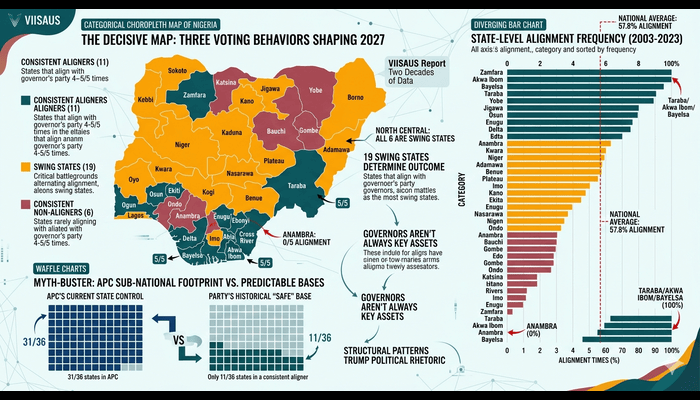
Nineteen states, not the much-discussed power of sitting governors, will ultimately determine the outcome of Nigeria’s 2027 presidential election, according to a new data-driven report analysing two decades of voting patterns.
A report by VIISAUS, a data-driven consulting and research firm, which examined presidential election results from 2003 to 2023, concludes that Nigeria’s electoral map is far more structurally defined than political rhetoric suggests, with a decisive bloc of 19 “swing states” consistently shaping national outcomes.
The study classifies all 36 states into three behavioural categories based on how often they delivered presidential votes in line with their governors’ parties: 11 “consistent aligners,” 19 swing states, and six “consistent non-aligners”
The ruling All Progressives Congress (APC) controls 31 of Nigeria’s 36 states, a commanding subnational footprint widely seen as strengthening President Bola Tinubu’s prospects for reelection in 2027.

While governors are often seen as key electoral assets, the data shows they deliver for their party’s presidential candidate only 57.8 percent of the time on average, masking significant regional variation.

The reliable bloc: 11 consistent aligner states
These are states that have delivered for their governors’ parties in at least four of the last five presidential elections. They form the most stable electoral base:
South South: Akwa Ibom, Bayelsa, Cross River, Delta
South East: Abia, Ebonyi, Enugu
South West: Ogun, Osun
North East: Taraba
North West: Zamfara
Akwa Ibom, Bayelsa and Taraba stand out with perfect five-out-of-five alignment records. The report notes that these states “represent the strongest historical base” for any party heading into 2027.
The battleground: 19 swing states
The largest and most critical category consists of states that have alternated between aligning and not aligning, making them the true deciders of presidential contests:
North Central (all six states): Benue, Kogi, Kwara, Nasarawa, Niger, Plateau
South West: Ekiti, Lagos, Oyo
South South: Rivers
South East: Imo
North East: Adamawa, Borno, Yobe
North West: Jigawa, Kaduna, Kano, Kebbi, Sokoto
According to the report, “every presidential election has been decided” in these states due to their competitive nature and sensitivity to candidates, national mood, and local dynamics.
The resistant bloc: 6 consistent non-aligner states
At the opposite end are states that have rarely followed their governors’ parties in presidential elections: Anambra, Bauchi, Edo, Gombe, Katsina, Ondo
Anambra is the most striking case, recording zero alignment across all five election cycles. The report attributes this to the dominance of a regional party without national presidential viability.
Other states in this group have aligned only once in two decades, with presidential outcomes going against the governor’s party in four out of five elections.
Regional patterns and implications
The data reveals sharp regional contrasts. The South South emerges as the most predictable zone, while the North Central stands out as uniformly competitive, with all its states classified as swing.
The South West presents a mixed but evolving pattern, with Lagos, Oyo and Ekiti firmly in the battleground category, reflecting shifting political alliances over time.
Looking ahead to 2027, the report argues that while eight governors in consistent aligner states are eligible for reelection, traditionally a factor linked with stronger electoral mobilisation, the broader contest will still hinge on the volatile swing states.
“The classification is not a prediction,” the report cautions, pointing to the 2023 election in the South East as evidence that entrenched patterns can shift. However, it maintains that long-term data remains the most reliable guide for political strategy.
The findings challenge conventional assumptions about incumbency power, suggesting instead that Nigeria’s presidential elections are shaped less by governors’ influence and more by deeply rooted, state-level voting behaviour.
As political alignments begin to crystallise ahead of 2027, the report concludes, understanding this electoral map, particularly the decisive swing states, will be critical to any serious campaign strategy.(BusinessDay)
-

 Politics21 hours ago
Presidency denies withholding ₦250bn NLNG dividends from states
-
Politics21 hours ago
2027: APC unveils online portal for support groups
-
News21 hours ago
FG disagrees with World Bank over H1 124% debt servicing/revenue ratio
-
News20 hours ago
5 Security Operatives Killed As B/Haram Attacks Adamawa Communities
-
Metro21 hours ago
Kidnapped Catholic Priest, three others rescued in Benue
-
Politics20 hours ago
Buhari Saw Tinubu As ‘Bad News’, Resisted His Presidency – Baba-Ahmed
-
News20 hours ago
Nnamdi Kanu’s Family Accuses UK Of Failing To Protect Its Citizen, Demands Action To Secure His Freedom
-
News20 hours ago
How Scavengers Stole N3bn Power Line Cables – Zulum