Opinion
N494billion question mark over Dapo Abiodun’s fitness for Ogun East senate

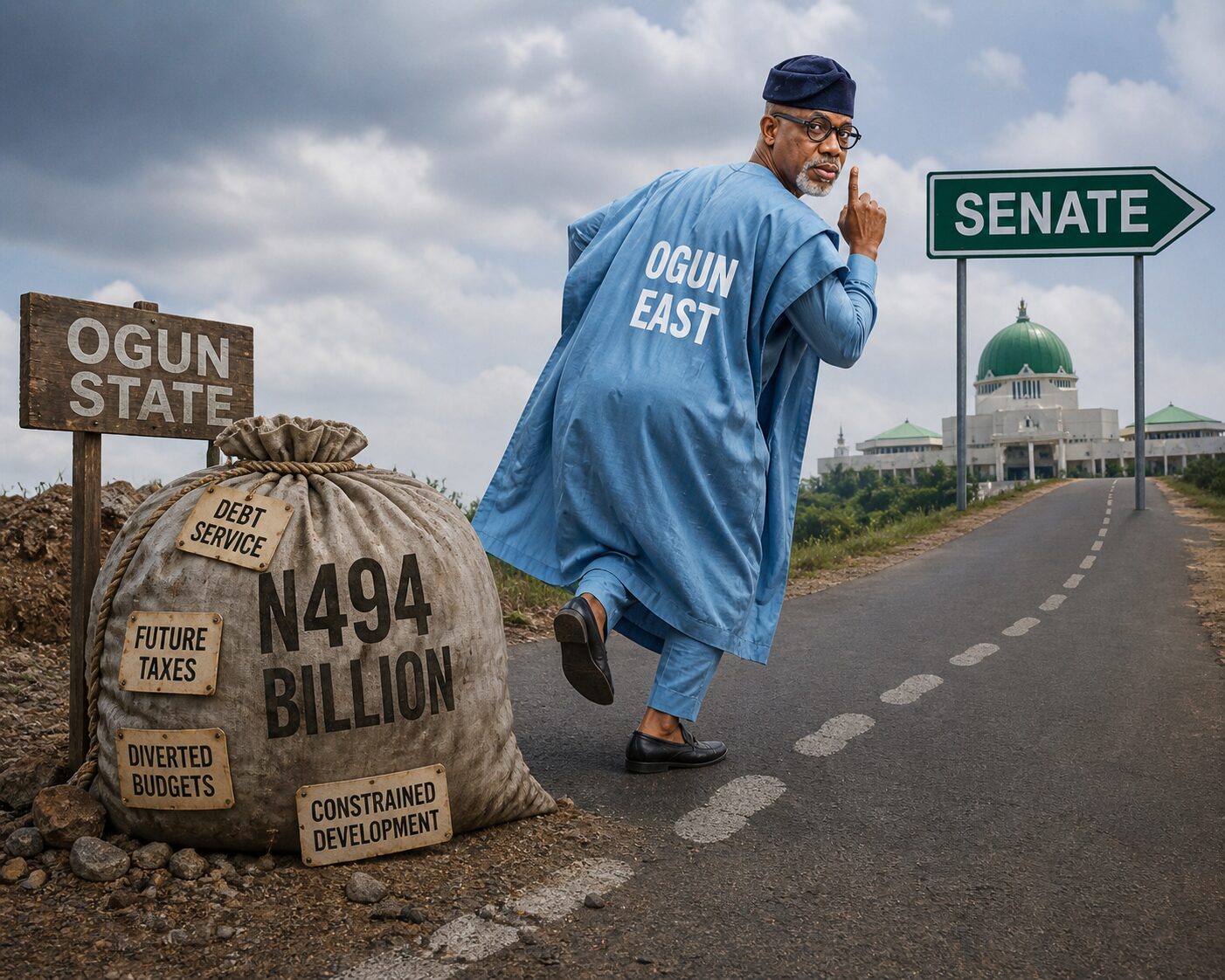
The emerging push by some APC stakeholders in Ogun East to position Dapo Abiodun for a senatorial seat in 2027 raises a serious question that cannot be glossed over by endorsements or party consensus: what exactly is being rewarded?
At the centre of this debate is a fiscal record that is difficult to defend. When Abiodun assumed office in 2019, Ogun State’s debt profile stood at about N166 billion. By December 2025, that figure had risen to roughly N494 billion.
This is not a marginal increase or a technical adjustment. It is a near tripling of public debt within a single administration.
Regardless of explanations around currency devaluation or inherited liabilities, the outcome remains the same: a significantly heavier financial burden placed on the state and its future.

This is not abstract economics. It translates into real consequences for ordinary citizens.
Debt servicing inevitably competes with funding for education, healthcare, infrastructure, and youth development.
It limits the flexibility of future governments and narrows the possibilities available to the next generation. In essence, today’s borrowing becomes tomorrow’s constraint.
The administration has defended its record by pointing to impressive growth in Internally Generated Revenue and a wide spread of infrastructure projects. Roads have been rehabilitated, health centres upgraded, and new developments initiated across various parts of the state, they claimed.
On paper, these are commendable efforts. However, the disconnect lies in scale and visibility.
For a debt profile approaching half a trillion naira, the expected outcome would be transformative, landmark projects that fundamentally alter the economic landscape of the state.
What is seen instead are incremental improvements that do not convincingly justify the magnitude of the financial exposure.
More concerning is the lingering question of transparency.
A government that has taken on such significant financial obligations owes its citizens a clear, detailed, and verifiable account of how those funds were deployed.
General statements about infrastructure and development are not enough. What is required is a project by project breakdown that links each borrowing to measurable outcomes. Without this, the narrative remains incomplete and the credibility gap widens.
Leadership at the senatorial level demands a different kind of responsibility.
A senator is expected to provide oversight, advocate for federal resources, and represent the interests of constituents without the baggage of unresolved governance concerns.
Elevating a governor whose tenure is marked by unanswered fiscal questions risks transferring those concerns from the state level to the national stage.
In contrast, the record of Gbenga Daniel offers a different benchmark for evaluation.
During his tenure as governor, Ogun State’s debt profile remained relatively controlled and aligned with visible development outcomes.
His administration delivered large scale infrastructure, expanded industrial capacity, and strengthened the economic base of the state without creating an overwhelming debt overhang.
Daniel’s era demonstrated a balance between borrowing and tangible value creation.
Projects executed under his leadership were not only visible but also economically strategic, contributing to long term growth and investment attraction.
The debt incurred during that period did not escalate at a rate that threatened fiscal stability, nor did it place an excessive burden on future administrations.
When measured through the lens of debt indexes and value delivery, the contrast becomes clear.
One trajectory shows a steep rise in liabilities with contested outcomes. The other reflects a more measured approach where financial decisions aligned closely with developmental impact.
Ogun East deserves representation that inspires confidence, not concern.
It requires a senator whose record reflects fiscal discipline, transparency, and a proven ability to translate resources into meaningful progress.
On that scale, the argument leans strongly in favour of experience that has already demonstrated balance and accountability.
The decision ahead is not merely political. It is a choice about stewardship, credibility, and the future direction of representation for Ogun East.
A senator’s role is legislative oversight, federal resource advocacy, and constituency service.
Handing Ogun East voters a governor whose signature economic legacy is a N494 billion question mark risks turning the seat into an extension of state-house defensiveness rather than a platform for bold representation.
The people of Ogun East are watching. The N494 billion debt is not just a number; it is a litmus test of stewardship.
Before any coronation as APC’s senatorial candidate, Abiodun owes them; and the next generation, a full, line-by-line reckoning. Without it, the endorsement rings hollow, and the case for his Senate bid collapses under the weight of unsustainable liabilities. Ogun East deserves better than borrowed time.
•Written By Victor Ojelabi
-

 News11 hours ago
UK universities withdraw admission offers to Nigerians over visa crackdown
-
News11 hours ago
Benue: Suspected herdsmen kill nine in fresh Ukum attacks
-
News11 hours ago
Why kidnappers target NYSC members — Security experts
-
Politics11 hours ago
2027: Protest, relief as INEC releases final candidates’ list
-
Politics10 hours ago
2027: Opposition, APC clash over campaign funding
-
World News11 hours ago
US gunman shoots dead 7 relatives, family friend
-
Business11 hours ago
Fitch revises Nigeria’s outlook to positive, affirms ‘B’ rating
-
Opinion11 hours ago
Did Obi actually win in 2023?