Business
Access Bank UK overtakes Nigeria as biggest earnings contributor for first time

…Q1 profit rises by 73.5% as international expansion reshapes group earnings
Access Holdings Plc’s United Kingdom subsidiary has overtaken its Nigerian operations as the group’s single largest earnings contributor for the first time, underscoring how the banking giant’s aggressive international expansion is steadily redrawing the geography of its profits.
BusinessDay analysis of the group’s first-quarter 2026 financial statements shows that Access Bank UK Limited, which was established in 2008, contributed more to group earnings than Nigeria, marking a symbolic turning point for a lender historically anchored by Africa’s most populous nation.

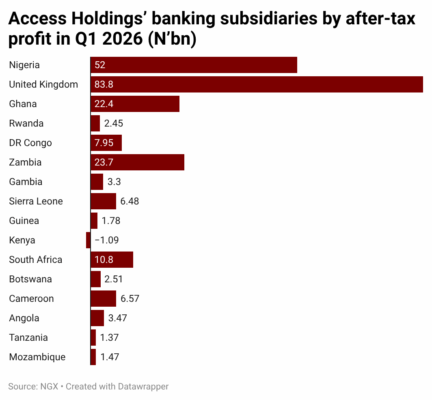
Profit after tax at UK rose by 73.5 percent to N83.8 billion in Q1 from N48.3 billion in the corresponding period of 2025, driven by a surge in operating income to N175.5 billion from N87.4 billion. But profit from the Nigerian business fell to N52 billion from N79.9 billion over the same period.
Overall, the group’s net profit rose to N216.5 billion from N182.8 billion, meaning the UK operation accounted for 38.7 percent of earnings, while Nigeria contributed 24 percent.
The shift reflects a strategy the group has quietly pursued for years: reducing dependence on Nigeria by building a diversified pan-African and international banking franchise.
“If you look at Access’ strategy, it is aimed at reducing the country’s contribution to the group’s overall earnings — not because the Nigerian business is weakening, but because the group wants to grow its other subsidiaries faster so that earnings are more balanced across markets,” said Ayokunle Olubunmi, head of Financial Institutions Ratings at Agusto & Co.
He added that Access UK has evolved beyond a traditional offshore subsidiary into a critical trade-finance hub for the group’s African operations. “Access UK is not just a standalone entity; it operates more like a regional trade hub within the group. Expanding the contribution of subsidiaries outside Nigeria has been part of Access’ long-term strategy to reduce the dominance of the Nigerian business.”
Trade finance boom powers UK growth
The performance highlights the increasing importance of trade finance to Nigerian banks as global lenders retreat from parts of Africa.
Major Nigerian lenders, including Access Bank, First Bank and the Nigerian Export-Import Bank (NEXIM), have expanded aggressively in trade-related businesses, offering payment guarantees, structured finance, foreign exchange solutions and cross-border settlement services to importers and exporters.
According to the African Development Bank Group, trade finance generates nearly 15 percent of total bank income across Africa.
For Access Bank, the opportunity has become even larger as trade flows between the UK and Nigeria continue to surge, helped partly by the naira’s sharp devaluations, which has increased the local-currency value of cross-border transactions and boosted demand for trade finance, foreign exchange and settlement services.
Latest data from the UK government’s Department for Business and Trade showed total trade between both countries climbed to a record £8.1 billion in the four quarters to the end of Q3 2025, representing an 11.4 percent increase and the highest level in a decade.
Nigeria also retained its position as the UK’s largest export destination in Africa. UK exports to Nigeria rose by 14.2 percent to £5.7 billion during the period, while imports from Nigeria increased by 5.1 percent to £2.4 billion, leaving the UK with a trade surplus of £3.4 billion.
Key sectors driving trade include energy, infrastructure, technology and financial services, supported by the UK-Nigeria Enhanced Trade and Investment Partnership.
According to Olubunmi, Access Bank UK has positioned itself at the centre of these flows.
“Access UK has become significant largely because of strong trade inflows as the bank has been very aggressive in trade finance and is involved in transactions across major ports, not only in Nigeria but also in several African countries,” he said.
“If you look at the broader story, the group is trying to fill the gap being left by foreign banks exiting or scaling back operations in parts of Africa. What they are using to drive this expansion is their trade solutions platform, with Access UK playing a central role. So, it is not surprising that the UK operation is becoming this large.”
Nigeria’s dominance fades
The latest earnings reinforce how quickly Nigeria’s dominance within Access Holdings is shrinking.
According to the group’s recent investor presentation, Nigeria accounted for 37 percent of group pre-tax profit in the first nine months of 2025, down from 61 percent in the same period of 2023 — the lowest contribution level in at least three years.
During the same period, earnings from other African subsidiaries rose to 35 percent, while the UK and other international operations contributed 28 percent.
The balance sheet tells a similar story.
Africa’s share of total group assets rose to 21 percent from 12 percent, while international assets climbed to 32 percent from 13 percent. Nigeria’s contribution fell to 47 percent from 75 percent.
The transition reflects a broader shift among the West African nation’s largest lenders, which are increasingly using fresh capital raised under the Central Bank of Nigeria’s recapitalisation programme to pursue regional expansion, diversify income streams and reduce concentration risk.
In March 2024, the CBN raised minimum capital requirements for banks, compelling lenders to shore up capital through equity injections, mergers or licence downgrades. International banks are now required to hold a minimum capital base of N500 billion by March 2026.
Access Holdings became the first bank to meet the new threshold after raising N351 billion in December 2024.
“Expansion outside Nigeria is primarily a diversification strategy,” said Gloria Fadipe, head of research at CSL Stockbrokers. “The Nigerian banking market is deeply regulated, which can limit performance.”
Subsidiaries become new growth engines
Access Holdings’ expanding African footprint is already beginning to reshape its earnings profile.
Among the group’s 16 banking subsidiaries, Gambia posted the highest profit growth in the first quarter, with earnings rising by 192 percent to N1.13 billion. Tanzania and Guinea followed with profit growth of 169.2 percent and 133.6 percent respectively.
Mozambique and South Africa swung from losses to profits of N1.47 billion and N10.8 billion, while Kenya reduced its losses to N1.09 billion from N3.33 billion a year earlier.
Only Nigeria, Ghana and Botswana recorded declines, with profits dropping by 20.3 percent and 32.7 percent respectively.
The performance supports comments made last year by Roosevelt Ogbonna, managing director and chief executive officer of Access Bank Nigeria, who said the group had invested roughly $1.2 billion across subsidiaries.
“We are creating real value and long-term wealth through our subsidiary operations,” Ogbonna told investors in April of last year.
Expansion drive faces regulatory pressure
The rapid international expansion, however, is beginning to attract closer regulatory scrutiny.
Last week, the group disclosed plans to reduce equity stakes in some foreign subsidiaries after the CBN introduced new limits on offshore exposures.
In June of last year, the apex bank directed lenders to suspend fresh foreign investments and capped equity investments in foreign subsidiaries at 10 percent of shareholders’ funds, giving banks a 12-month compliance window.
Ogbonna said Access Holdings’ current exposure stands at 19.4 percent and confirmed the group is considering divestments.
“We are looking at divestments to bring down our equity stake,” he said during an investor call in Lagos. “We will still be the controller of those banking entities, and the value creation will continue to be strong.”
The group is also weighing options on refinancing a $500 million Eurobond due in September, primarily to extend its debt maturity profile rather than address liquidity pressures. A separate decision is also expected on another $500 million perpetual bond maturing in October.
Acquisitions reshape the franchise
Access remains one of the most aggressive acquirers in African banking.
Last year, the lender acquired Standard Chartered Bank’s Gambian subsidiary, while Access Bank UK purchased a 76 percent controlling stake in Mauritius-based AfrAsia Bank. The group also completed the acquisition of National Bank of Kenya from KCB Group.
According to the bank’s Q1 earnings report, the AfrAsia acquisition resulted in provisional goodwill of N16.3 billion ($10.6 million), reflecting fair value adjustments recognised during the transaction.
“The Group intends to finalise the purchase price allocation within the permitted measurement period, which shall not exceed 12 months from the acquisition date,” the report said. (BusinessDay)
-

 News23 hours ago
Loyola College Alumni Launch ₦750m Endowment Fund to Secure School’s Future
-
 News7 hours ago
Cocaine: Bizman KC Luxury’s Cybertruck, hotel, millions frozen
-
Politics6 hours ago
I’ll withdraw as Atiku’s running mate if fuel hits ₦600 tomorrow – Amaechi
-
News6 hours ago
Issues Tinubu Left Out In 66th Independence Day Speech
-
News7 hours ago
NYSC kidnap: N950m ransom throws families into panic
-
Business19 hours ago
NNPC offers N66 fuel discount nationwide
-
Politics19 hours ago
2027: Why I withdrew indigeneship suit against Yayi — Ogun NNPP candidate
-
News6 hours ago
Sanusi, Bayero face arrest threat as Kano tightens enforcement of durbar ban