News
Nigeria’s recovery finds an unexpected growth engine

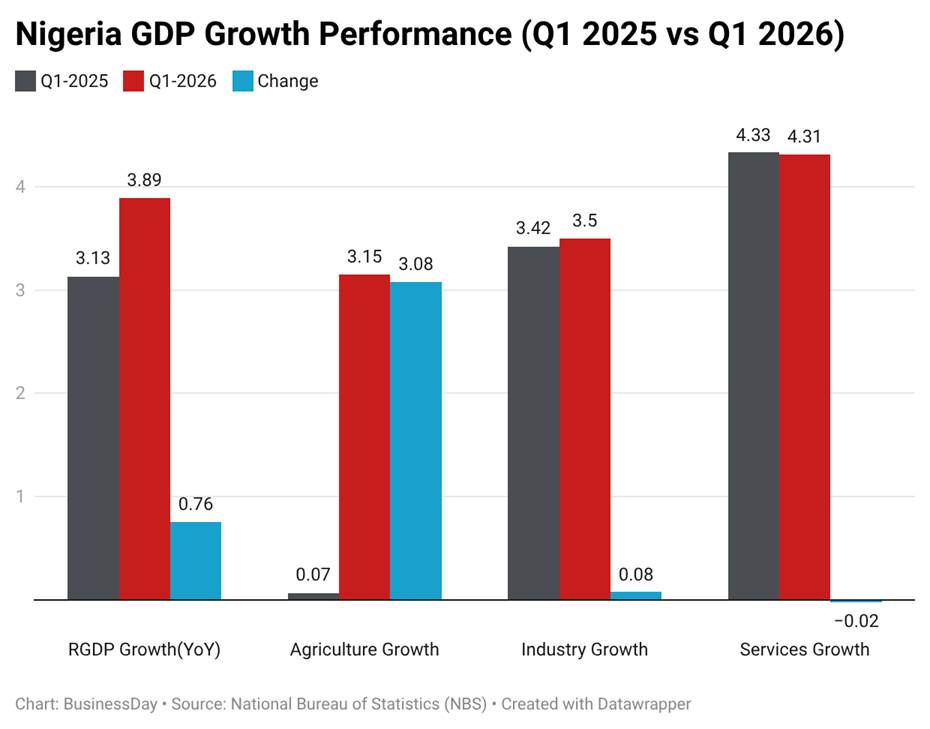
Nigeria’s economy expanded by 3.89 percent in the first quarter of 2026, according to the latest GDP report released by the National Bureau of Statistics on Monday, broadly in line with BusinessDay Economics’ April projection of 4.0 percent, with a marginal deviation of 0.11 percentage points. The outcome reinforces a growing view among economists that Nigeria’s reform programme is beginning to deliver measurable economic gains.
But the most consequential detail in the report was not the headline figure. It was the shift in the underlying drivers of growth.
For much of the past three years, agriculture had been one of the weakest links in Nigeria’s economic performance, constrained by insecurity, rising input costs and persistent disruptions across key farming regions. Historical data in the report show agricultural output expanded by just 0.07 percent in Q1 2025, effectively stagnating in a sector that remains one of the country’s largest employers.
The latest numbers mark a decisive reversal.

Agriculture rebounded to 3.15 percent in Q1 2026, emerging as one of the strongest turnaround stories within the real economy and helping to broaden growth beyond its recent narrow base. But it was not the only driver.
A more balanced growth profile
The recovery was underpinned by a more even performance across major sectors. Industry expanded by 3.50 percent, slightly above the 3.42 percent recorded a year earlier, reflecting modest gains in manufacturing, construction and related activities.
Services, which remains the dominant engine of the economy, grew by 4.31 percent, broadly stable compared to 4.33 percent in Q1 2025, but continued to account for the largest share of output at 57.73 percent, marginally higher than 57.50 percent in the previous year.
Together, these figures point to an economy that is not relying on a single engine of growth. Instead, recovery is increasingly being shaped by a combination of agricultural rebound, steady industrial expansion and sustained services resilience.
Why the agricultural rebound matters
The significance of agriculture’s recovery extends beyond output statistics.
The sector remains deeply embedded in Nigeria’s economic structure, not only as a contributor to GDP but as a primary source of livelihoods. According to World Bank estimates, around 35 percent of Nigeria’s labour force is employed in agriculture, underscoring its outsized role in household income distribution and rural economic stability.
Unlike services or oil, its transmission effects are direct, flowing through food supply, rural incomes, employment and consumption patterns.
When agriculture weakens, the impact is quickly reflected in food inflation and household strain. When it strengthens, it eases supply bottlenecks and supports broader macroeconomic stability.
In that context, the latest data suggest more than a cyclical improvement. They indicate a sector that is beginning to shift from being a drag on growth to a stabilising force within the economy.
Three years after reform shocks, signs of stabilisation
The first-quarter data arrive nearly three years after a series of structural policy shifts that reshaped Nigeria’s economic landscape, including fuel subsidy removal, exchange-rate liberalisation and sustained monetary tightening.
The immediate effects were severe. Inflation accelerated sharply, business costs rose, and household purchasing power came under sustained pressure. At the time, questions intensified over whether the reforms would eventually translate into durable growth.
The latest report does not settle that debate, but it strengthens the case that the adjustment phase is maturing.
GDP growth has now steadily improved from 2.31 percent in Q1 2023 to 2.98 percent in 2024, 3.13 percent in 2025 and 3.89 percent in 2026. The consistency of this trajectory, despite multiple shocks, suggests the economy may be transitioning from stabilisation into an early recovery phase.
Growth is improving, but transformation remains limited
Despite stronger headline performance, the structure of growth remains largely unchanged.
Services continue to dominate the economy, accounting for 57.73 percent of GDP, while industry has yet to show a meaningful structural acceleration. Manufacturing and broader industrial activity remain constrained relative to the scale needed for deep productivity gains.
This matters because sustained income growth is rarely driven by services alone. Industrial expansion typically anchors job creation, strengthens domestic value chains and deepens economic resilience.
The latest data therefore point more to resilience in existing structures than to structural transformation.
Why it matters for investors
For investors, the report offers a more nuanced signal than the headline figure suggests.
The broadening of growth across agriculture, industry and services reduces concerns about excessive concentration in a narrow set of sectors. The agricultural rebound, if sustained, could help ease food inflation pressures and improve real household incomes, with spillover effects into consumption-driven sectors.
Sectors linked to domestic demand, consumer goods, agriculture, logistics and financial services, stand to benefit if current momentum persists.
However, key risks remain. Manufacturing growth is still subdued, financing conditions remain tight, and private sector investment continues to face structural constraints. The durability of recovery will depend on whether reforms translate into productivity gains, infrastructure improvements and improved capital formation.
For foreign investors, the data may reinforce the view that the most disruptive phase of adjustment is gradually easing. For domestic investors, the central question is whether recovery can evolve into sustained expansion.
“What we are seeing is a gradual normalisation of output after major policy adjustments, but the sustainability of this recovery will depend on investment response and inflation dynamics,” said Analyst at STL.
The next phase becomes more difficult
Nigeria’s reform programme is now entering a more complex phase.
The first stage focused on restoring macroeconomic stability. The next will be defined by whether that stability can be converted into inclusive, job-rich growth.
The central question is no longer whether growth has returned, the data suggest it has. The challenge is whether it can translate into employment, rising incomes and improved living standards.
“As long as growth does not translate into jobs and improved living standards, households will remain unconvinced by the reform story,” said Muda Yusuf.
Agriculture’s rebound provides a measure of optimism. But the broader lesson from the Q1 data is that recovery and transformation remain distinct outcomes.
Nigeria has made visible progress on the first. The second remains the defining challenge. For now, the latest GDP report offers one of the clearest signals yet that the economy is gradually emerging from the long shadow of reform adjustment.
The forecast was broadly correct. The surprise was not the growth rate, but the breadth behind it. (BusinessDay)
-

 News16 hours ago
Outcry as fake products flood markets
-
Celebrity Gist16 hours ago
Okoye really sweet, Cardi B says after third sighting
-
News16 hours ago
N33.75bn Cash Transfer Mystery: FG Failed to Prove Millions of Vulnerable Nigerians Received Funds — Auditor-General
-
Business16 hours ago
Airport policies didn’t drive Uber out of Nigeria, says FAAN
-
Metro16 hours ago
Trafficker lures, sells 15 Nasarawa children