Business
Nigeria’s middle class wanted better cars. The naira had other plans

Kekemeke Karatei realised he had saved up more hope than cash after arriving at the car lot to be informed that the N6 million he had been nursing for many months to finally own a 14-year-old used Honda was only sufficient to get him something even older and at a bargain.
In his 30s and closing in on his call to the bar, he knew he needed better mobility options around Lagos if he was to settle down properly. “I kept saving, just in case the heavens bless my pocket, maybe I would get my choice.” His choice was a 2012 Honda Crosstour. “But I eventually settled for a 2008 Toyota Camry Muscle, influenced by the degree of my financial muscles,” he told BusinessDay.
Karatei’s experience is similar to that of several Nigerians whose quest for imported, fairly used cars, also known as Tokunbo, has met the brick wall of never-fulfilled dreams for the aspirational middle-income class.
Car prices in Nigeria’s used vehicle and secondary car market have more than doubled in the last decade, fuelled by a depreciating Naira that has raised purchasing costs and duties paid by importers and resellers amid stagnant income levels.

After the Central Bank of Nigeria (CBN) floated the currency in 2023, collapsing multiple windows into a single market system, the naira went into freefall. That liberalisation, while welcomed by investors and multilateral institutions as a long-overdue correction, unleashed a wave of volatility that stripped the currency of more than half its value.
The triple-digit rates that had held for years phased out as the naira charted a new course with stability as a priority. It currently trades above N1,360 to the dollar in the official market, pushing up costs priced in the American currency.
“A vehicle that cost N8 million two years ago is between N18 and N22 million today for the exact same unit,” Ayodeji Alao, founder of Rehoboth Auto Connect, told BusinessDay. His company sources vehicles from auctions in the United States and ships them on Roll-On and Roll-Off (RORO) vessels to Tin-Can Island in Lagos.
According to the International Trade Administration, the US is the largest supplier of used passenger cars and spare parts to Nigeria’s used car market, which is estimated at $1.18 billion by Modor Intelligence, a market intelligence firm.
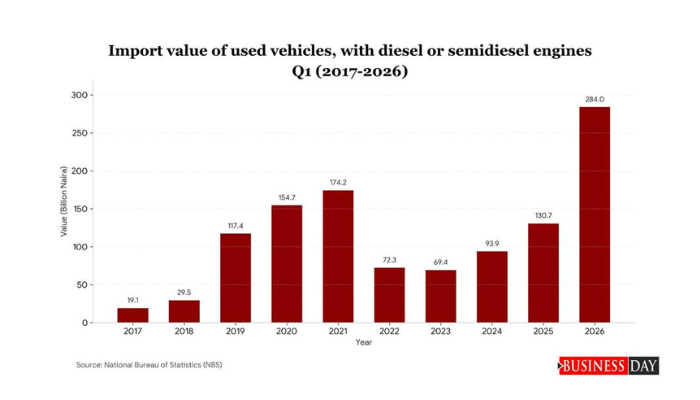
That number is expected to reach $1.27 billion this year. In the first quarter of 2026, the country spent N284 billion on used diesel vehicle imports, according to the National Bureau of Statistics, 118 percent more than in the corresponding quarter of 2025.
“People who bought a 2017 Highlander for N9 million in 2022 have seen better returns than most investment accounts,” Alao said. “Add port delays and customs duties going up year on year, and the supply of clean vehicles has tightened.”
Importers of used cars in Nigeria face a layered tariff structure that begins with a 20 percent Customs import duty on the Cost, Insurance and Freight (CIF) value, followed by a 7 percent surcharge computed on the duty. It is followed by a 15 percent National Automotive Council levy, a 0.5 percent ECOWAS Trade Liberalisation Scheme levy for vehicles sourced within West Africa, and a 7.5 percent Value Added Tax.
Last year, the Nigeria Customs Service unsuccessfully tried to implement a controversial four percent Free on Board (FOB) levy to replace the one percent Comprehensive Import Supervision Scheme (CISS) that would have lengthened the bill.
Babatunde Adekoya, a clearing agent specialising in vehicle trade, told BusinessDay that a 2012 Toyota Corolla or Honda Accord, currently being sold for between N11 million and N16 million in the market, according to findings, would have incurred up to N1.5 million in import duties, 100 percent more than it would have ten years ago. That is, in addition to N2.5 million in clearance fees, he said.
The Japanese brands are in high demand and hold a controlling market share due to consumer perception of their reliability and fuel efficiency.
Oluwaseyi Oduola, an automobile industry expert, reckons that shipping costs are contributing to the squeeze.
Deals for used vehicle shipments are typically made to Nigerian importers on a Free on Board (FOB) basis, which means that once the vehicle is handed over at the port of export, the responsibility of paying for shipping, insurance and the car itself shifts to the Nigerian buyer or their agent.
According to information extracted from logistics firms, including BR Logistics, SGK Global and AES shipping, it costs between $1,200 and $4,500 to ship a car to Nigeria from a port in the United States, depending on the method.
RoRo vessels cost between $1,100 and $2,500. Shared containers, which present the most economical method for transporting accident cars from US auctions, cost between $1,800 and $2,500, while sole-use container shipping costs between $2,500 and $4,500, depending on the container.
Elsewhere in the Middle East, a war that has gone on for over three months now has spurred major shipping lines to pile on emergency conflict and fuel surcharges to compensate for the immense operational costs of vessel shortages, longer sailing distances and oil shocks.
Meanwhile, prices appear to be moving everywhere except in workers’ paychecks. Double-digit inflation persistently burrows into the earnings of a 240 million population where the minimum monthly wage of N70,000 ($51) is barely enforced, forcing many Nigerians to choose between buying food or a car.
“My money is not meant for me alone. I have a wife and a son. I have siblings, too, that I take care of. If you look at what you spend on feeding, rent and some other things, where’s the money for a car?” said Abayomi Karounwi, a young man in his 30s who commutes several hours every week to his job as a security guard in Lekki, one of Lagos’ affluent communities.
His N150,000 ($109) monthly salary has refused to budge. At his current income level, Karounwi said he will need to save “for at least five years” to afford a Tokunbo and three years for a Nigerian-used vehicle. His dream car, he said, is a Mercedes-Benz.
Yet, Karounwi fears that even after meeting his savings target, like Karatei, the price would have risen again. “If I say I want to save from January to December, before the middle of the year, the price will have risen again. I know. I have all these dealers on my TikTok, so I do follow up with them,” he said.
Apart from the sense of pride Karounwi said owning a car will bring him and being able to skip his family the hassle of public transportation to church and other events, he also said he could consider offering ride-hailing services to earn extra cash.
The boom in ride-hailing services like Bolt, Uber, InDrive and LincRide, which provide a steady source of income for thousands of drivers, has created a massive, highly specific demand for a particular tier of imported used vehicles.
BusinessDay found that in most cases, ride-hailing drivers in Nigeria do not buy their Tokunbo cars upfront. Instead, the market is driven by Hire-Purchase agreements where fleet investors buy Tokunbo cars from local dealers and hand them over to drivers. Drivers make fixed weekly payments, often ranging from N60,000 to N100,000 depending on the vehicle condition and year, for two to three years before taking full ownership of the car.
Because investors need to recoup their money quickly without dealing with constant breakdowns, they prefer paying a premium for a clean-title Tokunbo vehicle over buying a cheaper, locally used car.
“What I’ve noticed on the sourcing side is that buyers have gotten much more specific. They’re not just buying any tokunbo. They want a clean title, no accidents, and low mileage. The days of buying anything and selling it are over. Quality vehicles are moving fast,” said Alao.
Yet, the financial pressure has forced some drivers and investors to shift away from traditional Tokunbo cars toward smaller, cheaper alternatives like the Suzuki Alto or specialised mini-vehicles specifically marketed for budget ride-hailing categories.
Though Nigeria still holds its ban on imports of vehicles older than 15 years, companies like Uber still accept cars as old as 26 years, provided it has “no cosmetic damage, a working radio”, and “paperwork.” This has helped fuel an internal demand for Nigerian-used vehicles, which are usually sold by buyers eyeing Tokunbo cars.
The federal government has previously tried to nip this in the bud and build internally. In 2014, it launched the Nigeria Automotive Industry Development Plan (NAIDP), aimed to discourage fully built imports by slamming them with a massive 70 percent tariff while offering zero to five percent duty incentives on Completely Knocked Down (CKD) and Semi-Knocked Down (SKD) kits to encourage local assembly. It attracted leading international carmakers and helped resume small-scale vehicle assembly in Nigeria, but not for long.
Low sales, high production costs, insecurity and inconsistent government policies caused several of them to relocate to other parts of West Africa and set up assembly plants that export vehicles to Nigeria.
Nigeria does have its own indigenous assemblers today, with the likes of Innoson Vehicles Manufacturing (IVM) and Nord Automobiles holding the torch. However, because components like engines, gearboxes, and electronics must still be imported at dollar rates amid naira depreciation, the final cost of a brand-new local car remains millions of Naira out of reach for ordinary citizens.
Without a functional, low-interest vehicle financing system, the majority of Nigerians are priced out of the new car market entirely and must rely heavily on Tokunbo imports for mobility.
The government has struggled with oversight. Unorganised sellers account for approximately 70 percent of Nigeria’s used car market, and many transactions occur without digital traces, according to Modor Intelligence.
Because vehicle registration systems are managed at the state level and are not fully integrated nationwide, it is often difficult to verify a car’s history across different jurisdictions, creating gaps that can be exploited. This fragmentation can enable fraudulent activities such as mileage tampering, concealment of accident history, or the movement of stolen vehicles across state borders to obscure their origin.
While systems like the Police e-CMR database and the FRSC VREG portal have improved traceability by recording ownership and registration details, their effectiveness depends on consistent adoption and integration across all states.
Meanwhile, industry players are pessimistic about a price hike reversal anytime soon. “I don’t see prices reversing unless the exchange rate stabilises significantly or new vehicle prices come down, and neither looks likely in the near term,” Alao said. Oduola thinks the trend will lead to longer vehicle ownership cycles and increased demand for vehicle maintenance and spare parts, further strengthening the secondary automotive market.
Others are optimistic that the imbroglio opens a port of opportunity to greener options. “There has been a huge shift towards full electric cars coming mostly from new markets like China. The statutory charges on the importation of these full electric vehicles range between 10 percent and 15 percent, and this means that car buyers can get newer electric vehicles for the same price as the tokunbo ones,” said Vincent Okeke, co-founder of LegitCar Africa.
“If this trend continues and the government policies remain stable, Nigerian roads will have much newer cars in the next couple of years, effectively phasing out the older vehicles,” he added. (BusinessDay)
-

 News14 hours ago
Court Orders Wike’s Son Jordan to Produce American Passport in $2.1m Abuja Land Suit
-
Politics13 hours ago
Pantami wins PDP repeat governorship primary in Gombe
-
News13 hours ago
NEMA deploys rescue teams as floods ravage states
-
News12 hours ago
After 68 Days Vacation, Lawmakers Embark On Another Recess
-
Metro14 hours ago
Lagos teen detained over slippers freed after four years
-
Politics12 hours ago
2027: Which running mate brings the most votes – Shettima, Amaechi or Kwankwaso?
-
News13 hours ago
Mixed reactions as FG demarcates First Niger Bridge
-
Sports13 hours ago
AFCON Qualifier: Guinea-Bissau Humble Super Eagles 3-0