Opinion
Game Over? Game Theory, Structured History Show Tinubu’s Inevitable 2027 Victory

By
Olabode Opeseitan
The 2027 Presidential Election is no longer about who wins. That conversation is over. Game theory confirms it. Structured history affirms it. The only question that remains, and the one that will define a chapter of Nigerian political history, is not if Tinubu wins, but by what margin.
The Architecture of Dominance
To understand why the outcome is no longer in serious dispute, you have to understand how political power is built and held in Nigeria. It is not built on social media trends, not on crowd sizes at rallies, and not on the moral force of a candidate’s rhetoric, real or contrived. It is built on governors, senators, grassroots structures, elite networks, the institutional weight of incumbency, and increasingly, on the visible record of governance that gives voters a tangible reason to return a sitting President. By every one of those measures, President Bola Tinubu enters the 2027 cycle in the strongest structural position of any Nigerian presidential candidate since the return of democracy in 1999.

The All Progressives Congress now governs 31 of Nigeria’s 36 states. APC holds more than two thirds of the Senate. At the party’s presidential primary, Tinubu pulled nearly 10.9 million votes, a figure that already exceeds the total number of votes he received in the entire 2023 general election. These are not projections or forecasts. They are facts on the ground, documented and verifiable, and they describe a political machine that has not contracted since 2023. It has expanded.
Yet the electorate’s two overriding concerns, cost of living and personal safety, cannot be glossed over.
On the economy, prices remain punishing at the household level. The government has offered no quick fix, but the structural indicators are moving: inflation has slowed and the macroeconomic trajectory is stabilising, Nigeria has posted consecutive trade surpluses in every quarter since Q3 2023, foreign reserves crossed $51.04 billion as of June 2026, the highest since January 2009, and infrastructure investment has reached a scale unseen in a generation. These are lagging indicators; ordinary Nigerians feel the reforms before they benefit from them, and that gap between policy progress and daily experience is precisely where electoral anxiety lives.
On security, the threat has grown more brazen, but so has the state’s response. Joint teams comprising the military, DSS, the Nigeria Police Force and local vigilantes pushed into deep forest enclaves in Kogi State, neutralising the notorious, long-operating bandit kingpin Ibrahim Bastuji in a fierce gun battle that successfully foiled a major planned assault on rural communities. The Federal Government has graduated and deployed over 7,000 Forest Guards drawn from seven frontline states to reclaim Nigeria’s 1,129 forest reserves. To address the devastating cycle of violence fuelled by disputes over land and the mass movement of livestock, Nigeria established the Federal Ministry of Livestock Development, a dedicated ministry designed to modernise pastoral farming, promote peaceful coexistence, and neutralise the banditry and insecurity that armed groups have ruthlessly exploited. A National Home Security Department has been created. And on June 11, 2026, both chambers of the National Assembly passed the constitutional amendment bill establishing state police, ending decades of institutional paralysis on the issue.
The question is not whether these pressures are real. They are, and they are documented above. But two separate questions govern the electoral outcome, and both must be answered honestly. The first is whether a sufficient majority of voters believe the government has demonstrated enough sincerity of purpose to trust that the nation is on a credible path to recovery. The second, and more structurally decisive, is whether those who remain unconvinced carry enough organisational clout to overcome the arithmetic that now governs the 2027 race. On current evidence, the answer to the first question may be contested by some. The answer to the second is crystal clear.
What Game Theory Tells Us
Game theory frames the 2027 election as a multi-player coordination game with asymmetric incumbent power. Tinubu’s dominance strategy is straightforward: hold the APC coalition together, continue absorbing opposition defections, exploit the advantages of state machinery, and allow the opposition to do what it has consistently done, which is fragment.
For the opposition, the game is structurally cruel. Each opposition leader, whether Peter Obi of the NDC or Atiku Abubakar of the ADC, is individually rational to stay in the race. Exiting means surrendering leverage, losing visibility, and handing your voter base to a rival without guarantees. But the collective consequence of both staying in is that they recreate the exact split-vote dynamic that handed Tinubu a plurality win in 2023. In game theory, this is called a coordination failure, and Nigeria’s opposition has now failed to solve it across two consecutive election cycles.
The field is even more fragmented in 2027 than it was in 2023. At least eleven presidential candidates have declared across various platforms, including Omoyele Sowore, Seyi Makinde, and a PDP faction reportedly courting former President Goodluck Jonathan. Every vote drawn to a minor ticket is a vote subtracted from the anti-APC pool. Every additional candidate is, functionally, a gift to the incumbent.
What Structured History Tells Us
The 2023 election is the most instructive baseline. Tinubu won that election with 36.61 percent of the vote, taking 8,794,726 votes and clearing the constitutional 25 percent threshold in 30 of Nigeria’s 36 states. He won not because he was universally beloved, but because the opposition split its votes between Atiku Abubakar, Peter Obi, and Rabiu Kwankwaso, none of whom could individually consolidate enough of the anti-APC electorate to surpass him.
The structural analog that opposition strategists point to is 2015, when the APC itself was a new coalition that successfully aggregated enough forces to defeat an incumbent PDP administration. But 2027 does not resemble 2015. In 2015, the opposition united early, nominated a single candidate, built cross-regional ticket balance, and executed a disciplined campaign. In 2027, the opposition is running on separate platforms, competing for overlapping voter pools, and entering the campaign with unresolved internal disputes and weakened organisational infrastructure.
The Zone-by-Zone Reality
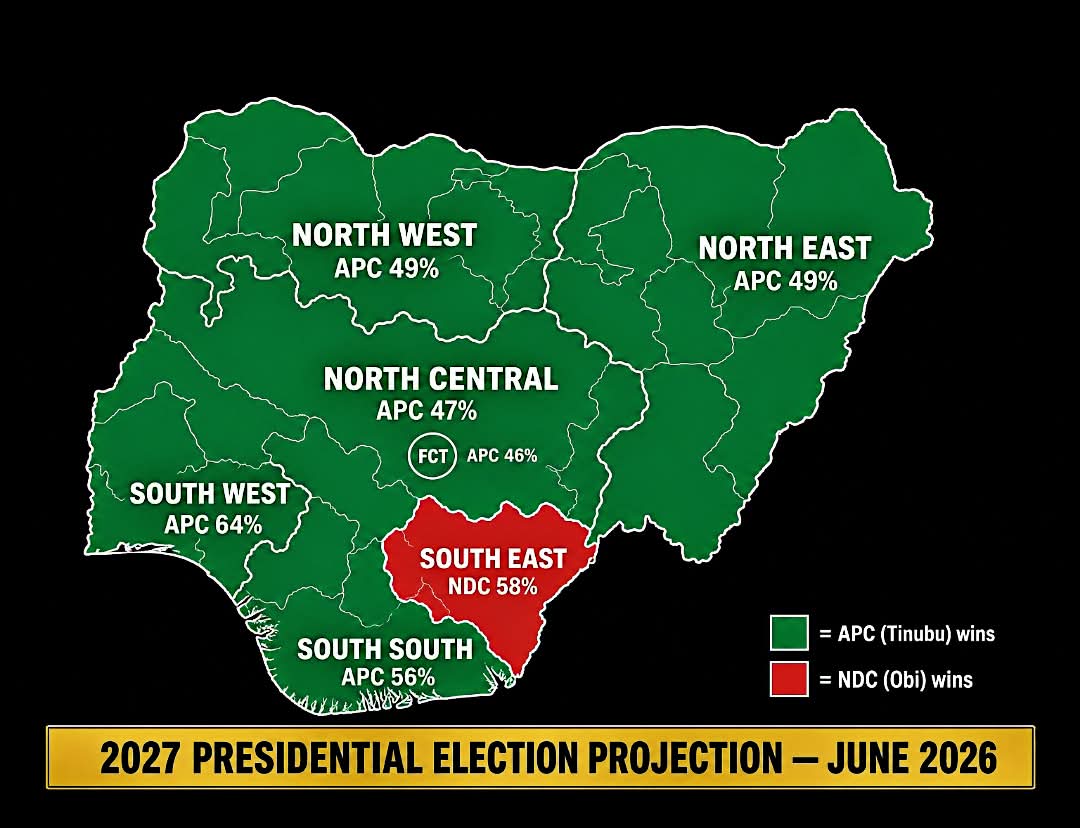
The South West is Tinubu’s home base and requires little elaboration. APC dominated the zone and the brief insurgent overhang from Obi’s 2023 Lagos presidential result did not survive the subsequent governorship cycle. In Osun, where Tinubu lost to Atiku in 2023, Governor Adeleke has since publicly declared his support for Tinubu’s reelection, citing the President’s ancestral roots in the state and the power rotation compact between North and South. Two of Osun’s three federal senators have also joined APC. The presidential race in Osun is resolved; the governorship contest is a separate matter.
The South South has undergone the most dramatic realignment of any region since 2023. All six states in the zone are now under APC-aligned governance. Rivers State, delivered to Tinubu in 2023 by the dominant influence of Nyesom Wike despite his PDP affiliation, remains in the APC column. Edo Governor Monday Okpebholo has committed to a massive mobilisation for Tinubu. In Delta, former Governor Ifeanyi Okowa, who served as Atiku’s running mate in 2023, defected to APC along with the sitting governor, ending 26 years of PDP control in the state. In Akwa Ibom, Senate President Godswill Akpabio and Governor Umo Eno have confirmed that 24 of 26 state assembly members and 30 of 31 local government chairmen are APC. The South South, which the opposition once counted on as competitive territory, is now a zone of APC consolidation.
The North West is the largest vote zone in Nigeria and it too has shifted decisively. Kaduna APC affirmed Tinubu unanimously across all 255 wards. Katsina’s governor declared it a solid APC stronghold at a formal stakeholders’ meeting. Sokoto, once a PDP state, is now APC-governed and delivered a clean sweep for Tinubu at the presidential primary. Kebbi followed the same pattern under Governor Nasir Idris. Kano remains the zone’s most competitive state, where Kwankwaso’s residual base gives the NDC ticket its best northern argument, but Kano’s sitting governor has crossed to APC and former governor Ibrahim Shekarau has rejoined APC, making it a split contest rather than a Kwankwaso stronghold.
The North East breaks down cleanly at the state level. Borno, the home state of Vice President Shettima, is an overwhelming Tinubu state. Gombe and Yobe are firm APC. Taraba’s governor formally joined APC in January 2026. Adamawa remains Atiku’s strongest single state, though it is under threat; the popular Governor Fintiri has decamped to APC and Atiku is projected to win it only narrowly. Bauchi is a genuine split. The net result is that Tinubu leads the zone overall.
The South East remains Peter Obi’s strongest zone and he is projected to win it. But the margin will be meaningfully narrower than in 2023. Two South East governors have joined APC. Governor Charles Soludo has aligned with the progressives movement and is actively campaigning for Tinubu. Former governors from the region have endorsed Tinubu. The City Boy Movement has built active grassroots structures across the zone. Obi still leads the South East, but it is no longer the near-monopoly it was.
In the FCT, a sweeping infrastructure programme covering rural roads, satellite town development, water, schools, and housing has fundamentally redrawn the political calculus. The programme is the product of President Tinubu’s deliberate decision to resource and back Minister Wike with the full weight of presidential support, translating federal commitment into visible physical transformation across areas that were previously neglected. Residents have been explicit: it is that tangible delivery, not political promises, that is driving their realignment. APC won five of the six Area Council seats in the February 2026 elections, reversing the same councils Peter Obi swept in 2023. The opposition’s structural problem compounds this further. In 2027, the anti-APC vote that delivered Obi a three-to-one margin in 2023 is now split between the NDC and ADC tickets, a coordination failure that benefits the incumbent regardless of turnout. APC enters the FCT contest as the marginal frontrunner, with Obi’s NDC retaining a meaningful but diminished presence among the territory’s educated urban electorate.
The North Central presents a mixed but ultimately favourable picture for APC. All six states in the zone are now APC-governed, including Plateau, Niger, Nasarawa, Kogi, Benue and Kwara, giving the party a commanding organisational advantage on the ground. The zone’s historical reputation as a swing region has been substantially eroded by this structural consolidation. Kwara remains firmly in the APC column under Governor AbdulRahman AbdulRazaq. The most competitive terrain within the zone is the Middle Belt corridor, where Peter Obi performed exceptionally well in 2023, sweeping the majority of votes in Plateau and narrowly missing first place in Benue. That performance reflected deep-seated grievances over security and land rights that the Obidient movement channelled effectively. In 2027, however, those same voters face a fragmented opposition and an APC with full gubernatorial control across every state in the zone. Obi retains genuine residual support in both states, but without the organisational infrastructure that governors provide, converting sympathy into votes at scale becomes a structurally harder task.
The Opposition’s Credibility Problem
The structural disadvantage of the opposition is compounded by a credibility problem that goes beyond numbers. Peter Obi, whose Labour Party insurgency produced one of the most emotionally charged campaigns in Nigerian electoral history in 2023, has not converted that energy into durable institutional power.
The Obidient Movement has publicly been forced to reject a rival faction claiming the same name, several key organisers have resigned citing organisational neglect, and independent fact-checkers found multiple inaccurate or overstated claims in Obi’s public presentations. His move to the NDC platform represents a fresh start on paper, but the structural assets that campaigns actually run on, governors, senators, state party machinery and organised finance, are not significantly stronger than what he had before.
There is also a structural footnote to 2023 that deserves scrutiny. A significant portion of Obi’s cross-regional appeal was energised by Christian community apprehension over the same-faith Tinubu/Shettima ticket, a concern that translated into both voter mobilisation and substantial financial backing from faith-based networks. That dynamic has been materially weakened by three years of a Tinubu administration whose appointments and policies have not borne out the fears of marginalisation. The emotional fuel that powered the Obidient movement in the North Central and beyond is running at a lower temperature in 2027. Even at its peak, that movement could only deploy agents in approximately 77,000 of Nigeria’s over 190,000 polling booths. In Nigerian electoral contests, a booth without an agent is a booth effectively conceded. The gap between Obi’s inspirational vote in 2023 and his organisational reach was always wider than his supporters acknowledged. In 2027, with the religious mobilisation factor diminished and the agent infrastructure no more resolved, that gap is harder to close.
Atiku Abubakar brings elite reach and a genuine northern base to the ADC ticket. But the defection of his 2023 running mate’s entire state organisation to APC is a public signal of how the political elite has read the direction of power. And without a single governor in the ADC fold, Atiku is running a national campaign without the state-level infrastructure that Nigerian presidential politics demands.
The Constitutional Path
Nigeria’s electoral law requires a winning candidate to secure both the highest overall popular vote and at least 25 percent of votes in two thirds of all states, meaning 24 of 36 states plus the FCT. In 2023, Tinubu cleared that threshold in 30 states. In 2027, with APC governing 31 states, the constitutional spread requirement is the least of his concerns. The more interesting number is how many states the opposition can hold him below 25 percent in, and that number is shrinking with every defection.
The Margin Is the Message
The final projection, drawing on the zone-by-zone analysis, the structural consolidation data, and the game-theory framework, places Tinubu at approximately 52 percent of the national vote, Obi and Kwankwaso of NDC at approximately 27 percent, Atiku of ADC at approximately 17 percent, and the remaining fragmented field at roughly 4 percent. That implies a margin of victory of approximately 25 percentage points over the second-place finisher.
A 25-point margin in a Nigerian presidential election would be historically significant. It would not just be a win. It would be a mandate of a kind that reshapes the political landscape for a generation, leaves the opposition searching for new ideas, new faces and new structural approaches, and confirms that the 2023 victory was not a fluke of vote-splitting but the beginning of a sustained political realignment.
Game theory told us this story was coming. Structured history confirmed the pattern. The numbers on the ground sealed the argument. The 2027 presidential election is, in every meaningful analytical sense, already over. The campaign that remains is not a competition for the winner’s podium. It is a competition for the margin.
POSTSCRIPT: This analysis is based on verified electoral data, party primary results, governorship alignment records, and coalition intelligence current as of June 2026. The game-theory framework applied here is not abstract speculation; it is a method that has repeatedly illuminated fragmented contests, from Nigeria’s 2023 presidential election to the Brexit referendum and the 2016 United States presidential election.
#nigeria
#RenewedHope
#PeterObi
#Tinubu
#Atiku
-

 World News23 hours ago
I’ll Be Impeached If I Lose The Midterms- Trump
-
News23 hours ago
Even Enemies Will Testify Lagos-Calabar Highway Is Tinubu’s Best Gift — Umahi
-
World News24 hours ago
US set for largest mass visa revocation in history targeting up to 200,000 foreigners, officials say
-
Politics14 hours ago
Why Tinubu Pulled Back Campaign Council List
-
Politics23 hours ago
2027: If ADC Can’t Perform, Don’t Vote For Us – Amaechi Tells Nigerians
-
Politics23 hours ago
“We Won’t Beg Govt Again, They’ll Know Our Stand At Election” – Ekiti Commuters
-
Politics5 hours ago
APC reopens membership registration exercise August 31
-
News23 hours ago
You can’t Impeach someone who resigned – Lawyers blast Edo Assembly