Politics
Our 93m voter register contains names of deceased – INEC

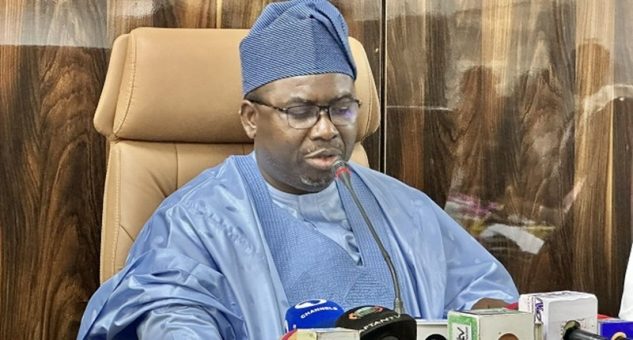
The voter register being used by the Independent National Electoral Commission (INEC) is filled with the names of deceased persons, its Chairman, Prof. Joash Amupitan, said yesterday.
According to INEC records, there are over 93 million names on the register used for the 2023 general election.
Since then, there has been continuous voter registration, including the ongoing exercise, which will end on July 10.
No fewer than three million names may have been added at the close of the registration.

The register was compiled in 2011 and has not been comprehensively reviewed.
Amupitan, who was appointed in November last year, attempted earlier this year to review the register.
However, suspicion over the motive behind the exercise by the opposition forced him to back down.
It is widely believed that since 2011, many Nigerians whose names are on the register have migrated, while many others have died.
“You can cast your mind to some family members whom you know have died and whose names were on the register and who have been counted in terms of the percentage of voter turnout,” Amupitan said yesterday during a visit by the Director-General of the National Orientation Agency (NOA), Mallam Lanre Issa-Onilu, to his office.
He added: “Before 2011, when technology was beginning to play a major role in election processes, what used to happen, when there was no digital capture of voters, was that somebody could write 50 names and just give them to you to register.
“Such names might not belong to existing persons. Those names are still on the register.
“What we can do is engage in claims and objections. But people don’t come out in their various polling units to point out that, ‘Oh, this person has died; this one is no longer in our community.’ This is the type of engagement that we need to push hard.”
He referred to persistent claims of low voter turnout, noting that the numerical integrity of the register cannot be guaranteed unless it is regularly updated.
He solicited the support of the NOA in enlightening Nigerians on their rights and responsibilities.
According to him, the two major elections he planned and supervised – the Federal Capital Territory (FCT) Area Council election and the Ekiti State governorship election – were properly conducted with near-perfect logistics, fairness, efficiency and credible results.
Amupitan added: “As we prepare for the 2027 general election, INEC cannot build a robust democracy in isolation.
“We can purchase the finest Bimodal Voter Accreditation System (BVAS) machines; we can optimise the INEC Result Viewing Portal (IReV) to international standards; and we can map out the most efficient logistical routes for material deployment.
“But all of these technological and administrative triumphs mean nothing if the citizens remain detached, uninformed, cynical or completely uneducated about the power of their votes.
“This is where the National Orientation Agency (NOA) comes in. The NOA is, without a doubt, Nigeria’s premier organisation for civic orientation.
“While INEC is the umpire that sets up the field and manages the game, the NOA is the custodian of the values that make the players and the spectators respect the rules.
“You speak the languages of our people, you understand their local fears, and you know how to navigate the cultural nuances that shape public opinion.
“This is consistent with your duties and powers under Section 3 of the National Orientation Agency Act, 1993.
“Therefore, our partnership with you on voter education is not a secondary option; it is an absolute necessity.”
He added: “We also see a sophisticated, orchestrated wave of fake news and disinformation designed to make the ordinary Nigerian believe that his or her vote will not count.
“Together, INEC and the NOA must rewrite this narrative. We need to co-create a decentralised, grassroots voter education campaign that goes beyond simply telling people when to vote.
“We need to teach them why their vote matters and how our new legal and technological safeguards protect their choices.
“We must look the rural farmer, the market woman and the disillusioned urban youth in the eye and explain to them, in the language they understand, that because of the current technological infrastructure, the era of ballot box snatching and manual rewriting of election results is over.
“We do not have to look far to see practical validation of these upgrades. The February 21 FCT Area Council election and the June 20 off-cycle governorship election in Ekiti State served as critical, real-world stress tests for our systems.
“In both elections, our operational achievements were undeniable: we recorded over 90 per cent early opening of polling units, impressive biometric authentication through the BVAS, and exceptionally swift and transparent uploading of results to the IReV portal. Administratively and technologically, the template is working.”
The NOA Director-General said there had been a reduction in genuine complaints arising from the last three elections.
He stressed the need for enhanced civic engagement to deepen the electoral process.
Issa-Onilu described democracy as the bedrock upon which the country either survives or fails.
The NOA boss added: “If there is anything we cannot toy with, it is the issue of citizens’ civic rights to decide who will be our leaders and who should not.
“It is the right of every citizen, and we all have a responsibility to protect, preserve and promote it.”
He noted that although youth participation in the 2023 general election increased, it was accompanied by challenges, with considerable attention devoted to issues that should never have dominated the electoral process.
-

 Politics17 hours ago
If Buhari, A Retired General Could Not Wipe Out Insecurity, What Do You Expect Of Tinubu? – Yari
-
 Politics17 hours ago
Tinubu Campaign Spokesperson Breaks Silence On Wife’s Fresh Role At INEC
-
Business7 hours ago
FG targets ₦750tn capital market, seeks NNPC, NLNG listing
-
Politics17 hours ago
Stop sending money to relatives at home; tell them to vote for competent leaders – Obi tells Nigerians abroad
-
Business7 hours ago
I’d rather go to prison than lose my phone – Dangote
-
News17 hours ago
FCT Residents Make ‘Tough’ Adjustments Over Rising Cost Of Living
-
Politics17 hours ago
INEC Mum Over Rejection Of Tinubu Spokesperson’s Wife As Head Of Electoral Operations
-
 News7 hours ago
Tinubu Extends Tenures Of Immigration, Prison CGs