News
MATTERS ARISING: How did a ‘non-existent’ agency open a CBN account?

When, in 2018, a sales clerk at the Benue office of the Joint Admissions and Matriculation Board (JAMB) claimed a mysterious snake had swallowed ₦36 million from the agency’s vault, Nigerians thought they had heard the most unbelievable claim.
Eight years later, another story has emerged from the heart of the federal government; one that sounds just as implausible but raises far more unsettling questions.
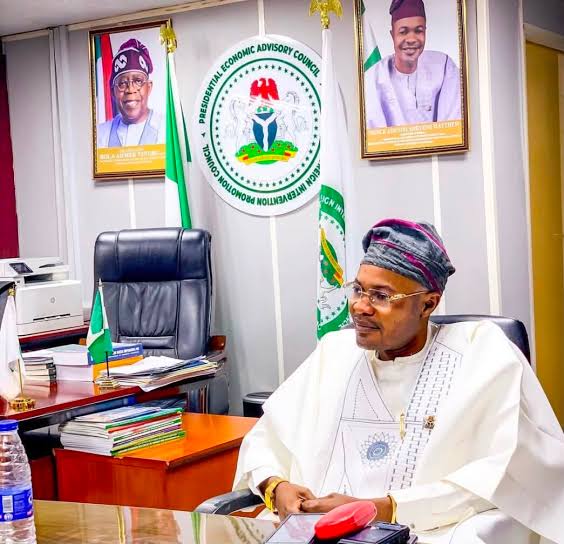
This time, there is no snake. Maybe a ghost — the Presidential Foreign Intervention Promotion Council (PFIPC), a government agency the presidency insists never existed. Yet, the purported agency allegedly had office space inside the federal secretariat, bank accounts with the Central Bank of Nigeria (CBN), a budget running into billions of naira, hundreds of approved staff, meetings with senior public officials, and years of public activity that unfolded largely without challenge.
If the presidency is right, how does a ghost occupy government offices? How does an agency that “does not exist” make its way into a federal budget, and how did it interact with ministers, lawmakers, anti-graft agencies and foreign diplomats before anyone publicly questioned its legitimacy?

The can of worms was eventually opened on June 11 when Femi Gbajabiamila, chief of staff to President Bola Tinubu, issued an unusually worded public disclaimer distancing the presidency from the appointment of Adeniyi Adeyemi as head of the Presidential Foreign Intervention Promotion Council.
Gbajabiamila said no such office exists under the Tinubu administration and that no appointment had been made.
The statement appeared, at first, to be a routine rebuttal. In the days that followed, it opened a trail that now stretches across multiple government institutions, court records, budget documents, security agencies and months of public engagements involving an organisation the presidency now describes as entirely fictitious.
Rather than retreating, Adeyemi stood his ground and publicly challenged the presidency’s account. Speaking at a press conference on Thursday in Abuja, he maintained that the PFIPC had accounts with the CBN, occupied office space within the federal secretariat and had obtained approval from the office of the head of the civil service of the federation to recruit more than 300 personnel.
According to him, the council was created to “serve a simple but powerful purpose: to support the administration of President Bola Tinubu”.
The claims were remarkable on their own, and they became even harder to dismiss after TheCable found that the 2026 appropriation act earmarked ₦1.3 billion for the council.
The mystery deepened further on July 1 when Bayo Onanuga, special adviser to the president on information and strategy, reaffirmed the presidency’s position.
According to him, the chief of staff had alerted the Department of State Services (DSS) and the Nigeria Police Force as far back as October 2025 after complaints emerged that the PFIPC was operating alongside the Nigerian Investment Promotion Commission (NIPC).
Onanuga said forged appointment letters bearing Gbajabiamila’s signature, official seals and reference numbers were used to give legitimacy to the purported agency.
If that account is accurate, another question follows: why did it take almost eight months — and a public disclaimer — for Nigerians to learn that the presidency believed the agency was fake?
THE AGENCY THAT EVERYONE SEEMED TO KNOW

Long before the presidency’s public disclaimer, Adeyemi had built a visible public profile for himself and the PFIPC.
Photographs, press statements and news reports showed him meeting senior government officials, lawmakers, diplomats and heads of federal agencies.
In July 2025, he met Benjamin Kalu, deputy speaker of the house of representatives, where he sought collaboration with the national assembly to advance what he described as the work of PEAC.
“As the Presidential Economic Advisory Council, we serve Mr President with evidence-based research on economic policy and implementation. To achieve this, we need the collaboration of the national assembly,” he said during the meeting.
Two months later, he led a delegation to the headquarters of the Economic and Financial Crimes Commission (EFCC), where he met Ola Olukoyede, the commission’s chairman, to discuss possible collaboration.
The PFIPC, in an Instagram post dated August 9, said Tinubu “graciously approved the waiver to recruit an additional 314 new staff, the establishment of PFIPC offices in all the 36 states of the federation, the rollout of 127 global offices across the world, the visionary support strengthens our resolve to champion Nigerian enterprise and attract foreign direct investments across every border”. The 2026 allocation to the council includes N802,978,783 for personnel costs, N200,000,001 for overhead expenditure and N300,000,000 for capital projects In September 2025, Afolabi Olaoye, Soun of Ogbomoso, led a delegation of traditional rulers from Ogbomoso on a courtesy visit to Adeyemi in Abuja, where the monarch reportedly pledged his support for both the PFIPC and PEAC.
These engagements were reported by several mainstream Nigerian media organisations. None prompted a public warning from the presidency.
According to Onanuga, however, Gbajabiamila had already petitioned the DSS on October 17, 2025, and ten days later, the police arrested Adeyemi.
A criminal case was subsequently filed at the federal high court in Abuja in November 2025. The matter remains before the court and is scheduled to continue in July 2027.
However, the public appearances did not stop. On November 22 — almost a month after the arrest — Adeyemi met Olamijuwonlo Alao-Akala, the lawmaker representing Ogbomoso north/south and Orire federal constituency.
After the meeting, the lawmaker, in a Facebook post, publicly described Adeyemi as director-general of both the PEAC and PFIPC.
The recognition extended beyond courtesy visits and public photographs. A letter dated September 2 that surfaced in the wake of the issue shows that the senate committee on anti-corruption and financial crimes formally corresponded with the PPFIPC, treating it as a government institution. Addressed to the council’s office at phase 3 of the federal secretariat complex in Abuja, the letter invited the PFIPC to nominate senior officials for a high-level study exchange on anti-corruption policy and institutional reform in London, scheduled for September to December 2025. Signed on behalf of the committee, the correspondence described the PFIPC as an “esteemed organisation” and specifically directed the invitation to its director-general, with the attention of the council’s anti-corruption and transparency unit. The invitation is dated after an earlier letter of August 28, 2025, suggesting that the committee had already been in communication with the council before issuing the reminder. The correspondence raises further questions about the extent to which the PFIPC had been accepted across government.
Meanwhile, the PFIPC continued operating active social media accounts, regularly publishing photographs and updates of official engagements without attracting any visible challenge from government authorities.
That raises perhaps the biggest question of all: If the agency was fictitious, who allowed it to keep functioning so publicly?
The chronology presented by the presidency raises another puzzle. If Adeyemi had been identified as early as October 2025 and the PFIPC was already under investigation, how did the council still make its way into the 2026 appropriation act, which was published by the budget office in January and assented to by the president in April? DOES NIGERIA HAVE A PEAC? Nigeria once had a Presidential Economic Advisory Council (PEAC), but it no longer exists. PEAC was an eight-member panel of economists and policy experts established by former President Muhammadu Buhari in September 2019 to replace the Economic Management Team. The council reported directly to the president and was tasked with providing independent advice on economic policy, fiscal management and strategies for national growth. The council functioned until 2022 and is not officially known to exist under the current administration. ADEYEMI, A HISTORY OF QUESTIONABLE CLAIMS The presidency has now labelled Adeyemi an impostor and serial con artist, pointing to what it said were previous false claims about him holding international appointments and affiliations. One of those claims dates back a decade. Between November 2016 and January 2017, several media reports stated that Adeyemi had been appointed the pioneer president-general of the World Youth Organisation (WYO), with the role reportedly based at the United Nations headquarters in Geneva, Switzerland. The reports also described the WYO as the youth arm of the UN and said his appointment followed a World Youth Conference held on November 12, 2016, in New Delhi, India. However, TheCable found no evidence that the UN has an official agency known as the World Youth Organisation. Rather, the UN coordinates youth-related programmes through its youth office and the programme on youth. Online profiles also claim Adeyemi is an alumnus of Ladoke Akintola University of Technology, Ogbomoso, and Western University in Ontario, Canada. In addition, several websites state that he founded the Ambassador Adeniyi Adeyemi Foundation, an organisation said to be dedicated to education, entrepreneurship and social welfare initiatives. However, searches conducted by TheCable found no verifiable online presence or official website for the foundation. TheCable could not independently verify Adeyemi’s educational qualifications or the existence of the foundation. WHAT NEXT? The questions surrounding the PFIPC extend far beyond Adeyemi. If the presidency is right that the agency never existed, then the bigger mystery is how it acquired the trappings of government legitimacy. From reported meetings with senior officials and federal agencies to a budgetary allocation, claims of office space, recruitment approvals and banking arrangements, the episode points to potential failures across multiple institutions. The website of the council has been inaccessible, but its social media accounts on X and Instagram have remained active with posts dating back to October 2025. TheCable could not independently verify if the council signed any official deals or memorandum of understanding, or entered into any agreements or partnerships on behalf of the government. Whether it was an elaborate deception, institutional negligence, or something in between, the affair has exposed glaring gaps in the systems meant to verify authority within government. Until those questions are answered, the real story is not merely about one alleged imposter. (TheCable)
-

 Metro13 hours ago
Child trafficking suspect admits receiving ₦250,000 per child
-
News13 hours ago
Ebola: Uganda seeks Nigerian woman’s travel history from FG
-
Politics13 hours ago
2027: Tinubu campaign council creates new directorate, reshuffles teams
-
News13 hours ago
Abuja bizman arrested over alleged $120m fraud
-
Business13 hours ago
Transport, petrol prices soar in S’East amid fuel discount
-
News23 hours ago
BREAKING: FG confirms Ebola case in FCT, identifies 44 contacts
-
Politics13 hours ago
Ebola case: Atiku urges calm, backs contact tracing
-
Business13 hours ago
Senate Summons Olam Nigeria, MD, Eight Other Executives Over Alleged $15Billion Forex Transactions