Opinion
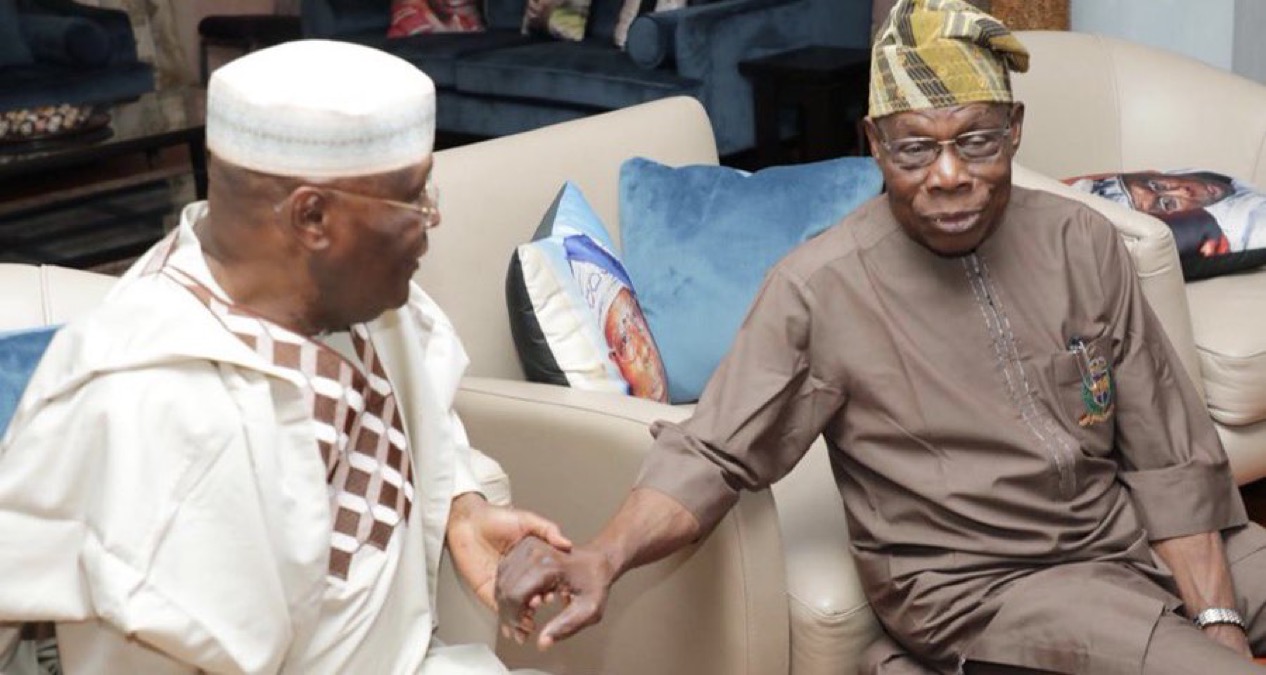
Obasanjo, Atiku and the burden of old political battles

BY OGECHI OKORO
Hypocrisy is an inherent part of human nature and manifests itself in every sphere of life. I have always been uncomfortable with people who repeat the same actions over and over again while expecting different outcomes. The long-running feud between former President Olusegun Obasanjo and his former Vice President, Atiku Abubakar, has become, at best, predictable and uninspiring. With every election cycle, Obasanjo resurrects familiar allegations against Atiku, making the narrative appear increasingly personal rather than factual. It raises the question of whether there is a connection between old age and selective memory.
The truth is that neither of these men is a saint. It is unhealthy for two of Nigeria’s most prominent political figures to continually engage in a cycle of accusations and moral grandstanding. There was a time when Obasanjo openly supported Atiku against Muhammadu Buhari and publicly declared that he had forgiven him. One is therefore left to wonder: what became of that forgiveness?
Obasanjo is undoubtedly a man of remarkable intellect. He also professes Christianity despite his well-known grounding in traditional African beliefs. Yet one question remains unanswered: what debt does Atiku still owe Obasanjo that has not already been paid? Ever since I became politically conscious, the narrative surrounding Obasanjo has remained largely unchanged. He often presents himself as the righteous statesman while portraying almost everyone else as morally compromised.

When Obasanjo returned to power in 1999, many Nigerians, especially progressives, believed corruption would finally be confronted head-on. After the dark years of General Sani Abacha’s regime, many saw Obasanjo as the leader who would usher Nigeria into a new era of democratic reforms. His emergence was widely viewed as part of a national effort to heal the wounds left by the annulment of the June 12 election and the tragic death of Chief M.K.O. Abiola. In many respects, his election was seen as a political concession aimed at national reconciliation. Some even argued that the late Dr Alex Ekwueme was the most qualified candidate to lead the country at the time.
However, shortly after assuming office, Obasanjo became consumed by partisan politics. The expectation that he would lay the foundations for sustainable national development gradually gave way to disappointment. Rather than focusing solely on institution-building, his administration often appeared distracted by personal and political vendettas.
It is perhaps time for Nigerians to move beyond the recurring narrative that Atiku Abubakar is the worst man ever to seek the presidency. Whatever anyone thinks of the Waziri Adamawa, one quality that stands out is his refusal to engage Obasanjo with the same level of personal hostility. Publicly, Atiku has generally refrained from making the relationship as personal as Obasanjo often does.
Looking at Obasanjo today, one sometimes gets the impression of a man carrying deep disappointments. Unfortunately, there also seems to be an attempt to project those disappointments onto others. Whether intentionally or not, that effort has largely failed.
It is also difficult to justify the extent to which a former president should involve himself in every election cycle. This observation should not be mistaken as support for President Bola Ahmed Tinubu. It is no secret that Obasanjo has never hidden his reservations about Tinubu. If circumstances had allowed, many believe he would have preferred someone else to become president.
Obasanjo has undoubtedly made his contributions to Nigeria, and history will ultimately judge his legacy. During his presidency, he enjoyed considerable goodwill from the international community and had a unique opportunity to tackle many of Nigeria’s structural problems. The question many Nigerians still ask is why those opportunities did not produce the transformative change that was widely anticipated. His recent reflections and publications would have been more complete had they also offered a more searching assessment of his own shortcomings in office.
Perhaps it is now time for President Obasanjo to allow the Waziri Adamawa to bear the consequences of his own political choices. Atiku may well be a politician with nine lives. Nigeria has repeatedly demonstrated that its politics can be remarkably unpredictable. Who knows? After President Tinubu completes his constitutional tenure, Atiku may once again find himself in contention. Having realised that contesting for the presidency has become almost a lifelong pursuit for the Waziri, I have simply chosen to let him enjoy his political journey. Whatever one’s opinion of him, Atiku remains, by most accounts, a remarkably cheerful man.
The rivalry between these two political iroko trees has endured for decades. Sadly, it appears destined to outlive their political careers and may ultimately end only when they are both gone. That would be unfortunate, for history should remember them more for their contributions to Nigeria than for a feud that has lingered far too long.
Dr Ogechi Okoro, a political and social commentator based in Hamilton, New Zealand, can be contacted via ogechi.okoro@yahoo.co.uk
-

 Metro20 hours ago
My wife miraculously woke up after six months in coma – Akpabio
-
Politics20 hours ago
Presidential Campaign Council: We don’t need your validation – OK Movement replies NDC
-
Sports20 hours ago
Haaland Makes EPL Record As Manchester City Overcome Sunderland In 8-Goal Thriller
-
News20 hours ago
Former Kogi governor Ibrahim Idris dies at 77
-
Politics20 hours ago
2027: Remo group warns sons against breaking Ogun zoning pact
-
Politics20 hours ago
2027: I’ll Never Spend Holidays Abroad If Elected – Obi
-
News20 hours ago
Niger govt unaware of miners’ arrest before deaths in NSCDC custody — Bago
-
Politics20 hours ago
Tinubu deserves second term, says Mimiko