African News
Xenophobia: Opportunities for locals not improving despite forced exit of ‘illegal’ immigrants from S/Africa

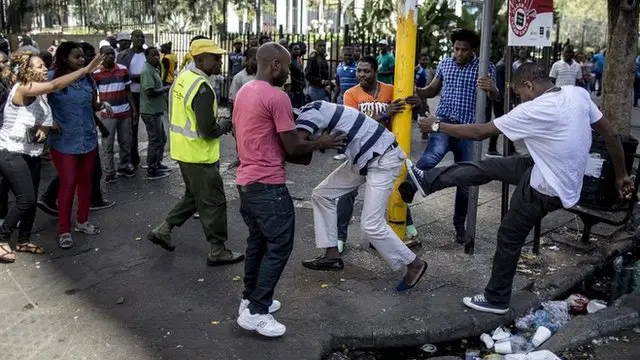
It has been months since over 178,000 African immigrants left South Africa over immigration crackdown and anti-immigration protests, including 1,695 Nigerians and 1,600 Ghanaians evacuated by their respective countries.
Though the South African government claimed that about 53,000 foreign nationals have been deported or repatriated since the launch of its migration management campaign this year, the figure still represents the biggest crackdown ever in the history of the country.
But observers doubt if the exodus of illegal immigrants has offered relief to many who blamed the rising unemployment rate in their country to the undocumented immigrants.
Others are questioning if the crime rate has also reduced as the undocumented immigrants are often blamed for crime in the country.

Sifiso Banzi, a Johannesburg-based lawyer, thinks otherwise.
According to him, unemployment and crime rates are not declining yet because the undocumented immigrants are not really behind them, but a weak structure.
“The undocumented foreigners do not have degree certificates and are not the reason white collar jobs are declining. Now they are gone, the jobs will not surface because it is a function of the economy and misplaced priorities,” he said.
The latest Quarterly Labour Force Survey (QLFS) by Statistics South Africa also confirmed that job opportunities have not increased after the exodus undocumented foreigners, rather they have declined further.
According to the survey, the unemployment rate rose to 33.6% in the second quarter of 2026, from 32.7% in the first quarter, with the number of unemployed people increasing by 345,000 to 8.5 million.
The survey also showed that employment declined by 16,000 over the quarter.
Highlighting the employment decline are recent closures, particularly the shutdown of 85 stores in the past 21 weeks by The Foschini Group, as shoppers move online, amid plans to close 180 stores over the next three financial years.
While that is putting jobs at Foschini, Markham and Sportscene stores at risk, observers decried that there are other businesses that are shutting down quietly, and worsening the unemployment crisis.
Mandla Bongani, a senior banker, in Sandton, decried that the collapse of some businesses is a function of the economy, but the workers often bear the brunt alone, while those responsible to ensure stability in the economy go scot-free.
Bongani, a Zulu, decried further that the undocumented immigrants are not necessarily the reason for the rising unemployment in South Africa, but weak structures, misplaced priorities and policies that have not been very supportive for investments.
“Nobody is pointing at the government, which is using migrants as scapegoats for our socioeconomic challenges.
“The government should leave politics and fix the economy, that is what people should protest about and not send people out of here,” Bongani said.
According to him, the unemployment rate is rising because the government lacks capacity to address it, and it is using immigration crackdown and protests to score cheap political goals, which will worsen unemployment after the elections.
While commending the South African government for making meaningful progress in implementing reforms to support investment and economic growth, the senior banker pointed to the urgent need for further efforts to generate sustained economic growth and meaningful job creation.
Kingsley Ikiteghi, a documented Nigerian, who lives in Cape Town, noted that jobs are not going to be available if all the undocumented and even documented nationals from other African countries leave South Africa, if the government fails to address the root cause of unemployment, which he insisted is the presence of undocumented immigrants.
Unemployment, according to him, is a global issue and countries make efforts to address it by offering a conducive environment for companies and private businesses to thrive because they are the major employers and not the government. “I came here with a degree and went on to do my masters, yet I couldn’t get a job. I created one that has employed 12 people including five South Africans. Job creation is better with businesses and the private sector, but the government needs to offer them an enabling environment to thrive and create more jobs,” he noted.
Observers have also noticed an increase in the number of applications to the Unemployment Insurance Fund (UIF) for benefits by workers who lost their jobs. The South African government introduced the UIF to cushion the impact of job loss of workers whose employers terminated their services.
Chifundo Mthunzi, a Malawian-born lawyer, who practices in Cape Town, confirmed increasing cases of clients seeking UIF benefits, but regretted that some are not qualified, yet are hoping to get benefits due to the huge impact of job loss on them and their families.
“The law requires you to contribute to the fund while you are working,” Mthunzi, whose mother is Xhosa, said.
But many who lost their jobs recently and who did not contribute to the fund, according to him, are insisting on getting benefits, which is impossible.
“Those who resigned, suspended or absconded from work do not get the benefits, but having spent all their savings after months of losing their job and nothing to fall back on, they are now desperate.
“I always advise them to get a job, but they keep asking me where the jobs are or that I should employ them instead.
Truly, the situations are not funny for many unemployed out there,” he decried.
While boosting job opportunities is a function of supportive government policies for businesses to thrive, expand and employ more hands, he thinks that the government and everyone should face the reality, which is urgent needs to support efforts at creating more jobs, rather than shutting down existing ones or blaming others for the rising unemployment.
“China and India both have over one billion people each, yet they allow immigrants.
“You cannot say there are no undocumented immigrants there. They manage them and get them to fit into their systems legally and productively. We should do that here to further grow the economy. We need more jobs here and not protests, which have not provided any jobs,” he insisted.
Preferring solutions to the headline unemployment rate, which remains stubbornly high, particularly youth unemployment, which is 62.8%, up from 60.9% previously, Lara Hodes, an economist with Investec, insisted that education is key.
The Quarterly Labour Force Survey also showed that education increasingly determines employment prospects as South Africans without a matric certificate faced an unemployment rate of 39.2%, while unemployment among graduates stood at just 12.4%.
Those with other tertiary qualifications also recorded unemployment rates well below the national average.
“Access to education remains essential, with the unemployment rate amongst those holding less than a matric certificate at an elevated 39.2%, while unemployment amongst graduates falls sharply to 12.4%,” Hodes said.
According to observers, the ball is now in the court of South Africans to create jobs for themselves as undocumented immigrants have left, many documented one mull leaving too in the face of hostilities.
“You said they should go, they have gone and more are leaving quietly too, including the documented doctors in our hospitals, lecturers in our universities and those supporting our economy genuinely.
“But you are not taking over their jobs and businesses because you lack the competence and drive. You are also not creating jobs too, so why the protests? Bongani asked in his conclusion.” (BusinessDay)
-

 Politics4 hours ago
2027: If Elected, I’ll Crash Petrol Price To N200 Per Litre – Adebayo
-
Metro4 hours ago
Nigerian Woman Declared Missing Found Alive In Qatar
-
Metro4 hours ago
Don’t Pray For Your Wife To Feed You – Pete Edochie Tells Men
-
News4 hours ago
Falana, SERAP demand probe into N33.75bn cash transfer
-
News3 hours ago
Military pay review: Generals’ pensionable salary rises to N2.5m monthly
-
News4 hours ago
15 Katsina villages deserted as bandits step up attacks
-
African News3 hours ago
Ex-Sierra Leone president Koroma leaves Nigeria after treason charges dropped
-
Business16 hours ago
The 30% building tax that’s driving up the cost of housing in Lagos