Business
Dangote taps China to build its shipping fleet

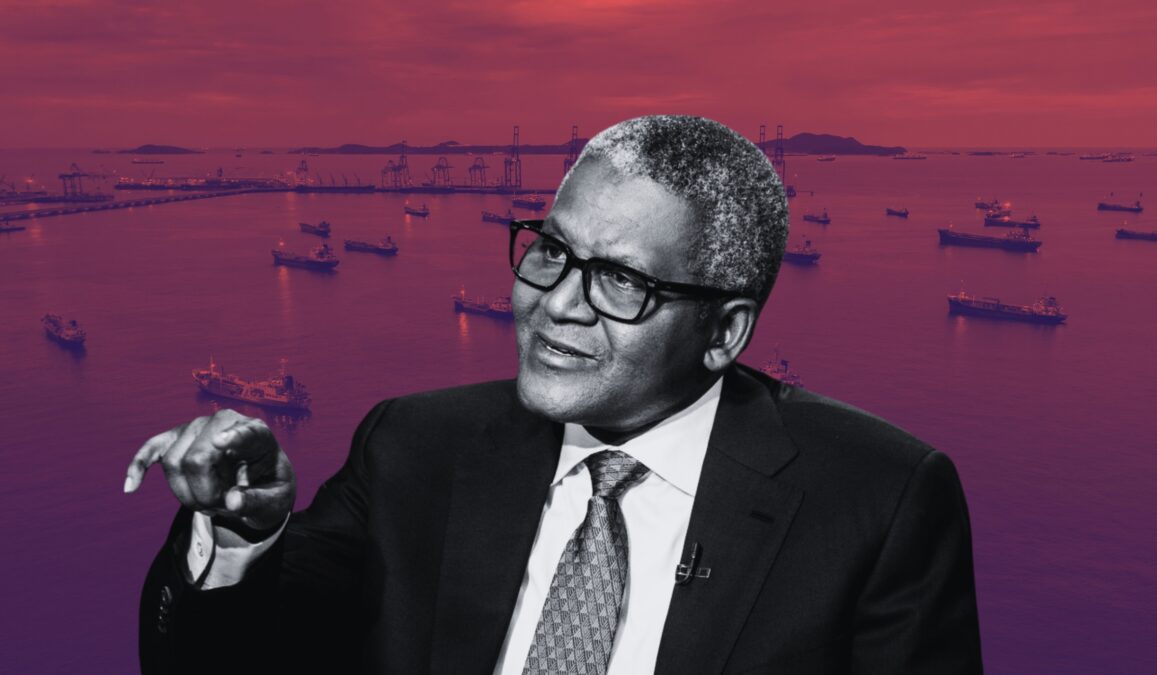
Dangote Group, led by billionaire Aliko Dangote, is turning to Chinese shipyards to build its new shipping fleet from scratch as the conglomerate looks to cut freight costs and keep pace with the growing cargo needs of its refinery and other businesses.
Edwin Devakumar, the group’s vice president for oil, gas and fertiliser, said this during a closed meeting with members of the Nigerian Chamber of Shipping (NCS) and other maritime government agencies in Lagos.
“Currently, we are looking at new vessels. That’s why we want to go to China, negotiate with the shipbuilders, and order the vessels,” he said.
Chinese shipyards accounted for nearly 67 percent of the global orderbook market share in 2025, according to Clarksons Research. The country’s share of the new order volume in tonnage sat at 62 percent. China’s Ministry of Industry and Information puts it even higher, at 69 percent, along with 56 percent of all completed deliveries for the year.

Devakumar said the first batch of orders could arrive as early as 2029. This would be in time for the expansion of the 700,000 barrels per day (bpd) Dangote oil refinery, whose output capacity the group aims to double to 1.4 million bpd in five years and will require roughly 1,800 vessel calls annually to ship its products.
“Currently, the petroleum refinery alone is doing 75 to 100 ships a month. That’s 900 ships a year. Once we finish doubling the capacity, the refinery alone will need 1,800 ships a year. That’s a lot of tanker vessel capacity,” Devakumar said.
The capacity expansion is being funded in part by an initial public offering of Dangote Petroleum Refinery and Petrochemicals, which will open for subscription on September 14 and is expected to raise roughly $1.6 billion.
The group’s other businesses compound that demand. Fertiliser and cement production requires about 45 to 50 vessels a year, and a planned expansion is expected to add another 25 to 40 vessels for sugar and about 50 for salt, the vice president said.
Devakumar did not specify how many of the needed vessels the group plans to acquire during the trip or how much it plans to invest in the business, but stated that it will start small and grow its fleet over time.
“We will start with as few vessels as possible, just to meet our immediate needs to some extent. And so, as such, we have not earmarked,” he said.
Dangote Group’s decision to invest in its own fleet is driven in part by capacity constraints in the indigenous shipping market, with vessel size and turnaround times limiting how efficiently its growing cargo volumes can be moved.
The refinery’s three export Single Point Moorings (SPMs) can handle vessels carrying up to about one million barrels, with the largest able to load or discharge within a day, but only ships of at least 155 metres qualify, Devakumar said. “The smaller the vessel, the more the turnaround time,” he said. “If the vessel is less than 155 meters long, then it cannot be fixed. Actually, there is a lack of capacity at the point.”
Acquiring its own vessels could also make it cheaper to move its refinery’s products to distant markets, the vice president added.
“We can bring our products to any part of the world at a cheaper price,” he said. “It’s not going to be commercially so viable for me to take the polypropylene all the way to Japan. But, if I am investing in the vessels, if I am buying polypropylene, it may be much more commercially competitive to take it and bring it back.”
Devakumar said the operation could initially focus on West Africa before expanding more broadly, creating an opportunity for Nigeria to build a larger indigenous shipping industry.
“As we develop the business, we can expand. We can expand initially into West Africa and then expand all over,” he said.
He called on regulators and private sector players to pool resources to push the industry towards self-sustenance and reduce capital flight.
“Nigeria has the cargo. Nigeria has the coastline. What remains is the collective will from the Nigerian Chamber of Shipping, from the Nigerian Maritime Administration Safety Agency (NIMASA), from government, from industry to ensure the ships, the professionals, the capital and the value created by the trade are as Nigerian as the molecules themselves.”
Private-sector players urged the group to not only plan to service its own cargo needs, but consider building a fleet large enough to seek national carrier status.
“You can launch 100 vessels and apply for national carrier status. I don’t see that you will not get it…Rather than we all waiting, begging the minister, and nothing is happening,” said Olisa Agbakoba, founding president of the NCS.
“You have the capacity. And then everybody will join. It opens the floodgates,” he said.
Since Nigeria’s National Shipping Line collapsed in 1995 after 36 years as a state-owned enterprise, the country has struggled to rebuild its indigenous shipping industry, conceding almost all of the $6 billion in freight earnings generated annually to foreign liners. (BusinessDay)
-

 Business20 hours ago
States generate N112bn taxes from self-employed Nigerians
-
News19 hours ago
NYSC kidnap: Kidnappers slash ransom to N100m as outrage mounts
-
News20 hours ago
Tinubu visits Oba of Lagos, receives prayers, counsels
-
Politics20 hours ago
S’Court ruling: Tension as INEC keeps affected candidates guessing
-
Politics19 hours ago
Defected Zamfara Lawmakers Were Suspended Long Ago For Gross Misconduct- Speaker
-
Opinion19 hours ago
Atiku is right, subsidy removal needs revisiting
-
Politics19 hours ago
2027: 4 INEC national commissioners’ seats vacant
-
Politics19 hours ago
Four visions for Lagos: How Hamzat, Funso Doherty, Rhodes-Vivour, Adedeji Doherty differ on housing, traffic, economy, education