News
Endless repairs, endless anguish on Lagos-Ibadan Expressway

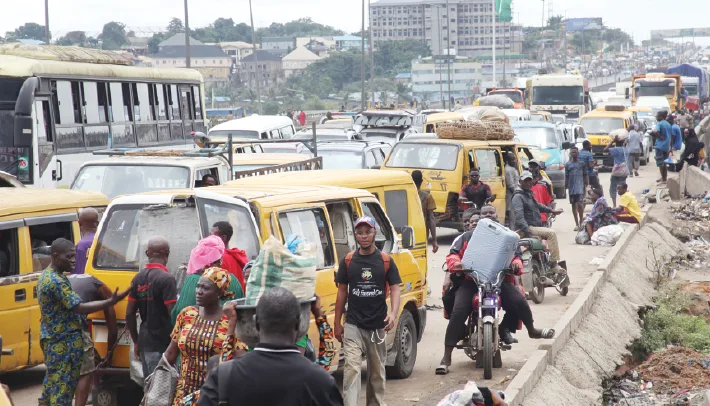
For years, motorists and commuters on the Lagos-Ibadan Expressway have endured repeated repairs and gridlock, with the latest intervention on the Kara Bridge once again bringing the busy highway to a standstill.
The ongoing repair of the damaged expansion joints of the bridge has triggered severe traffic congestion along the Lagos-Ibadan corridor, leaving thousands of travellers stranded for hours and renewing concerns over the recurring maintenance challenges on one of Nigeria’s busiest highways.
In a routine announcement that has become familiar to motorists plying the route, the Federal Ministry of Works, in a statement on September 5, announced plans to begin a two-week repair of damaged expansion joints on Kara Bridge.
This followed an earlier planned commencement in July, which was later suspended amid concerns about traffic management.

Although there have been repeated rehabilitation and repair works on different sections of the expressway over the years, the most gruelling period dates back to the reconstruction of the 127.6-kilometre highway, described as the busiest in Africa. The rehabilitation, which was approved in 2013 by the administration of President Goodluck Jonathan, lasted a decade before its completion.
During this period, the expressway subjected motorists to severe traffic bottlenecks on different sections of the highway almost daily, particularly around the Lagos-Sagamu Interchange.
Motorists would later heave a sigh of relief following the completion of the reconstruction in 2023.
While the road has since become motorable, with travel time now considered relatively moderate as expected, the repeated rehabilitation of bridges along some sections has become a source of concern for many, as it continues to bring back the experiences associated with the earlier reconstruction of the highway.
With every announcement by the Federal Government on bridge rehabilitation comes the anxiety over the traffic gridlocks expected to follow.
Motorists lamented that the interventions have often been followed by renewed hardship and prolonged traffic disruptions. When the work eventually began on Tuesday, September 8, the impact was immediate.
Motorists were stranded for several hours as traffic built up from the Kara Bridge in Ogun State towards Lagos. By the afternoon, the gridlock had stretched beyond the Secretariat Bus Stop, while motorists coming from Ikeja and Agege and trying to access the Otedola underpass were also caught in the congestion. By nightfall, the gridlock had extended about 15 kilometres into Lagos.
The situation brought together personnel from the police, military, Lagos State Traffic Management Authority, Federal Road Safety Corps and Ogun State Traffic Compliance and Enforcement Corps, who worked to control the movement of vehicles and prevent the situation from worsening.
Yet, for many commuters caught in the traffic, the presence of traffic officials did little to ease the pain of sitting for hours on a journey that ordinarily should take a fraction of the time.
While gridlock has been the most visible consequence of the exercise, the disruption has far-reaching economic implications for motorists, commuters, businesses and transport operators.
It’s a period where a commercial driver is delayed for several hours, losing trips and income, as well as a worker who lives in Ogun State but works in Lagos, spending hours in traffic, arriving late at work or returning home long after closing hours.
Similarly, a traveller heading to another state risks missing a scheduled journey, while others may miss important appointments because of the congestion.
Goods are also delayed as a result of the traffic, while fuel is consumed as vehicles remain stationary for hours. As a result of this, transport operators are consequently forced to factor the additional time and expenses into their operations.
Checks revealed that the situation has become increasingly frustrating for many commuters who use the expressway daily, with some now considering longer alternative routes to escape the congestion.
One of them, Timilehin Adio, told our correspondent that he was considering travelling through Ikorodu and Sagamu or using the Lekki-Epe route.
He said, “With the repairs practically putting the stretch of the expressway on lockdown, I now consider going through Sagamu and Ikorodu to Lagos. I can also take the Lekki-Epe route. The traffic is becoming unbearable.”
Another motorist, who identified himself simply as Saheed, said Tuesday’s gridlock left him stranded for several hours before he eventually got home around 2 am.
Saheed, who lives in the Mowe area of Ogun State and works on Lagos Island, told our correspondent on the first day of the repair that he was also considering an alternative route.
He said, “The gridlock was worse yesterday (Tuesday). I got home around 2 am. The traffic was at a standstill. This was because of the high volume of vehicles coming in from Lagos. I may have to consider going through the Lekki-Epe route or Ikorodu axis when returning home.”
It was also gathered that some motorists whose destination extends beyond the bridge spent close to six hours in the gridlock.
This is as those whose offices are located on the Island had considered staying back at their workplaces or seeking temporary accommodation in Lagos pending the completion of the repair.
The current repair is being done in phases. One half of the affected section is closed while motorists use the other half under controlled traffic arrangements, with work expected to move to the other side as the project progresses.
With what appears to be a seemingly endless cycle of repairs, the latest Kara Bridge intervention raises a more troubling question: why does a road that has undergone several rehabilitation exercises continue to return to the repair table?
A recurring repair cycle
The latest intervention did not begin in isolation. In July 2025, The PUNCH reported concerns by motorists over damaged expansion joints on the Kara Bridge section of the expressway.
During a visit to the area by our correspondent, damaged rubber covers and a section resembling a pothole were observed around the expansion joints, with some motorists swerving to avoid the damaged portions. The Federal Ministry of Works subsequently disclosed that it had begun the process of repairing some of the faulty expansion joints following the report.
By February 2026, the problem had returned to the centre of attention. The Federal Government announced a six-week partial closure of sections of the Lagos-Ibadan Expressway to enable repairs on expansion joints at Kara Bridge, Magboro Bridge and Arepo-Punch Bridge.
The Ministry of Works said the joints had deteriorated significantly, posing safety risks and contributing to crashes.
The February intervention itself followed earlier work that had been suspended because of complaints about prolonged traffic congestion.
According to the Federal Ministry of Works, half of each side of the affected bridges had been repaired the previous year before the work was suspended because of the traffic situation. The ministry subsequently returned to the sites, promising improved traffic management and durable repairs.
Then came another planned intervention in July. The Federal Government announced another replacement of expansion joints on the Kara Bridge, but the exercise was postponed after motorists raised concerns about the likely traffic consequences. The repair was, however, back on the agenda by September.
The sequence, however, has left motorists wondering whether the repairs are solving the underlying problem or merely providing temporary relief before another section fails.
An infrastructure governance and sustainability advocate and multidisciplinary built-environment professional, Engr. Babatunji Adegoke, said regular maintenance of infrastructure was essential, but the real concern was how such maintenance was planned and carried out.
He said, “If the current work on Kara Bridge relates to its expansion joints, their deterioration is not unusual. These components are subjected to constant traffic, temperature changes and weather conditions and will naturally wear over time.
“However, on a critical route like the Lagos-Ibadan Expressway, such deterioration should be anticipated and managed before it becomes an emergency.
According to him, the fact that similar repairs were carried out recently should also lead to a proper assessment of why the component is failing repeatedly.
He also noted that the ministry needed to look beyond simply replacing the expansion joint and establish whether the underlying problem was related to design, material quality, installation, drainage or traffic loading.
He said, “What is required is a shift from reactive maintenance to planned and preventive maintenance. Regular inspections and condition monitoring should identify problems early enough for interventions to be scheduled with minimal disruption to traffic.
“Ultimately, the objective should not simply be to repair infrastructure when it fails, but to manage it throughout its lifecycle. That approach will reduce repeated repairs, minimise disruption to motorists and provide better value for money.”
An Assistant Chief Cvil Engineer, Bright Ezeonye, said different remedial approaches could be adopted depending on the nature and severity of defects discovered on the bridge.
Davies, however, said repeated repairs to the same components could raise questions about the quality of the previous work and its supervision.
He added that proper traffic impact analysis should also precede major repair works on such a critical route.
“Repeated repairs of the same works on that bridge could be attributed to incompetence and lack of proper supervision
“Adequate traffic impact analysis should have been conducted, and a proper solution on how best to manage the ripple effect should have been proposed,” he added.
On how to prevent recurrent repairs, Davies said the first step was to establish whether the problem affected the structural integrity of the bridge.
“If the finding is not a major one, that is, it is not a structural defect (foundation), then proper planning is needed both procurement-wise and implementation-wise,” he said.
Davies noted that available information suggested that the current work involved damaged expansion joints, which, he said, was not in itself necessarily a structural failure of the bridge.
He also identified corruption, incompetence and funding constraints as possible factors that could contribute to recurrent repairs.
‘Repair should last at least 10 years’
Responding to an inquiry by our correspondent on whether the ongoing intervention was a permanent solution that would put an end to the recurrent repairs of the expansion joints, the Federal Controller of Works in Ogun State, Michael Komolafe, said the current repair was designed to be durable.
He also lamented that the road was overloaded, thereby affecting the infrastructure.
He said, “A durable one, a durable one. What we are doing is a very durable kind, and we expect it to last a certain time. The problem is that there are no alternative routes. Otherwise, concrete is supposed to cure for 28 days to attain its maximum strength.
“But now, although we have increased the strength of the concrete we are using, it is a special one. Within seven days, we are expecting it to attain reasonable strength to withstand the impact of vehicular movement on it.
“But we cannot forget the truth that the kind of loading on our roads is abnormal. A road is designed for 40, 45 or 60 tonnes, and then vehicles are carrying 80 or 90 tonnes. You can imagine that. So, you expect abnormality.
“We still have that issue. It is very important to check all this loading on the road and bridge. If the road is overloaded, it will affect the infrastructure.
“However, what we are doing shall last for a long time. Under normal conditions, we should not be expecting the need for another vehicular-related repair for less than 10 years.”(Punch)
-

 News17 hours ago
N267bn in education funds lie idle as 70% of Nigerian children can’t read
-
Sports15 hours ago
Celebrity boxing: Boom for entertainers, bane of professional boxers?
-
News17 hours ago
Child soldier: US threatens to cut military aid to Nigeria
-
Metro17 hours ago
Hardship: Jigawa almajiri pupils lament decline in free food
-
News17 hours ago
Obasanjo urges increase in 13% derivation for oil-producing states
-
Business15 hours ago
Power plants record zero output amid grid instability
-
Business24 hours ago
Nigerian Govt can no longer cover electricity tariff shortfalls — Power Minister
-
Politics17 hours ago
Tinubu’s re-election crucial to Nigeria’s prosperity – Hamzat