Business
How fiscal incentives revived Nigeria’s forgotten gas field

…With project valued at $800 million
For nearly fifty years, the Ima gas field sat beneath shallow waters off Bonny Island, discovered but untouched, a stranded asset in a country with plenty of gas and too few commercial reasons to develop it.
That changed last week, when TotalEnergies SE and Nigerian independent AMNI International Petroleum Development Co. made a final investment decision to spend $800 million to bring the field into production, betting that a shift in Nigeria’s fiscal architecture has finally made half-century-old discoveries pay.
The project
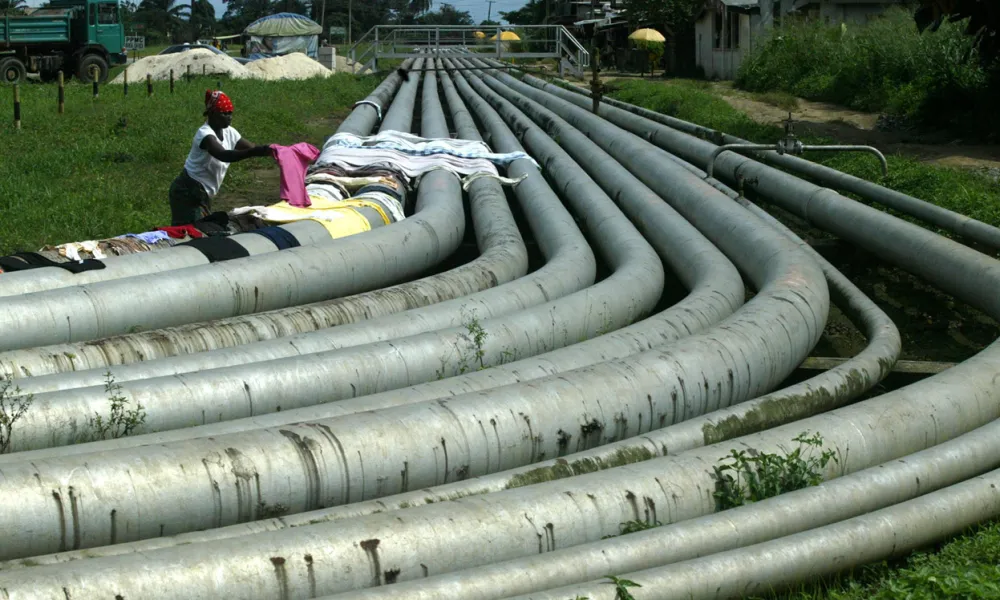
Ima straddles two licenses, OML 112 and OML 117, and will be developed as a single offshore platform tied back by a 22-kilometre pipeline to the Nigeria LNG terminal, in which TotalEnergies holds a 15 per cent stake.

TotalEnergies operates the project with a 40 percent interest; AMNI holds the remaining 60 percent. First gas is targeted for 2028, with output plateauing at 350 million cubic feet a day, or the equivalent of more than 60,000 barrels of oil per day.
Ima is expected to supply around a third of the feed gas for Train 7, the expansion project that will push Nigeria LNG’s liquefaction capacity to 30 million tons annually from 22 million tons. This means that one of Africa’s largest LNG complexes needs more molecules to process, and Ima is being built to help supply them.
Why now, after fifty years
Ima belongs to a cluster of offshore Nigerian gas discoveries that operators and LNG developers largely bypassed for decades, as oil took investment priority and gas buyers gravitated toward “associated” gas, the kind that comes up as a byproduct of oil production and is cheaper to monetise, over standalone, non-associated fields like Ima that require their own dedicated development.
The economics only turned after Abuja introduced fiscal incentives specifically targeted at non-associated gas projects, changing the math on fields that had sat idle since their discovery roughly five decades ago. TotalEnergies has pointed to that policy shift as the throughline connecting its recent run of gas sanctions in the country.
Ima is not the company’s first project to benefit. It follows Ubeta, a gas development TotalEnergies sanctioned in 2024 that is due onstream next year.
“We are very pleased to announce the FID for the Ima gas project, marking a new milestone in the deployment of our integrated gas strategy in Nigeria,” said Nicolas Terraz, president of Exploration & Production at TotalEnergies.
“After the Ubeta project was sanctioned in 2024 and is expected to start up next year, Ima demonstrates again our ability to unlock new low-cost and low-emissions gas resources, following the incentives introduced by the Nigerian Government for non-associated gas developments,” Terraz said, adding that the project “will contribute significantly to Nigeria LNG gas supply and create lasting value for its partners and for Nigeria.”
A lower-carbon template
TotalEnergies is framing Ima as something of a model for how it wants to build offshore in Nigeria going forward.
The platform design has been simplified, and rather than running on gas turbines, it will draw electric power from shore, a setup meant to cut emissions from the facility itself.
The company said the project will have no routine flaring and will carry continuous methane detection and monitoring.
There’s also a domestic-content angle that’s become close to non-negotiable in Nigerian upstream deals: all major contracting packages on Ima have gone to local companies, and the partners expect about 60 percent of the development-phase workforce to come from communities near the field.
The bigger picture
Ima’s sanctioning lands amid a broader scramble to feed Bonny Island’s growing appetite for gas. Once Train 7 is complete, Nigeria LNG will rank among the largest liquefaction complexes in the world, a scale that requires a steady pipeline of new feed-gas projects behind it, not just Ima and Ubeta, but whatever comes next.
Experts said Ima is a test case for whether a policy lever, a set of fiscal terms designed to make previously uneconomic gas viable, can do what decades of geological certainty could not: pull stranded discoveries out of the ground.
If the incentive framework keeps working the way it worked on Ubeta and now Ima, the offshore gas fields Nigeria has been sitting on for fifty years may finally stop being a list of things that could have been developed, and start being a list of things that were.(BusinessDay)
-

 News12 hours ago
Court Orders Wike’s Son Jordan to Produce American Passport in $2.1m Abuja Land Suit
-
News12 hours ago
NEMA deploys rescue teams as floods ravage states
-
Politics11 hours ago
Pantami wins PDP repeat governorship primary in Gombe
-
News10 hours ago
After 68 Days Vacation, Lawmakers Embark On Another Recess
-
Metro12 hours ago
Lagos teen detained over slippers freed after four years
-
Politics10 hours ago
2027: Which running mate brings the most votes – Shettima, Amaechi or Kwankwaso?
-
News12 hours ago
Mixed reactions as FG demarcates First Niger Bridge
-
Sports11 hours ago
AFCON Qualifier: Guinea-Bissau Humble Super Eagles 3-0