Business
Inside Nigeria’s trillion-naira pipeline security system where oil theft persists

BusinessDay Investigations exposes how oil theft persists despite trillions spent on private pipeline surveillance across the Niger Delta, and the gaps in public records that make it difficult to assess what Nigeria receives for its spending.
Gabriel Boma knew something was wrong when he reached the stream his family had depended on for years in Eteo, Rivers State.
Crude had darkened the water, and the smell of petroleum hung in the air. Boma, who had gone to fetch water, returned home with empty buckets.

Residents have long relied on the stream for drinking, cooking, bathing, and processing cassava. That changed in May 2023 after a road-construction vehicle struck an illegal connection installed on a pipeline passing through the community, releasing crude into the environment.
“The water we trusted, we could no longer touch,” Boma said.
A joint finding documented by the National Oil Spill Detection and Response Agency (NOSDRA) estimated that 1,734 barrels of crude were spilt during the incident and attributed it to third-party interference.
The authorities initially recovered 460 barrels, while subsequent figures put total recovery at 930 barrels, leaving 804 barrels unaccounted for in the regulator’s published figures.
Fortune Chutte, chairman of the community’s development committee, said residents still could not rely on the stream for drinking or processing cassava.
What happened in the Eteo community depicts how oil theft and illegal pipeline connections impose environmental and economic costs on communities that neither committed nor benefited from the crime.
The Federal Government has committed substantial resources to protecting Nigeria’s petroleum infrastructure, including employing private surveillance companies to protect oil assets.
Despite this, BusinessDay’s review of incidents between 2023 and 2025 found that illegal connections, illegal refining facilities, and crude-transport operations continued to be discovered across oil-producing areas.
While tracking the payments for the surveillance deal, our correspondent found that publicly available financial records do not provide a comprehensive breakdown of payments to contractors or identify the precise assets each company is responsible for protecting.
Trillions behind Nigeria’s pipeline protection
As Nigeria intensified pipeline protection, private surveillance became a prominent part of the country’s petroleum-security arrangements.
One of the most widely reported contracts was awarded in 2022 to Tantita Security Services Nigeria Limited, associated with Government Ekpemupolo, popularly known as Tompolo.
BusinessDay reported that the contract was valued at approximately N4 billion monthly, equivalent to N48 billion over 12 months.
The reported surveillance coverage included Delta, Ondo, Imo, Rivers and parts of Bayelsa states.
However, the N48 billion figure represents the reported annualised value of that arrangement, not independently verified annual payments.
Other companies, including Pipeline Infrastructure Nigeria Limited (PINL), Maton Engineering Nigeria Limited and Abokus Integrated Security Services Limited, have been identified in reporting and proceedings concerning pipeline surveillance.
It was also observed that government security agencies conduct parallel operations, creating a layered security structure with divided geographic responsibilities and potentially overlapping mandates.
BusinessDay examined NNPC’s financial disclosures to establish how much the protection system costs.
Our correspondent discovered that NNPC’s financial statements contain balances described as other receivables from the Federation, including advances made on behalf of the government and costs incurred in protecting oil and gas assets.
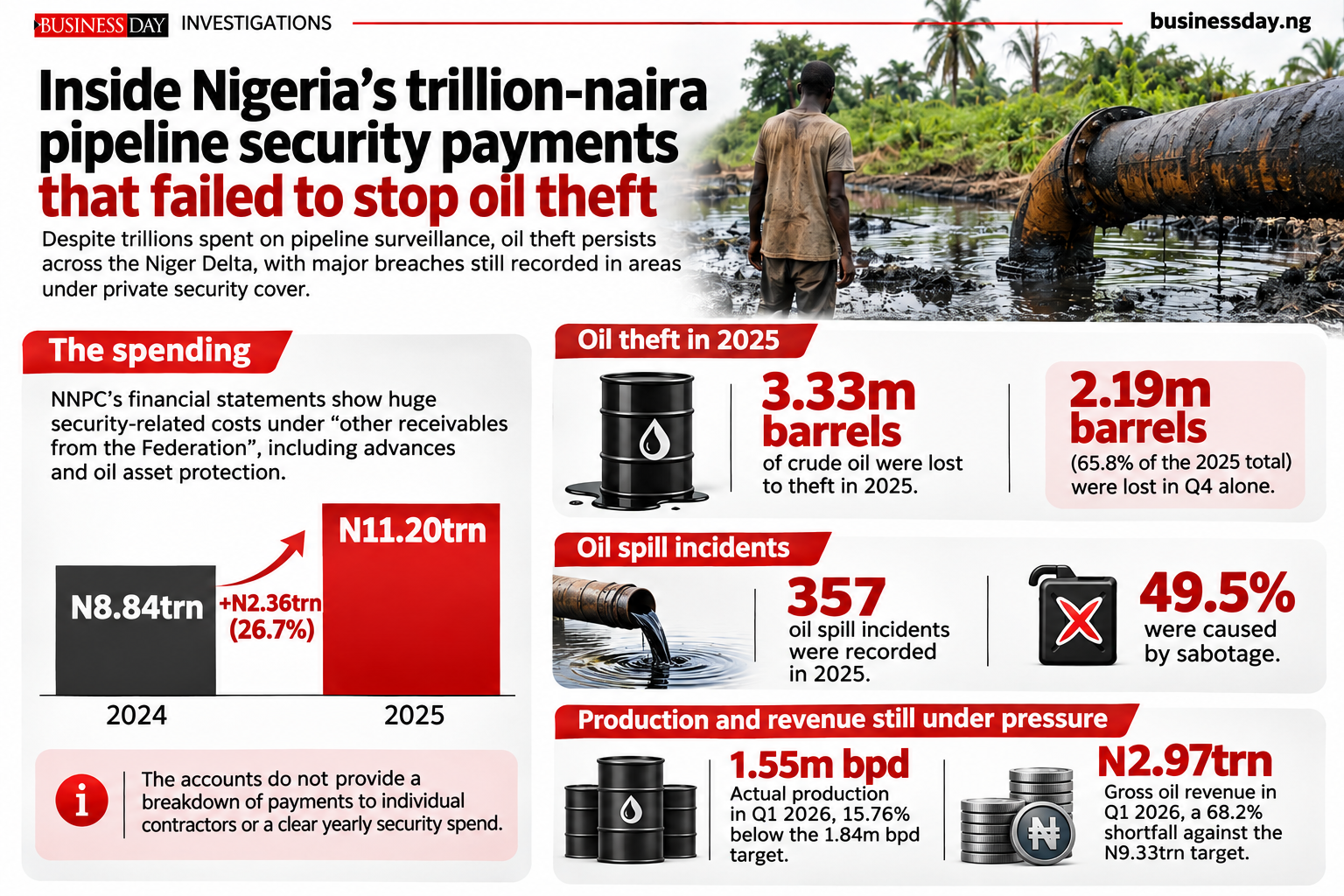
In 2024, the company recorded approximately N8.840 trillion under this category.
By 2025, the balance had increased to N11.201 trillion, an increase of N2.361 trillion, or 26.7 percent.
The accompanying note said the balance included advances to the Federation and security costs incurred in protecting oil and gas assets.
Public records show Nigeria has spent heavily to protect oil and gas infrastructure since the 2022 theft crisis, but the audited accounts do not provide a consistent yearly breakdown of how much was spent on asset protection in 2022, 2023, 2024 and 2025.
Companies behind private pipeline surveillance
BusinessDay identified four companies associated with Nigeria’s private pipeline-surveillance arrangements.
Their public profiles provide some insight into the organisations involved, but the available material does not establish a complete financial and contractual picture.
Tantita Security Services is associated with former Niger Delta militant leader Government Ekpemupolo, popularly known as Tompolo, who is publicly identified as the company’s chairman. Its pipeline-surveillance contract, awarded in 2022, was reported at N4 billion monthly, equivalent to N48 billion annually.
Pipeline Infrastructure Nigeria Limited (PINL) is linkedoperationally to the late businessman Hosa Okunbo’s business network, with his son, Osahon Okunbo, publicly identified in its management.
The company operates around the Trans-Niger Pipeline, where its surveillance team helped security agencies detect a suspected illegal bunkering operation in Eleme in October 2024.
Maton Engineering Nigeria Limited is headed by businessman Matthew Tonlagha, who has been publicly identified as its chairman and chief executive. The company’s own project records show pipeline-surveillance operations in the Niger Delta dating back to September 2020.
Abokus Integrated Security Services Limited is associated in publicly accessible company-record summaries with Matthew Abugo, identified as a majority shareholder. The company was among those named in 2026 litigation concerning pipeline-surveillance contract renewals, alongside Tantita and PINL. The proceedings did not establish wrongdoing by the companies.
However, identifying the companies proved easier than establishing how much each received.
BusinessDay’s review of NNPC financial statements, company disclosures and publicly accessible government records found no comprehensive breakdown of annual payments to the four contractors between 2022 and 2025.
While Tantita’s original contract was publicly valued at N48 billion annually, the records reviewed did not establish its actual yearly disbursements or provide comparable verified payment figures for PINL, Maton and Abokus.
NNPC’s 2025 accounts also leave that question unresolved. The company’s 2025 accounts recorded N11.201 trillion in Federation receivables, including advances and oil asset security costs, without disclosing the security portion or payments to individual contractors.
BusinessDay could identify major companies involved in protecting Nigeria’s pipelines but could not establish from published records how much each was paid annually or the precise value delivered against those payments.
Our correspondent emailed NNPC Limited seeking clarification on pipeline surveillance spending, contractor payments and performance. The company had not responded as of the time of filing this report.
How persistent oil theft led to private security
BusinessDay’s review showed that the country’s decision to involve private pipeline surveillance in protection of oil assets followed years of crude losses, vandalism, and production disruptions.
The crisis was severe in 2021 and 2022, when attacks on petroleum infrastructure coincided with declining production and difficulties moving crude through major export routes.
The Nigeria Extractive Industries Transparency Initiative (NEITI), in its 2021 oil and gas audit, recorded 37.57 million barrels attributed to theft and sabotage.
According to figures cited in the audit, approximately 28.91 million barrels were associated with the Bonny system, 7.12 million with Forcados and 1.54 million with Brass.
The losses exposed the vulnerability of Nigeria’s major crude evacuation systems, where pipeline interference can disrupt production, constrain exports and reduce government revenue.
Against these challenges, the Nigerian National Petroleum Company Limited (NNPC) expanded its reliance on private surveillance contractors working alongside government security agencies and community networks.
The objective was to improve monitoring, identify illegal connections, support enforcement operations, and reduce interference with petroleum infrastructure.
BusinessDay discovered that this arrangement quickly became an important part of NNPC’s explanation for improvements in production.
In April 2026, the company said its integrated security approach had contributed to a recovery from approximately 960,000 barrels per day in 2022 to an average of 1.71 million barrels per day in 2025.
Findings by BusinessDay Investigations, however, showed that crude oil theft remains persistent, despite significant changes in the volume of losses over the past five years.
Data published by the Nigerian Upstream Petroleum Regulatory Commission (NUPRC) showed that the country lost 37.6 million barrels of crude oil in 2021, averaging 102,900 barrels daily.
The losses declined to 20.9 million barrels in 2022, representing an average of 57,200 barrels per day, before falling sharply to 4.3 million barrels in 2023 and 4.1 million barrels in 2024, according to the commission.
NUPRC’s annual report revealed that the country lostapproximately 3.33 million barrels of crude theft in 2025.
The quarterly breakdown showed 896,471 barrels in the first quarter, while the second quarter recorded a negative 200,400 barrels due to excess volumes identified during reconciliation.
Reported theft rose to 440,434 barrels in the third quarter before surging to 2.19 million barrels in the fourth quarter alone, representing 65.8 percent of the annual total.
BusinessDay’s analysis showed that the fourth-quarter theft was nearly five times the previous quarter’s figure.
The annual report also documented 357 oil spill incidents in 2025, with sabotage accounting for 49.5 percent.
Although oil theft fell from 4.1 million barrels in 2024 to 3.33 million in 2025, 2.19 million barrels were recorded in the final quarter alone, showing that large-scale theft continued despite earlier gains.
NNPC claimed private security companies have helped protect oil assets, but BusinessDay found that theft persists in areas they reportedly patrol.
It was discovered that the illicit economy built around pipeline breaches has endured despite the trillions of naira NNPC says it has spent on security.
Protected corridors, persistent breaches
Despite the trillions spent on pipeline surveillance, BusinessDay’s review found continued illegal connections, refining activities and crude-transport operations across Rivers, Ondo and other oil-producing areas where these private security companies operate.
Even the FG, in its Q1 2026 Budget Implementation Report, acknowledged that crude oil theft, pipeline vandalism and infrastructure deficits contributed to the N6.36 trillion shortfall in the country’s first-quarter oil revenue target, despite higher international crude prices.
The 2026 Q1 Report showed that crude oil averaged $83 per barrel, 27.99 percent above the $64.85 budget benchmark, but daily production fell 15.76 percent below target at 1.55 million barrels against 1.84 million barrels.
Also, gross oil revenue reached N2.97 trillion against a quarterly target of N9.33 trillion, a 68.2 percent shortfall, with crude and gas sales generating N180.05 billion against N585.22 billion projected, while petroleum profit and gas taxes brought in N1.34 trillion against N5.98 trillion.
The financial report highlighted the fiscal consequences of persistent oil-sector disruptions, showing that higher crude prices cannot compensate for production losses linked to theft, vandalism and infrastructure weaknesses.
BusinessDay findings showed that these challenges persist even along corridors covered by private surveillance arrangements.
In Eleme, Rivers State, a May 2023 investigation found an illegal connection on the 28-inch Nkpomu-Bomu pipeline.
A road-construction vehicle struck the protruding connection, releasing an estimated 1,734 barrels of crude. Another investigation found a one-inch valve on the 12-inch Ogale-Ebubu pipeline, causing a 58-barrel spill.
By October 2024, two tanker trucks capable of carrying about 45,000 litres each were discovered near a suspected connection to the Trans Niger Pipeline.
Similar activities persisted around Cawthorne Channel and OML 18. Between February and September 2024, security forces intercepted refinery-construction materials, destroyed another refining site and disrupted operation involving more than 198,000 litres of suspected stolen crude, a barge, tugboat and three speedboats.
Maton Engineering and Tantita Security Services participated in patrols within the wider Cawthorne Channel security arrangement, although the records do not establish their responsibility for the precise locations.
This extended to the Forcados corridor where Tantita operates. A suspected illegal storage facility was foundin Awoye, Ondo State, in March 2024. Seven months later, alleged sabotage reportedly cut supply to the Forcados terminal by as much as 50 per cent.
The attacks continued into 2025. On May 19, Renaissance Africa Energy Company confirmed that an illegal connection on its Okordia-Rumuekpe pipeline caused a spill and forced production to stop.
Although NUPRC reported daily crude losses falling from 11,900 barrels in 2023 to 9,600 by July 2025, BusinessDay found that pipeline breaches and illegal refining persisted across several oil-producing corridors.
Experts demand accountability for pipeline security spending
Meanwhile, experts said the continued discovery of illegal connections and crude theft operations raises questions about the effectiveness of Nigeria’s pipeline surveillance arrangements.
They argued that government spending should be assessed against measurable results, including the frequency of breaches, response times, and the protection of critical infrastructure, rather than arrests and discoveries alone.
David Tamuno, Executive Director of the Niger Delta Oil Accountability Initiative, said the government should subject pipeline surveillance contracts to independent performance assessments to establish whether the billions of naira committed to protecting oil infrastructure had translated into sustained reductions in crude theft and pipeline breaches.
He said the discovery of illegal connections and refining sites should not, on its own, be taken as proof that surveillance contractors had failed.
Tamuno argued that the government needed to establish where incidents occurred, which contractors were responsible for the affected assets and how quickly the breaches were detected and addressed.
“The government cannot determine whether it is getting value for money simply by announcing arrests, intercepted crude, or the destruction of illegal refineries. It must demonstrate how much it spends, what each contractor is responsible for, and whether those arrangements are reducing breaches and preventing repeated attacks,” he stressed.
The expert said the absence of publicly available, contractor-by-contractor payment figures and independently verifiable performance data made it difficult for citizens to assess the effectiveness of the arrangements.
According to him, the government should publish contract values, actual payments, the duration and geographical scope of agreements, performance targets, and the results of periodic audits while ensuring that commercially sensitive information did not become an excuse for withholding basic public-accountability information.
Tamuno also called for a central database documenting pipeline breaches, including their locations, the volume of crude lost, the time taken to respond, the outcome of investigations, and whether similar incidents recurred.
He said such records would help distinguish between incidents that demonstrated effective detection and enforcement and those that exposed weaknesses in surveillance or coordination between private contractors and government security agencies.
Tamuno further stressed that continued pipeline breaches placed oil-producing communities at risk of environmental damage, loss of livelihoods, and prolonged uncertainty over access to clean water.
He urged the government and relevant oil operators to ensure that spill investigations, remediation measures, and compensation processes were documented and communicated to affected communities.
He noted, “The ultimate test of pipeline security should be whether crude losses are reduced, critical infrastructure is protected, public spending is justified, and communities are no longer repeatedly exposed to the consequences of oil spills and illegal operations.”
(BusinessDay)
-

 Politics16 hours ago
2027: INEC dispatches 186,277 BVAS to states
-
News16 hours ago
Senate sends State Police Bill to Tinubu for assent
-
Sports15 hours ago
FIFA Appoints Amokachi, Four Others To Manage Nigeria Football Federation
-
Politics16 hours ago
Tinubu Revises Campaign Schedule, Drops Bauchi, Adds More States
-
Metro16 hours ago
Eight-hour gridlock paralyses Lagos-Ibadan Expressway
-
Metro16 hours ago
Kano TikToker Jailed For ‘Insulting’ Hisbah DG
-
Business15 hours ago
Chairman’s firm buys 9.125% of Seplat senior notes
-
News15 hours ago
US hails Nigerian military over rescue of 125 kidnap victims