News
Oversight concerns as Assemblies hastily pass N34.63tr budgets

• High ‘speed’, executive dominance, poor checks mark rituals
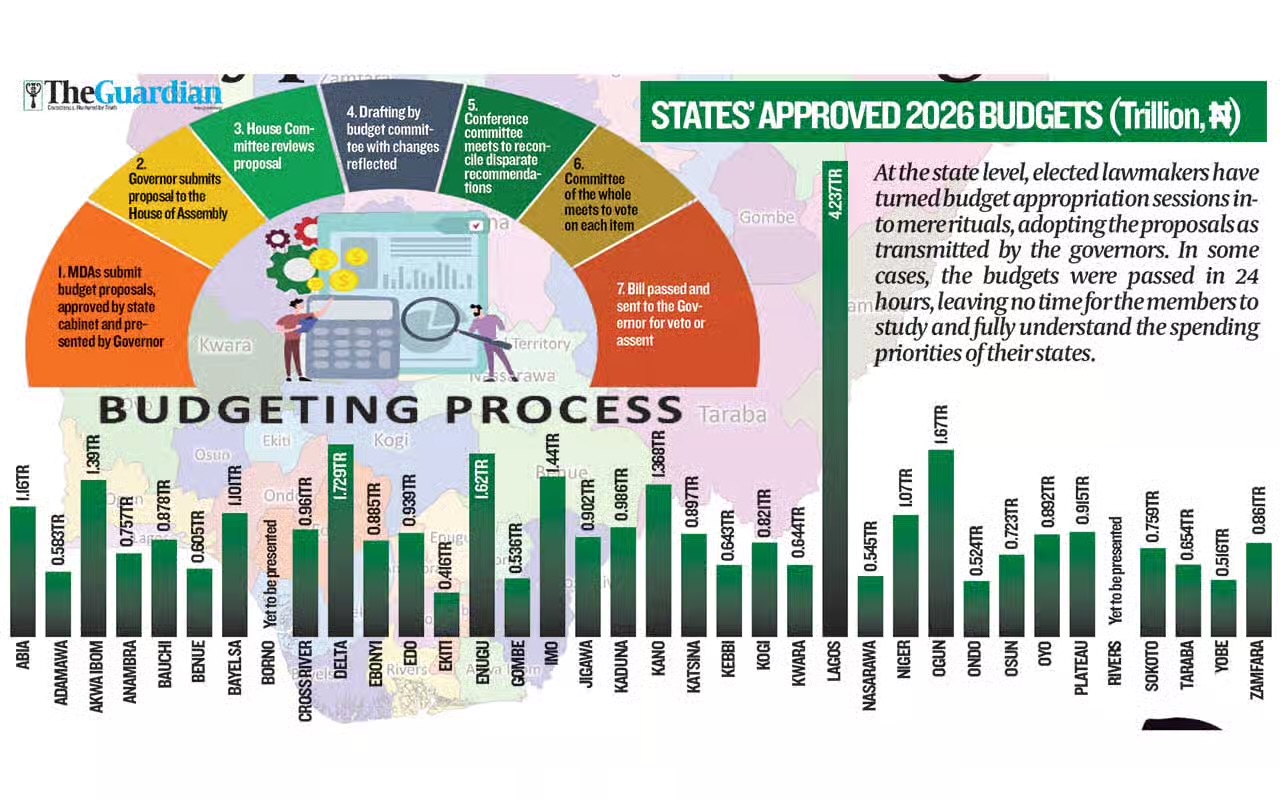
• 34 states to spend N34.63 trillion next year
• Imo lawmakers pass budget within 24 hours
• Edo, Ekiti, Enugu legislators return figures unaltered
• Rivers, Borno yet to present budget estimates
• Legislative, executive ‘partnership’, political partisanship eroding budget sanctity
From North-west to South-west, South-east to North-east and across South-south and North-central, state budgets are assuming a strangely similar pattern – hasty legislative processes that return the figures to chief executives almost unchanged from the versions received.
Amidst speedy passage, some state assemblies are returning the executive bills to the governors without the slightest changes in the figures received. In Edo, Ekiti and Enugu states, the governors had the appropriation passed to them as transmitted to the lawmakers.

Politicians often see the accelerated legislation and scanty scrutiny of the proposal as evidence of a stronger bond and closer working relationship between the executives and lawmakers.
But there are fears that the emerging trend points to deeper structural defects that are eroding the very essence of the democratic system – strong checks and balances – while reducing state budgets to mere chief executives’ wish lists.
Beneath the brisk legislative process are appropriations that cater to the egos of political actors or populist agendas rather than addressing the peculiar socio-economic needs of the sub-national entities.
Most of the state appropriations, which The Guardian understands were on hold in wait for the Federal Government’s budget, were hurriedly submitted towards the end of the year and in December.
Subsequently, the governors presented, secured passage and assented to trillion-naira budgets in record time, reinforcing a growing perception that state legislatures are prioritising calendar alignment over rigorous examination of spending proposals, which fates of millions of Nigerians are tied to.
The state lawmakers mirror what has also become a convenient trend at the centre. For instance, the anchor of the 2026 appropriation bill – the 2026-2028 Medium-Term Expenditure Framework/Fiscal Strategy Paper (MTEF/FSP), which was supposed to have been transmitted to the parliament in August, only secured the Federal Executive Council’s (FEC) approval early in December. Within three days, the document was passed by the two houses of the National Assembly, which retained all key parameters despite experts’ caution.
Like the MTEF/FSP, the 2026 appropriation bills have followed a similar path, with both the Senate and the House of Representatives giving the proposal an accelerated hearing with little or no scrutiny of the key parameters many have considered spurious.
At the state level, elected lawmakers have turned budget appropriation sessions into mere rituals, adopting the proposals as transmitted by the chief executives, who double as political godfathers to many of the legislators in many cases.
In some cases, budget appropriation bills are concludedin less than a week. On rare occasions, the processes are completed in 24 hours, leaving no time for the members to study and fully understand the spending priorities of their states. This raises questions about the quality of oversight the important governance documents receive from the legislative arms and whether the lawmakers have not become accomplices in the journey to eroding budgetary culture.
On December 19, the National Assembly received the N58.18 trillion 2026 budgetary estimate from President Bola Tinubu and referred the bill for a second reading. Some people noted that a similar abridgement of time would be observed at the Committee stage, to which it has been sent.
The 2026 yearly estimate, which is an executive bill, is the third of such bills that the executive arm under Tinubu has related to the legislative arm and Nigerians have observed with worry at the speed at which the parliament handles the budgeting process.
A few days to the end of the 2025 fiscal year, the Nigerian National Assembly has not yet passed the 2026 Appropriation Bill into law, with stakeholders noting that the late action on the fiscal instrument disposes the National Assembly to turn out hasty budgets.
Critics have condemned the seeming low critical rigour in scrutinising the budgets, stressing that in the haste to guarantee legislative support to Tinubu’s programmes and financial action plans, the lawmakers end up as poor sentinels.
In the last two years, it has also become apparent that state legislators have borrowed the ugly leaf from the National Assembly, culminating in sloppy budgets that read as a voodoo document that leaves room for opacity in implementation and oversight.
What should ordinarily be a routine transition from one fiscal year to another has instead exposed deep structural weaknesses in the country’s budgeting architecture, raising questions about whether the legislature is asserting its constitutional authority or merely managing executive errors after the fact.
A fundamental procedural breach is the delayed submission and passage of the Medium-Term Expenditure Framework (MTEF) and Fiscal Strategy Paper (FSP), the statutory documents that anchor the yearly budget.
Under the Fiscal Responsibility Act (FRA), the MTEF ought to reach the National Assembly not later than four months before the commencement of the next financial year. But the 2026–2028 MTEF arrived several months late, effectively collapsing the statutory budget calendar and forcing lawmakers to improvise.
Despite this breach, the executive proceeded to present the 2026 Appropriation Bill, triggering unease within and outside the National Assembly. Analysts warn that debating a budget that arose from a flawed process, particularly concerning the MTEF, undermines fiscal credibility and reduces the budget exercise to an exercise in guesswork.
For a National Assembly already battling perceptions of excessive deference to the executive, the optics are troubling, because it was against this backdrop that the Chairman of the Senate Committee on Appropriations, Adeola Olamilekan, tried to clarify discrepancies surrounding the 2026 budget figures, including the repeal and re-enactment of the 2024 and 2025 budgets.
Adeola acknowledged the confusion caused by conflicting figures—N58.18 trillion in the President’s budget speech and N58.247 trillion in the documents before lawmakers, attributing the N292 billion difference to post-presentation adjustments arising from amendments to previous budgets.
He declared the appropriation bill itself as the “authoritative document,” fixing the 2026 budget at N58.472 trillion for legislative consideration, which underscores the fact that a budgeting process is so fluid that headline figures change between presentation and debate.
While citizens and investors were left to track the true fiscal position of the state, Adeola defended the controversial decision to repeal and re-enact the 2024 and 2025 budgets, arguing that years of overlapping budget implementation had eroded fiscal discipline.
“The practice of funding multiple budgets from the same year’s revenue, often spanning three fiscal years, distorted planning, delayed project execution and weakened legislative oversight. The solution is a clean break beginning in 2026: one budget per financial year, funded strictly by that year’s revenue,” he noted.
In practice, however, the transition has been anything but orderly. The directive to roll over about 70 per cent of the 2025 capital budget into 2026, while extending the 2025 budget by three months to March 31, 2026, has created precisely the overlap the reform claims to abolish.
Senate Leader, Opeyemi Bamidele, in leading the debate on the 2026 Appropriation Bill, adopted a more optimistic tone, portraying the budget as one of “consolidation” rather than experimentation.
He emphasised its development focus, pointing to N23.214 trillion in capital expenditure, the largest discretionary component of the budget, and a stated commitment to infrastructure, security, human capital and productivity.
With expected revenues of about N34.33 trillion against expenditure of over N58 trillion, the deficit remains substantial, even if officially pegged within medium-term limits.
The Senate’s attempt to assert control came through the Committee on Finance, which suspended consideration of the 2026–2028 MTEF/FSP pending submission of detailed performance reports for the 2024 and 2025 budgets.
Committee Chairman, Mohammed Sani Musa, insisted that lawmakers need clarity on fund releases, capital execution and revenue performance before endorsing new fiscal assumptions. This move, though belated, suggests a flicker of institutional pushback.
Analysts raise concerns about budgeting process
Analysts argued that the damage may already have been done. By allowing the process to drift this far off course, the National Assembly risks being seen as complicit in the erosion of budgetary culture.
Seun Onigbinde of BudgIT captured this sentiment bluntly when he described Nigeria’s budgeting system as “a system without a calendar,” lamenting the collapse of the tradition where budgets, even when presented late, took effect on January 1.
Without a predictable budget cycle, planning becomes reactive, oversight weakens, and accountability suffers, just as rising debt service, stagnant revenues and delayed capital releases combine to stall development and deepen public distrust.
At the House of Representatives, as deliberations on the 2026 budget continue, the National Assembly has taken interim steps to ensure fiscal stability by repealing and re-enacting the 2024 and 2025 Appropriation Acts, while also extending the implementation of the 2025 budget to March 31, 2026.
Explaining the move, the Deputy Spokesperson of the House of Representatives, Hon. Philip Agbese, said the decision was aimed at aligning Nigeria’s budgeting framework with global best practices, enhancing transparency, and easing implementation challenges that have trailed previous budget cycles.
Speaking in an interview on Friday, Agbese said the lawmakers acted to strengthen accountability and reduce the oversight burden that often complicates budget execution.
“Basically, it is to align the nation’s budgeting system with global and international best practices. It is also to ensure transparency and accountability at all levels, and to lessen the burden of oversight during implementation,” he said.
While remarking that the repeal and re-enactment will help streamline Nigeria’s fiscal process by creating a more coherent and predictable funding structure, the lawmaker said the step would pave the way for a single national budget cycle after March 31, 2026.
Agbese commended the House Committee on Appropriations, chaired by Hon. Abubakar Bichi, for its diligence and prompt handling of the re-enactment bill transmitted by President Tinubu, noting that the committee’s speed enabled the House to pass the bill before proceeding on its Christmas and New Year recess.
He said the move would help address the long-standing problem of running multiple budgets simultaneously, which he described as a major source of fiscal confusion and waste.
According to the lawmaker, the poor performance of the 2025 capital budget was largely due to overlapping budget cycles, which often led to scattered funding and delayed project execution.
Agbese stressed that the House remains committed to reforms that will strengthen public finance management, improve service delivery, and restore public confidence in the budgeting process.
Consequently, yearly budgets are nothing more them mere fulfilment of fiscal expectations, with poor execution becoming a national concern. In recent years, only a few states have reached 80 per cent performance while many struggle to cross 60 per cent.
In many cases, the critical capital expenditures, which have the highest impacts on the citizens, perform below 50 per cent, as state governments struggle with unrealistic revenue targets that should have been scrutinised by vigilant lawmakers.
Despite reports of poor performance of the 2025 budgets, states have significantly increased their spending estimates for the coming year. While some states are yet to secure legislative approvals, the total estimated budgets of 34 states, according to collation by The Guardian at the weekend, were N34.63 trillion, which is 54.4 per cent higher than the N22 trillion the 36 states appropriated this year.
Rivers state, which has been facing political upheavals, and Borno state are expected to present their estimated budget in the coming weeks. On average, a state is looking at spending a total of N1.02 trillion next year, as against this year’s N611 billion.
States’ brisk appropriation processes
Nationwide, the 2026 budget cycle has unfolded at an unusually brisk pace, with many state governments and legislatures concluding appropriation processes within days or weeks, raising concerns about the depth of scrutiny, legislative independence and the credibility of fiscal oversight.
In Delta state, Gov. Sheriff Oborevwori presented a N1.729 trillion 2026 appropriation bill tagged ‘Budget of Accelerating the MORE Agenda’ to the House of Assembly on November 26, 2025. Lawmakers passed the budget on December 15, while the governor signed it into law the following day, completing the process in less than a month.
Bayelsa state followed a similar pattern. Gov. Douye Diri assented to the N1.01 trillion ‘Budget of Assured Prosperity II’ on December 23, after its presentation on November 13, followed by a swift legislative approval.
In Akwa Ibom, Governor Umo Eno laid the N1.39 trillion ‘People’s Budget of Expansion and Growth’ before the House on November 25. Though official confirmation of passage and assent was unavailable at press time, there is nothing in the book that shows the legislation would transcend what is considered politically expedient.
Cross River State concluded its cycle after Governor Bassey Otu signed the N961 billion ‘Budget of Inclusive Growth’ into law on December 25. The bill, presented on October 28, received over a month of deliberation before passage.
Edo state recorded one of the fastest turnarounds. Gov. Monday Okpebholo presented the N939.85 billion Budget of Hope and Growth on December 16 while the state’s lawmakers passed it in a few days. The governor assented to it on December 23, with no significant amendment to the figures.
Rivers remains an outlier. The 2026 budget had yet to be presented, pending the completion of the reconstructed Assembly complex. While figures were undisclosed, the government indicated a focus on completing ongoing projects and prioritising education, healthcare, security and youth empowerment. The state’s 2025 budget stood at N1.48 trillion.
In the South-east, adjustments are done hastily. Enugu State Governor, Peter Mbah, presented a N1.62 trillion 2026 budget on December 2, while the House of Assembly passed it unchanged on December 18. The document was signed into law on December 24.
Anambra lawmakers adjusted Gov. Chukwuma Soludo’s N757 billion proposal upward to N766.37 billion before passing it on December 24. As at filing, the budget was yet to receive assent.
In Imo state, Gov. Hope Uzodinma presented a N1.44 trillion estimate on December 23, only for the lawmakers to pass it in less than 24 hours without changes. Though assent was pending as of press time.
Governors across the South-west region have unveiled their 2026 budgets, with the plans largely emphasising infrastructure development, social services, education, healthcare and economic empowerment.
While some states have already passed and signed their budgets into law, others remain under legislative review.
In Oyo state, Gov. Seyi Makinde presented the 2026 budget to the House of Assembly on November 24, 2025. The proposed figure was N891.99 billion, focusing on infrastructure, education, healthcare and economic empowerment. The House of Assembly passed the budget on December 18, 2025, approving a total of N892.085 billion, which Makinde signed into law on December 22, 2025.
In Ondo State, Governor Lucky Aiyedatiwa submitted a N492.795 billion budget to the House of Assembly. The House approved an additional N31.61 billion, raising the total to N524.41 billion, which has been assented to by the governor.
Former Deputy Director of the Central Bank, Bashorun Olorunfunmi, has stressed that the timeline for presenting, passing, and signing state budgets often masks the complexity involved in their preparation. He noted that while a layperson may focus on dates, extensive groundwork usually precedes the presentation of appropriation bills.
Olorunfunmi explained that proper due diligence before submission can minimise delays. “A lot of collaboration and input occurs at the constituency and local government levels, and the key issue is how lawmakers monitor budget implementation,” he said.
Lanre Odubote, former spokesman to the late Speaker of the Lagos State House of Assembly, added that while no law specifies how long a state Assembly should take to pass a bill, executives submitting proposals late bear part of the responsibility.
He also highlighted historical lessons from the federal level, recalling the 2016 budget stalemate between former President Muhammadu Buhari and the Bukola Saraki-led Senate. The impasse delayed budget approval until May that year. “Since then, the ruling party has committed to maintaining the January-to-December fiscal year to prevent similar delays,” Odubote said. (Guardian)
-

 News21 hours ago
FG unveils loan for Nigerians to build or buy houses – How to apply
-
Politics21 hours ago
Osun Election: Bamidele urges Oyebamiji to congratulate Adeleke, offer policy ideas
-
Metro21 hours ago
Tupac Shakur’s accused killer was out for ‘revenge’, jury hears
-
Politics21 hours ago
UK commends Osun election, urges Nigeria to apply lessons to 2027 poll
-
Politics13 hours ago
Osun poll raises 2027 questions as APC reviews defeat, observers flag flaws
-
Politics21 hours ago
ANALYSIS: How Large Voter Turnout Diluted Vote Buying In Osun
-
News13 hours ago
Insecurity: 31 states spend N252bn on security in six months
-
Business13 hours ago
Nigerian tycoon Wale Tinubu is drilling 62 wells to more than double Oando’s output