News
Tinubu Abroad 22 Days In 1 Month

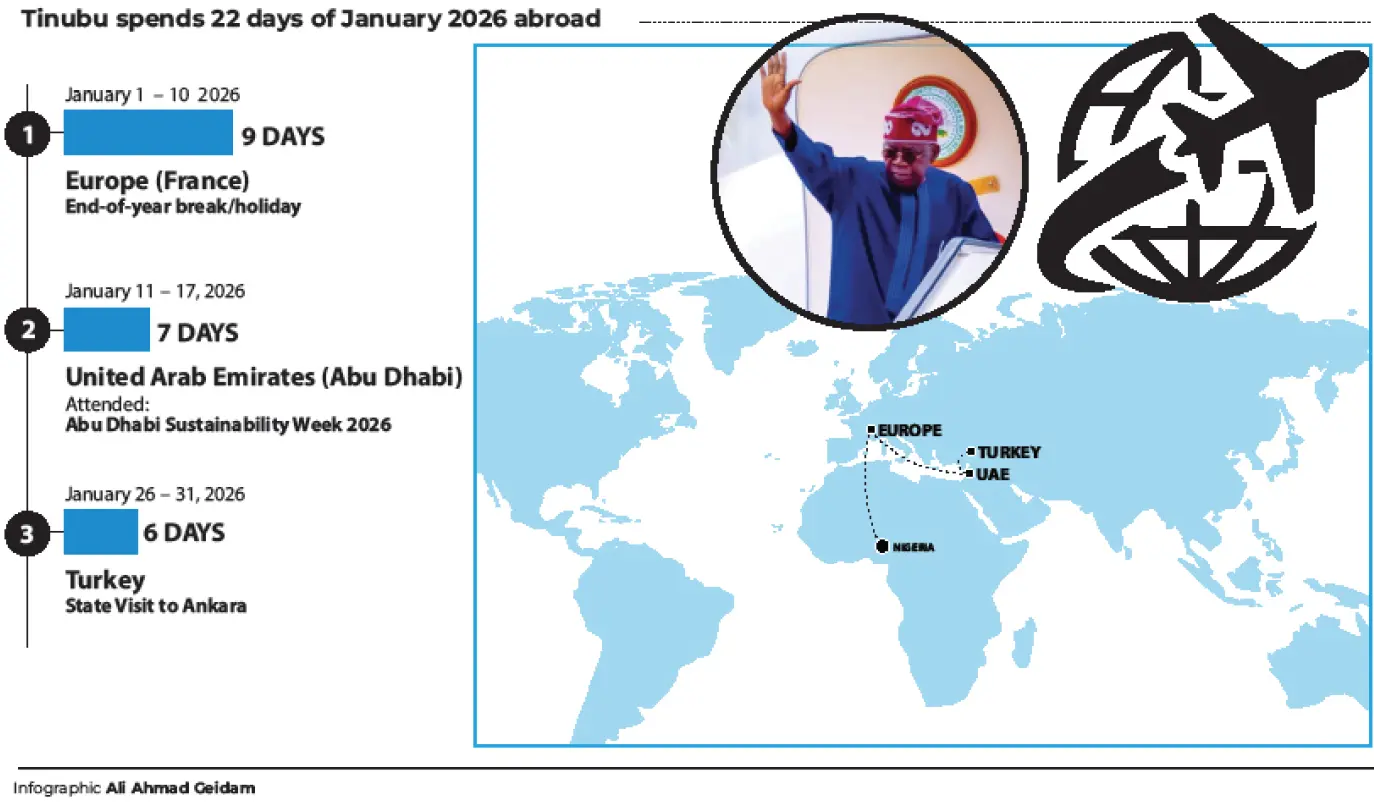
President Bola Ahmed Tinubu spent 22 days outside Nigeria in January 2026 alone, according to a review of his officially announced foreign trips.
Within the period, the president visited France, the United Arabs Emirates and the Republic of Türkiye.
The president’s foreign trips have drawn flak from civil society groups and opposition political parties which alleged that spending that number of days abroad reflects misplaced priorities at a time when Nigeria faces some domestic challenges.
They described what they called the president’s “long” stay abroad as excessive and potentially counterproductive, alleging that the trips divert attention and public resources away from critical areas such as insecurity, education, healthcare and infrastructure.

They also alleged that many of the agreements signed during the president’s fooreign trips have not translated into tangible benefits for Nigerians.
But the national chairman of the All Progressives Congress (APC), Professor Nentawe Goshwe Yilwatda, described the president’s trips as a sacrifice made in the national interest.
On January 31, 2026, President Tinubu returned to Abuja from a week long state visit to the Republic of Türkiye after spending six days in the European country.
Before then, the president had spent the first 10 days of the year in Paris before arriving in Abu Dhabi (UAE) on January 11 for the Abu Dhabi Sustainability Week Summit.
From Abu Dhabi, the president returned to Nigeria on January 17 and stayed in the country till 26 before jetting out to the Republic of Türkiye for a state visit where he spent another six days before returning on January 31.
During the president’s trip to Abu Dhabi for the 2026 edition of Abu Dhabi Sustainability Week, Nigeria signed a Comprehensive Economic Partnership Agreement (CEPA) under which the UAE will eliminate tariffs on over 7,000 products for Nigerian exporters in the areas of agricultural and industrial products.
The president embarked on a state visit to the Republic of Türkiye last Monday and returned on Saturday. While in Turkiye, officials from both countries signed agreements on diaspora policy, defence cooperation, joint declaration establishing the economy and trade joint committee, halal quality infrastructure, higher education, media and communication, diplomacy academy, among others.
Tinubu’s 10 trips in 2025
In 2025, President Tinubu traveled to 10 countries for various reasons ranging from state visits, private vacations, summits and diplomatic engagements.
His first trip in 2025 was to Ghana to attend the inauguration of President John Dramani Mahama before going to the United Arab Emirates for the Abu Dhabi Sustainability Week Summit and later, Tanzania to participate in the Mission 300 Africa Energy Summit in Dares Salaam.
In February last year, Tinubu travelled to France on a private working visit before and later, Ethiopia to attend the African Union Heads of State and Government Summit in Addis Ababa.
In April, the president embarked on working visits to France and the United Kingdom, during which he held consultations with officials and political stakeholders.
In May, Tinubu visited Italy and attended the inauguration Mass of Pope Leo XIV at the Vatican; an event that drew several world leaders from across the globe.
The president later embarked on a two-leg trip in late June and early July, visiting the Island of Saint Lucia on a state visit before proceeding to Brazil to attend the BRICS Summit on the invitation of the Brazilian leader.
In August, he travelled to Japan for the Tokyo International Conference on African Development (TICAD), followed by a bilateral visit to Brazil where meetings were held with business and government officials.
In September, President Tinubu undertook a 10-day working vacation between France and the United Kingdom, which was described by the his spokesman, Bayo Onanuga, as a period of rest combined with strategic consultations.
In December, Tinubu travelled to Europe for what Onanuga called a year-end break ahead of the Abu Dhabi Sustainability Week Summit.
Challenges at home don’t allow for a visiting president – ADC
Mallam Bolaji Abdullahi, National Publicity Secretary of the ADC, in an interview with Daily Trust yesterday, said the challenges in Nigeria do not allow for a visiting president.
He stated: “We think what the Presidency is doing is not good for the country or the President himself. A President is primarily a human being regardless. But they are behaving as if they are hiding something, thereby fuelling speculations.
“Our president is spending unusual amount of time outside the country. The challenges at home do not allow for a visiting president. They therefore need to be more transparent and let us know what exactly is going on.”
Tinubu should prioritise his work at home – PDP
On his part, PDP’s spokesman, Ini Ememobong, asked the president to prioritize his work at home.
Speaking to Daily Trust yesterday, he said: “The president obviously has very serious reasons that make him frequently travel outside Nigeria, especially to France. This reason has always been buried in official work and engagements. Nigerians deserve to know the truth, the whole truth and nothing but the truth.
“The PDP wants the president to prioritize his work here as there are many existential problems facing Nigerians which need presidential action urgently. These frequent travels are not helpful.”
Tinubu’s trips, sacrifice for Nigeria – APC nat’l chairman
Speaking last night on Trust TV’s Sunday Politics, the APC’s national chairman, Prof. Nentawe Yilwatda, said Nigerians should not take President Tinubu’s efforts for granted.
He described the president’s trips as a sacrifice made in the national interest.
He said Tinubu undertook the trips because of his experience, exposure and global network, arguing that what the president could achieve in a day would take others years to accomplish.
“Because of his experience, exposure and connections, what he can connect in one day will take most of us years to gain and achieve,” Nentawe said.
He added: “For this man (President Tinubu) to sacrifice for this country, to move around, attract investment, work on security and negotiate bilateral agreements, should we take that for granted?”
Nentawe also criticised the media and the opposition for what he described as unfair treatment of the president.
He said: “It is only when the president travels that it is counted as travelling. How many times has the vice president travelled? The vice president went to Davos; it was not counted. He went to Switzerland and travelled to two countries this January.”
Meanwhile, the Minister of Information and National Orientation, Mohammed Idris; the Special Adviser to the President on Information and Strategy, Bayo Oanuga and the Special Adviser to the President on Policy Communications, Daniel Bwala, could not be reached on their mobile telephone lines for reactions. They did not reply to text and WhatsApp messages sent to them either.
CSOs react
Speaking to Daily Trust yesterday, Mr Kolawole Omoniyi of the Resource Centre for Human Rights and Civic Education (CHRICED), said while the president has the right and responsibility to engage internationally on issues of diplomacy, investment and bilateral relations, his frequent trips had become alarming to many Nigerians, especially in the absence of clear information on their costs and tangible benefits to the country.
“We are not opposed to presidential travel, and we cannot restrict the president’s freedom of movement. But our concern is that these trips must be strategic, transparent and driven by measurable results,” Omoniyi said.
He said the destinations and frequency of the trips should be linked to Nigeria’s pressing domestic challenges, including economic hardship, insecurity, inflation and unemployment.
“Mr President has been governing largely from abroad, and leadership should not be remote. Nigeria is facing serious challenges that require constant attention and presence,” he said.
Omoniyi also urged the National Assembly, particularly relevant committees, to review and scrutinise the cost and impact of presidential foreign travels in the interest of transparency and fiscal responsibility.
“Governance must remain rooted at home. If Nigerians are being held accountable for taxes and civic duties, the government must, in return, be transparent about how public resources are being used and the benefits derived,” he said.
He warned that continued foreign travels without clear results risk being perceived as wasteful and undemocratic, stressing that Nigerians need to see tangible benefits now, not in the distant future.
Founder and Chief Executive Officer, Resource Management for Accountability Centre, Akibu Hamisu, described the president’s frequent trips as “alarming and largely unproductive at a time Nigeria is grappling with serious domestic challenges.”
“From my perspective, this country requires the president’s attention, action and physical presence. Spending almost an entire month outside the country within such a short period signals lack of seriousness in governance,” he said.
Hamisu argued that many of the international engagements undertaken by the president could be handled by representatives, including the vice president, relevant ministers or Nigerian ambassadors to the host countries, who could later brief the president on outcomes of such meetings.
Executive Director, Community Outreach for Development and Welfare Advocacy (CODWA), Taiwo Otitolaye, said: “The president’s continuous trips overseas are becoming too much and look like an abdication of responsibility back home.”
Global Director, Brain Builders Youth Development Initiative (BBYDI), Olasupo Abideen, said: “Initially, we thought late President Muhammadu Buhari would be one of the most travelled Presidents. But now, President Tinubu’s overseas trips have made Nigerians start asking a lot of questions about the return on investment of all these trips and how they compare with the priorities of citizens.”
Ahmad Auwal Salihu, Executive Director, Centre for Community Actions for Peace and Development (CCAPAD), stated: “In all honesty, we feel disappointed and challenged by our colleagues in the other parts of the world whenever we are taken up on the frequency of the president’s traveling abroad.
“Some of us are proponent of the fact that it is important to keep our diplomatic missions because some of the trips are supposed to be made usually in the interest of the country. We agree so. But we also believe that when there are pressing needs that are supposed to be addressed by the leadership in the country, their absence makes it impossible especially with the critical issues that have to do with insecurity bedeviling the country.”
President only visits Nigeria to welcome defectors – Obi
Earlier yesterday, the presidential candidate of the Labour Party (LP) in the 2023 general elections, Peter Obi, slammed President Tinubu for spending much of January outside the country, alleging that he only comes home to receive defectors.
Obi, in a post on his X handle yesterday, wrote: “This first month serves as a critical measure of the challenges that lie ahead, and it is painfully evident that the situation in the country continues to worsen.
“Insecurity has surged alarmingly across the nation. In just January, we saw reports of several killings, hundreds of kidnappings and abductions that include children, pregnant women, and nursing mothers with the abductors demanding millions. Farmers remain unable to return to their farms plagued by ongoing insecurity which exacerbates food shortages and rural poverty.
“Education stands as a cornerstone of national development, yet countless children remain out of school and those in school cannot attend because of insecurity or teachers’ strikes. This is particularly tragic in Abuja, the seat of government, where schools remain shuttered. This is the same Abuja where billions were squandered on renovating a conference centre for the president and Bus Terminals. One must question whether our leaders genuinely appreciate the vital role of education.
“Our nation with the worst access to electricity without an abysmal supply have witnessed two grid collapses in just January.
“While leaders in other nations prioritise domestic governance in January, Nigeria’s president prioritises international engagements over pressing national issues. This month, he spent 23 days abroad across two trips—beginning the year overseas and returning on the 17th, and departing less than 10 days on the 26th to Türkiye, where he remains as of January 31.
“What urgent matters continuously warrant his absence from the nation? When he does return, it often appears to be merely to welcome defectors into the APC before he jets off again.
“The ruling APC, in particular, seems more concerned with rallies and welcoming defectors than with visiting failing institutions or addressing the daily struggles of the Nigerian people.” (Daily trust)
-

 Business23 hours ago
Dangote exports 87% of aviation fuel output as Nigeria records zero imports
-
Business24 hours ago
Nigeria’s $100 oil strengthens the case for freezing Gazelle crude
-
Entertainment24 hours ago
Ex-gang leader sentenced to minimum 40 years for Tupac murder
-
News23 hours ago
Asari Dokubo Challenges Olu Of Warri Over ₦2.7tn Pipeline Row, Says ‘Stop The Selective Criticism, Answer The Questions’
-
News23 hours ago
Ondo Crash: Residents Fear Disease Outbreak As Body Parts Float
-
Politics23 hours ago
Opposition dares Tinubu, says Wike, Soludo inclusion won’t save APC
-
Politics24 hours ago
S’ Court ruling: INEC gives Oct. 24 deadline for parties to submit omitted candidates
-
News24 hours ago
Court overrules El-Rufai’s objection to DSS forensic witness