Politics
Politicians, INEC Under Burden Of Rising Election Cost

As Nigeria prepares for another general election next year, attention has gone beyond political alignments and campaign strategies to the cost of contesting by aspirants and conducting the polls by the Independent National Electoral Commission (INEC).
From consultation to declaration and the cost of obtaining Expression of Interest and nomination forms to mobilisation of voters to post election litigation expenses’ the average Nigerian contesting for political office is known to incur huge expenses.
For INEC on the other hand, from the cost of registering and updating voters to creating awareness to voter education to deployment of men and materials for the polls to engaging counsels for post election disputes, the costs have been equally astronomical.
A former senator from Plateau State who does not want to be named, said he spent about N5 million while contesting for the Senate seat in 1998 but that by 2003 when he wanted to contest for a second term, he incurred a bill of over 35 million but lost.

Experts say the cost of contesting elections increases after each cycle as the expectations are higher, while political parties also raise the cost of participation,
Burden of huge bills on aspirants
A former member of the House of Representatives from Imo State, who asked not be named, told our correspondent that in the year 2015, when he first contested the seat, he spent about N300 million to win the seat, but said by 2019 when he went for second term, he spent no less than N500 million.
Probes by our correspondents reveal that such costs are incurred in the process of consultation with stakeholders, holding meetings with various groups, pre-election campaign projects, billboards and posters, radio and TV jingles as well as outright cash donations to individuals and interest groups.
There is also un-receipted spending like extension of patronage to stakeholders and opinion moulders, and to delegates or party members/ officials involved in conducting primaries.
Due to the increase in cost of contesting elections, many have been discouraged from running for political offices due to a lack of financial weight.
A former senator representing Kaduna Central senatorial zone, Shehu Sani, once likened party delegates to bandits who he said collect money to vote and vowed not to bribe any delegate. Probably because of that, he got only two votes at the primaries.
The costs, according to observations vary according to the size of the political office. For instance, the cost incurred in contesting for the House of Assembly is said to be is lower than for the House of Representatives, while the cost for contesting a House of Representatives seat is higher than a state legislative seat but less than the cost for the Senate seat and governo,r while the highest is that of the President.
In the 2023 elections, the All Progressives Congress (APC) old its Expression of Interest forms at N30 million and nomination forms for N70 million, bringing the total forboth forms alone to N100 million.
For the governorship ticket, a total of N50 million was for expression of interest and nomination forms.
While the PDP sold forms for the presidential ticket for N40 million and N21 million for governorship.
Our correspondent recalls that many administrations have tried to intervene to reduce the influence of money in politics by cutting down on the expenses.
How previous governments tried to cut costs
The Ibrahim Babangida regime then even went ahead to create two parties so that none could claim ownership of the parties,s making it difficult for money bags to hi-jack the structures.
In the current dispensation, the 1999 Constitution provided for parties to be funded through government subventions.
Due to the noticeable increase in spending during the election, Central Bank of Nigeria governor, Yemi Cardoso, recently expressed worry that the next cycle spending ahead of 2027 could threaten the gains being recorded by the current administration in the bid to check inflation.
He said, “The election cycle is another risk, as election periods typically involve increased liquidity injections. This must be carefully monitored to ensure it does not undermine the bold reforms that have restored stability.”
The current spending limit under Section 92(1-8) of the Electoral Act, raises spending threshold for presidential polls from N5 billion to N10 billion while spending threshold for governorship poll has been upped from N1 billion to N3 billion; from N100 million to N500 million for the Senate; from N70 million to N250 million for the House of Representatives; from N30 million to N100 million for the House of Assembly; from N30 million to N60 million for Area Council and from N5 million to N10 million for the councillorship poll.
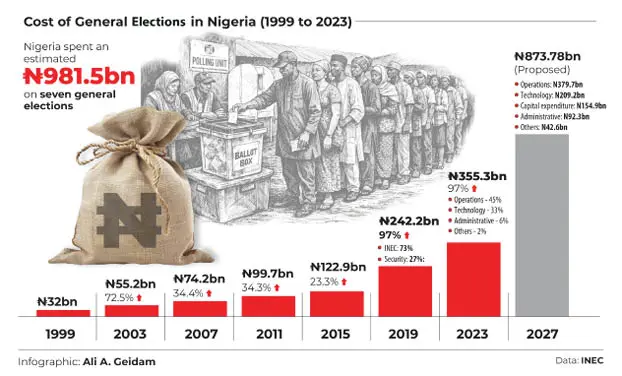
For INEC, N32 billion spent on the country’s first post-military elections in 1999 to the N873.78 billion proposed for 2027, the financial outlay for choosing leaders has expanded steadily over the past 28 years. A review of official figures from the Independent National Electoral Commission shows a consistent upward trend in election expenditure across successive cycles, reflecting the growing scale, logistics and technological demands of managing polls in Africa’s most populous democracy.
1999 to 2023 election cost
The cost of conducting general elections in Nigeria has increased significantly since the country returned to democratic rule in 1999. Data from the Independent National Electoral Commission (INEC) and historical budget records compiled by Weekend Trust show that election expenditure has risen from N32 billion in 1999 to a proposed N873.78 billion for the 2027 general elections.
The data shows that the 1999 general elections were conducted at an estimated cost of N32 billion. In 2003, expenditure increased to about N55.2 billion, representing a 72.5 per cent rise within one electoral cycle. By 2007, the cost had climbed to approximatelyN74.2 billion, a further 34.4 per cent increase from 2003.
In 2011, spending reached about N99.7 billion, reflecting a 34.3 per cent rise compared to 2007. The 2015 general elections cost roughly N122.9 billion, indicating a 23.3 per cent increase over the 2011 figure.
A sharper escalation occurred in 2019 when the cost rose to approximately N242.2 billion. This represented a 97 per cent increase compared to 2015. Records show that about 73 per cent of the 2019 allocation went directly to INEC for election operations, while the remaining 27 per cent supported security agencies and related services deployed for the polls.
The 2023 general elections record the highest expenditure so far at over N355.3 billion, marking a 46.7 per cent increase from the 2019 figure. According to INEC’s financial disclosure, the 2023 expenditure was broken down into major components. Electoral operations accounted for about N159.8 billion, representing approximately 45 per cent of total spending. Electoral technology, including accreditation and result management systems, consumed about N117.4 billion, equivalent to roughly 33 per cent. Administrative costs stood at about N20.4 billion, representing nearly 6 per cent, while contingency and unforeseen expenses amounted to about N7.4 billion, roughly 2 per cent. The remaining balance covered other related election activities and statutory obligations.
Cumulatively, Nigeria spent an estimated N981.5 billion on seven general elections between 1999 and 2023. Over the 24 years, election costs increased by more than 1,000 per cent when comparing the N32 billion spent in 1999 to the N355.3 billion spent in 2023.
2027 proposed election budget
Looking ahead to 2027, INEC has proposed N873.78 billion for the next general elections. If approved, this would represent a 145.9 per cent increase over the 2023 expenditure and more than 2,630 per cent above the 1999 figure. The proposed 2027 budget is structured into major categories, including approximately N379.7 billion for operational expenses, N209.2 billion for technology, N154.9 billion for capital expenditure, N92.3 billion for administrative costs and about N42.6 billion for other related expenses.
Why election costs keep rising – National Commissioner
Former National Commissioner of the Independent National Electoral Commission, Festus Okoye, has attributed Nigeria’s rising election expenditure to the wide constitutional powers of the Commission, expanding voter population, logistics demands and macroeconomic pressures, stressing that higher funding alone cannot guarantee free and fair elections.
Speaking on the increasing cost of conducting polls, Okoye said the budget of any electoral management body is tied directly to its statutory responsibilities. In Nigeria, he noted, INEC is solely responsible for organising presidential, governorship, National and State Assembly elections, as well as Area Council elections in the Federal Capital Territory.
Okoye recalled that in the 2011 general election, Nigeria had 73,528,040 registered voters spread across 119,973 polling units. Following a voter register clean-up, the figure dropped to 69,288,117 in 2015, before rising to 84,004,084 in 2019.
He added that polling units increased from 119,973 in 2011 to 176,846 by the 2023 general election, reflecting the need to accommodate a growing electorate and reduce overcrowding.
The former commissioner said the expansion in polling units automatically translated into higher operational costs, including recruitment, training and deployment of personnel.
“For the 2023 general election alone, the Commission deployed over 1,131,814 ad-hoc staff and more than 91,382 vehicles,” he said, noting that each of the 176,846 polling units required staffing, supervision and logistical coordination.
Beyond polling units, he said collation officers must be trained and deployed to 8,806 Registration Areas (wards), as well as to 774 local governments and Area Councils nationwide.
He added that result collation and declaration must take place across 993 State Assembly constituencies, 360 federal constituencies and 109 senatorial districts, in addition to governorship and presidential collation processes, all of which carry financial implications.
Okoye explained that macroeconomic variables such as inflation, the consumer price index and foreign exchange rates significantly influence election costs.
“The price of PMS in 2023 is not what it was in earlier years. The exchange rate of the dollar to the naira also fluctuates, affecting procurement, especially where electoral materials are sourced offshore,” he said.
He noted that some electoral supplies are imported, while others are procured locally, exposing the Commission to currency volatility.
The former INEC official also pointed to the increasing role of technology in elections, saying that new systems sometimes need to be acquired, while existing ones require upgrades. Printing the voters’ register for all polling units, preparing collation centres, generating power supply, providing water at distribution centres, and paying transporters and other logistics providers all add to overall expenditure.
He added that costs are not limited to election day, as funds must also support Continuous Voter Registration and ongoing staff training between election cycles.
Providing comparative figures, Okoye said the average cost per voter has, in fact, declined over time in dollar terms despite overall budget increases.
He cited figures showing that in one election cycle, the average cost per voter stood at $9.62, dropped to $7.38 in 2015, and further decreased to $6.72 in 2023.
This, he argued, suggests that while aggregate election budgets have risen, the cost efficiency per voter has improved in relative terms.
Okoye, however, cautioned that increasing budgetary allocation to INEC cannot on its own, guarantee credible elections.
He added that the media and civil society organisations have a responsibility to act professionally and help voters make informed choices. Voters themselves, he said, must resist inducement and act in the national interest.
Analysts raise concern
Political analyst, Kamilu Sani Fage, said Nigeria’s rising election budgets have not translated into credible outcomes.
Fage said the core purpose of elections globally is to enable citizens choose their leaders and achieve good governance, not to become an end in themselves.
However, he argued that Nigeria appears to have reversed that logic.
“But in our case, we are making, or we have successfully made an election as an end itself, in the sense that we pump a lot of money into it,” he stated.
Fage further suggested that by global standards, Nigeria could rank among the most expensive countries in conducting elections.
“And perhaps if you are to take statistics, Nigeria will be among the past 10 most expensive countries in the world in terms of conducting elections,” he said.
Despite the increasing allocations, he questioned the outcomes.
On his part, a Political analyst Jide Ojo has called for greater transparency in assessing Nigeria’s rising election budgets, saying the debate over value for money must be properly contextualised.
Ojo described elections as a “very complex exercise,” stressing that both endogenous and exogenous factors shape planning and implementation.
“There are those things that are within the control of INEC or State Independent Electoral Commissions, particularly for local government elections, and there are those other things they don’t have control over,” he said.
He questioned assumptions often made about the size of election budgets, asking whether the electoral body actually receives the full amount appropriated.
“Does INEC have control over the release of the money?” he asked, noting that while figures may appear large on paper, it is unclear whether all appropriated funds are eventually cash-backed and released.
Ojo said public debate has been clouded by misinformation, including claims that the commission planned to spend N200 billion on electronic transmission devices.
“I don’t think that is right. I don’t think that is true. But unless we see the audit reports of INEC, particularly from previous elections, we will not be in good conscience able to say whether there is value for money or not,” he stated.
According to him, what the commission has consistently published are election reports, not audited financial statements.
“I’ve not seen any audited financial reports. I don’t know whether they exist. And it is important to have that so that we know whether, vis-à-vis the budget, INEC is getting the full complement of money released,” he said.
He added that even though the law provides that INEC should receive its full funding at least 12 months before a general election, it remains unclear whether this provision is implemented strictly.
Ojo further argued that the sharp increase in election budgets must also be viewed against prevailing economic realities, particularly exchange rate depreciation and inflation.
He pointed out that ad-hoc staff payments, which may have been around N10,000 in previous cycles, would no longer be attractive under current economic conditions, especially with the minimum wage rising from N30,000 to N70,000.
He recalled that in 2025, INEC requested about N126 billion, drawing scrutiny from lawmakers who questioned the need for such funding in a non-general election year. According to him, then INEC chairman, Professor Mahmoud Yakubu, explained that about N86–N87 billion of that request was for personnel costs, noting that the commission also conducts off-cycle elections and by-elections.
Ojo maintained that without audited financial disclosures and clarity on actual fund releases, it would be difficult to fairly determine whether election spending represents value for money.
(Daily trust)
-

 World News22 hours ago
I’ll Be Impeached If I Lose The Midterms- Trump
-
News22 hours ago
Even Enemies Will Testify Lagos-Calabar Highway Is Tinubu’s Best Gift — Umahi
-
News24 hours ago
Oyo govt condemns exclusion of Makinde from Ibadan-Ijebu-Ode road flag-off
-
World News23 hours ago
US set for largest mass visa revocation in history targeting up to 200,000 foreigners, officials say
-
Politics13 hours ago
Why Tinubu Pulled Back Campaign Council List
-
Politics24 hours ago
Tinubu deserves to be president for long term – Olubadan
-
News24 hours ago
Adeleke releases N500 million relief fund for Osun election violence victims
-
Politics22 hours ago
2027: If ADC Can’t Perform, Don’t Vote For Us – Amaechi Tells Nigerians