Politics
Absence from congress, meetings with opposition figures, is Badaru on his way out of APC?

As Nigeria gradually inches towards the 2027 general elections, political calculations are already unfolding across the country.
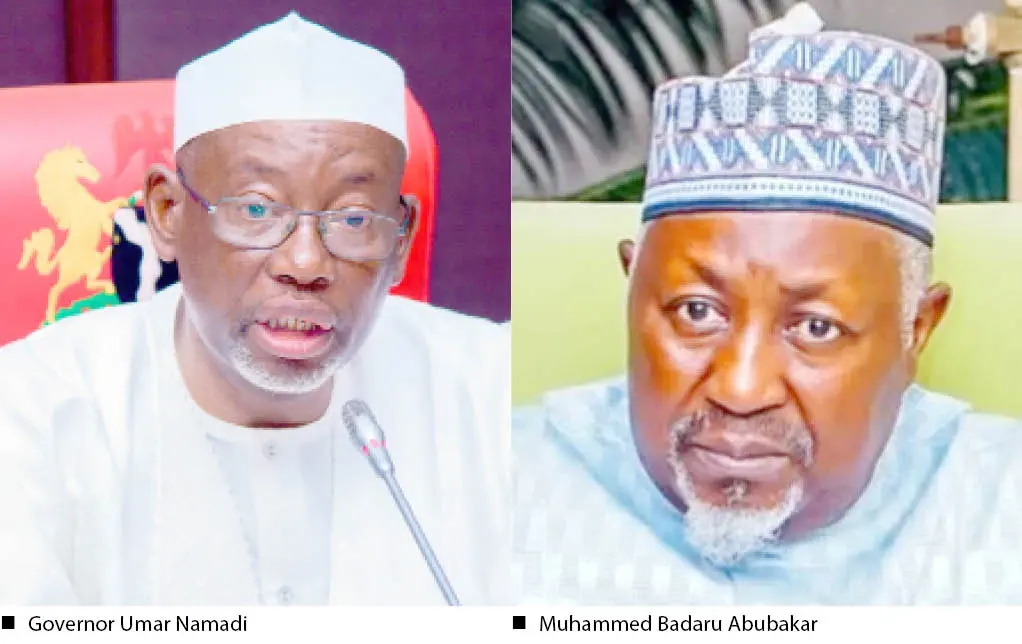
In Jigawa State, however, the unfolding drama revolves around one central figure, former governor of the state and immediate past Minister of Defence, Muhammed Badaru Abubakar.
In recent weeks, a series of political engagements involving the former minister have stirred intense debate among political observers and party loyalists in the state.
Although Badaru has publicly dismissed reports suggesting he may defect from the ruling All Progressives Congress (APC) to the African Democratic Congress (ADC), his recent interactions with prominent opposition figures have raised eyebrows and reignited conversations about the direction of Jigawa’s politics ahead of 2027.

While some analysts see the meetings as routine political consultations typical of northern political culture, others believe they may represent early signals of shifting alliances that could reshape the political landscape of the state.
Harvest of political speculations
The latest wave of speculation did not emerge overnight. Rather, it has been building gradually through a combination of political symbolisms, public engagements, and the activities of Badaru’s supporters.
The conversation intensified when a prominent loyalist of the former minister, Zakari Kafin-Hausa, shared on social media a video of a cleric criticising the policies of President Bola Tinubu.
In the video, the cleric alleged that the administration favours Southern Nigeria despite strong electoral support from northern voters in the 2023 election.
Political watchers interpreted this as a subtle expression of dissatisfaction among some northern political actors.
The speculation was further fuelled by Badaru’s recent meetings with key figures from across the political divide.
Within the span of a week, the former minister held two separate meetings with Mustapha Lamido, the Peoples Democratic Party (PDP) governorship candidate in Jigawa during the 2023 election and son of veteran politician Sule Lamido.
Mustapha Lamido himself has been rumoured to be considering moving from the PDP to the ADC, a development that has added another layer of intrigue to the unfolding political dynamics.
Badaru also reportedly met with former senator Ubale Shitu, a notable figure within the ADC structure in Jigawa, as well as with former governor Sule Lamido a political rival with whom he once shared a bitter confrontation.
Further to that, Badaru’s absence at the APC congresses particularly the state congress held on Tuesday has intensified the suspicion of a potential parting of ways with the party that provided him the platform to become governor and minister.
Many high-profile figures, including Governor Namadi, National APC representatives, and 2023 governorship aspirants Farouk Aliyu and Sabo Nakudu, attended the congress.
Other bigwigs who attended included former Immigration Comptroller General, Muhammad Babandede, federal and state lawmakers and the Speaker of the House of Assembly, Haruna Aliyu.
The congress elected Ahmad Garba as the state chairperson and 35 other executive members from across the state’s three senatorial zones.
In his inaugural address, Mr Garba delivered what appears to be a warning to the former minister.
He said no individual can successfully play politics in isolation, warning that the new leadership would not tolerate “dual loyalty.” Some observers interpreted the remarks as referencing Mr Badaru’s ties with both the APC and the ADC in the state.
From rivals to Ramadan visits?
For many observers, the meeting with Sule Lamido was perhaps the most surprising.
During Badaru’s tenure as governor, Lamido faced criminal charges that resulted in his brief detention in 2017 following accusations of defamation and public disturbance. The legal battle at the time deepened the political rivalry between the two camps.
Yet in what supporters describe as a “gesture of reconciliation,” Badaru recently visited Lamido at his residence — an act that many in Jigawa politics have interpreted in different ways.
Badaru’s allies insist the meeting should not be politicised.
Speaking on a local radio programme, Kafin-Hausa confirmed that several opposition figures had indeed visited the former minister, but he framed the engagements as social interactions linked to the spirit of Ramadan.
No rift with Gov Namadi
Despite the swirling rumours, there is little evidence of an open confrontation between Badaru and his successor, Governor Umar Namadi.
In fact, the two leaders have consistently maintained a cordial relationship in public.
Badaru was instrumental in supporting Namadi’s emergence as APC governorship candidate in 2022 and later endorsed him during the election campaign.
Since leaving office, he has also spoken positively about the governor’s performance, stating on several occasions that Namadi’s achievements in office have validated the choice of his administration’s successor.
Governor Namadi, on his part, has repeatedly dismissed suggestions that divisions exist within the state’s ruling party.
He has urged party members to remain focused on governance and avoid being distracted by political rumours.
Observers say this mutual respect has helped preserve relative stability within the APC structure in Jigawa.
The Underlying Political Tensions
Nevertheless, beneath the surface calm lies a complex web of political interests.
The roots of the current tensions can be traced back to the internal contest that produced Namadi as the APC governorship candidate in 2022.
At the time, several political heavyweights within the party had expected to clinch the ticket, only to be surprised by the emergence of Namadi, who had previously served as commissioner and deputy governor but was widely seen as a quiet technocrat rather than a dominant political figure.
Since assuming office in 2023, Governor Namadi has pursued a governance approach that prioritises institutional reforms over traditional political patronage.
Some party members have taken to local radio stations and social media platforms to express their dissatisfaction, arguing that the administration has sidelined grassroots political mobilisers.
This discontent has created a subtle but noticeable undercurrent within the party.
What It could mean for 2027
For now, many analysts believe it is too early to draw firm conclusions about Badaru’s political intentions.
According to political commentator Muhammad Haruna, the former minister is known for his cautious and calculated style of politics.
“He is not someone who rushes into political decisions,” Haruna said. “He usually studies the environment carefully before taking any major step.”
The Jigawa state government when contacted, however dismissed concerns over the recent political moves by the former Governor saying his possible defection from the ruling All Progressives Congress (APC) would not weaken the party in the state or at the national level.
The Chief Press Secretary to the Jigawa State Governor, Hamisu Mohammed Gumel, made the remark while reacting to the absence of the former governor at the recent state congress of the party and his alleged meetings with politicians believed to be members of opposition parties.
Speaking on the development, Gumel said although the government had observed Badaru’s recent activities, including visits to some opposition politicians and social media posts showing such engagements, the development was “not a thing to worry about” for the APC in Jigawa.
“Of course, we have noticed that the former governor was not present at the state congress, and as you rightly said, he has recently been seen visiting the houses of some opposition party members and taking pictures for social media posts,” Gumel said.
He described the development as unfortunate, adding that it was surprising for a politician of Badaru’s stature to allow himself to be influenced by what he called inexperienced individuals pursuing personal political ambitions.
“As much as I can say this is unfortunate, it is not a thing to worry about because even if he ultimately leaves the APC, which is what he appears to be contemplating now, it will not reduce anything for the party either in the state or at the national level,” he stated.
Gumel also referenced the recent House of Representatives bye-election in the former governor’s area, alleging that Badaru failed to deliver victory for the APC in his own ward.
The media aide to former Minister of Defence and former Governor of Jigawa State, has dismissed speculation about his principal’s alleged defection from the ruling All Progressives Congress (APC).
In a response to Daily Trust, the aide, Mati Ali, clarified that Badaru remains a committed member of the APC and has no intention of leaving the party.
Mati explained that the recent visit by the former minister to Sule Lamido, a chieftain of the opposition People’s Democratic Party (PDP), and his son Mustapha Sule Lamido, should not be misconstrued as a political realignment.
According to him, the meeting was part of ongoing political consultations aimed at mobilising support for President Bola Ahmed Tinubu ahead of the 2027 general elections.
He further noted that Badaru’s absence at the recent APC state congress in Jigawa State should not be interpreted as a sign of defection.
“His absence at the congress does not in any way signify that he is leaving the party. He is still a loyal and committed member of the APC,” the aide added. (Daily trust)
-

 Business16 hours ago
Job losses loom as N3.9trn debt may cripple 22 firms
-
News17 hours ago
Delta dep director’s killing: Police arrest commissioner, 3 others
-
Business17 hours ago
GTCO Plc Releases 2026 Half Year Audited Results
-
 Business17 hours ago
Fuel import: Abuja court ruling opens fresh battle
-
Metro17 hours ago
Why Nigerians should stop boiling eggs, rice together – Experts
-
News16 hours ago
FG plans to lift 5 million Nigerians out of poverty with skills acquisition
-
Politics17 hours ago
Obi makes U-turn, says he’ll restore petrol subsidy after curbing corruption
-
Metro17 hours ago
Hospital seeks to stop inquest into Chimamanda son’s death