News
Shanties and drug peddling… inside filthy settlements springing up along Lagos-Calabar coastal highway

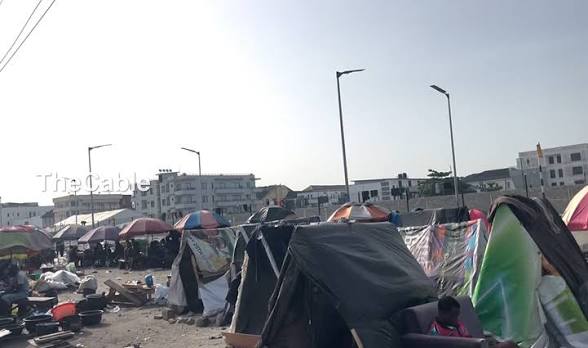
The newly constructed phase one section of the Lagos‑Calabar Coastal Highway, a 700‑kilometre corridor hailed as a transformative artery that would cut travel times, boost trade, and unlock economic potential along Nigeria’s south‑south coast, now bears, behind its partitions, the stark imprint of shanties and heaps of refuse.
At first glance, the shanties appear as scattered, makeshift structures along Maruwa on the Lekki–Epe axis, almost blending into the roadside. But a closer look reveals a dense cluster of shelters.
Built from splintered wood, salvaged planks, and rusting nails, the fragile shelters are draped in faded tarpaulins — blues, greys, blacks, and burnt orange — pulled into crude V-shapes that barely shield occupants from Lagos’ harsh sun and rain, held down only by stones to keep the wind from ripping them apart.
Some are no wider than a corridor, narrow enough that two people sharing the space must negotiate every movement. Inside, the air is heavy, unmoving. A single shanty can house two or three people, their lives compressed into a few square feet of heat, darkness, and improvisation.

In front of one such structure sat 29-year-old Musa, a native of Argungu LGA in Birni Kebbi, Kebbi state, who had come to Lagos in search of greener pastures. Beside him, his makeshift charging station — a wooden board cluttered with tangled wires and multiple sockets — buzzed to life, powered by the relentless growl of a petrol generator.

Within the settlement, men move in and out of the shanties — some lounging idly, others tending to small trades that sustain the community.
Musa told TheCable that his presence in the settlement is driven by the high cost of rent in the city, rather than by choice.
“The government sometimes comes to chase us. But they have taken a pause now because the election is around the corner,” he told TheCable.
“I’m staying here not because I like it, but because I don’t have anywhere to stay. If I can afford money for rent, I would find a better space.”

Musa explained that with as little as N20,000 to N30,000, one can erect a shanty — a fragile claim to a space in a city that offers little mercy to the poor.
Beneath this informal order lies a system of control. The area is controlled by a king they call the “Sariki” — the community head who mediates their stay with the enforcement agencies.
Musa alleged that business owners in the settlement are required to contribute N10,000 each from time-to-time, which is collected by the Sariki and allegedly paid to law enforcement officers to prevent the demolition of their shanties.
He told TheCable that the last time such a payment was made was on Monday, April 6, a day before TheCable’s visit.
“If enforcement agencies come to demolish our shanties, the Sariki will gather money from business owners, N10,000 each, and settle them, just to ensure we continue having a shelter.”
At the time of our visit, the Sariki was nowhere to be found, but his presence lingered in every conversation.
SHADY BUSINESSES ON THE RISE ALONG THE COASTAL HIGHWAY

Despite the chaos, the area buzzes with activity, from wood sales, barbing salons, and phone charging stations to provision stalls and the discreet trade of hard drugs.
Further down the stretch, another resident in his 30s spoke with the ease of someone who has watched the area evolve long before the highway carved through it.
His trade reveals a darker undercurrent, as he told TheCable that he deals in drugs including marijuana, cocaine, and methamphetamine, locally called “ice”.
When asked about the price, he said a gram of methamphetamine is sold at N14,000, while persuading these reporters to patronise his trade.
“I’ve been here for over 20 years,” he said, implying that the coastal road is the newcomer, not him.
Meanwhile, at the entrance of this area, just behind the barbed wire partitions meant to secure the highway’s edges, lies another reality entirely.

What should have been protective buffers have morphed into informal dumping grounds. Piles of refuse, including plastic waste, rotting food, and human excrement, sit exposed, baking under the sun.
The air is thick with the acrid stench of urine, sharp enough to sting the nostrils and linger long after one has left.
The Lagos-Calabar coastal road, the brain-child of President Bola Tinubu, stretches about 1,600 kilometresalong Nigeria’s southern coastline, connecting Lagos to the southeastern states.
It was conceived as a bold infrastructure project that promises to ease congestion, enhance connectivity, and unlock economic potential along Lagos’ shoreline.
Controversy arose over environmental concerns, as the project was reported to have bypassed proper environmental impact assessments (EIA) in some sections, raising fears of long-term damage to fragile coastal ecosystems.
David Umahi, minister of works, had said that upon completion, the highway will feature multiple spurs connecting major towns and cities, including a link to the Ogoja-Ikom-Cameroon road.
However, the growing presence of shanties, informal activities, and waste along parts of the corridor is already undermining the project’s objectives.
As the Lagos population expands and housing costs soar, many have been pushed to the margins, living under bridges, abandoned vehicles, and shanties.
The recent displacement from waterfront demolitionsin communities like Makoko has also pushed many into spaces like this.
With no comprehensive resettlement plan, and as the cost of living continues to climb, more people are pushed into living under bridges, along highways, behind fences — turning public infrastructure into shelters.
And when the rains come, the situation worsens. Floodwaters creep into these fragile structures, soaking their mattresses, wooden frames and seeping into sleeping spaces.
THE LAGOS STATE ENFORCEMENT DRIVE

The Lagos state government has repeatedly carried out enforcement raids targeting homeless persons in informal settlements across the city.
In January 2026, the state arraigned 62 suspects arrested during a midnight enforcement operation by the environmental task force across several parts of Lagos Island.
In May 2025, Lagos arrested and arraigned 74 homeless individuals during a clean-up enforcement operation across key areas within the Lekki axis of Lagos Island.
In November 2024, the state task force carried out a late-night operation along the rail track from Pen Cinema underbridge to Fagba Junction, arresting 94 suspects.
However, with economic hardship biting harder, such operations have done little to stem the growing number of people seeking shelter in informal settlements.
When contacted on the situation along the coastal road corridor, Tokunbo Wahab, commissioner for environment and water resources, said Lagos is under increasing pressure from rapid population growth and migration.
He noted that although the state occupies a relatively small landmass, it accommodates over 10 per cent of Nigeria’s population.
“It is also important to acknowledge that Lagos increasingly bears the burden of migration driven by limited opportunities in other states. Many people arrive in search of better economic prospects without making adequate arrangements for accommodation, which often leads to the occupation of public spaces for shelter,” Wahab told TheCable.

The commissioner said the proliferation of shanties along the coastal highway corridor is partly linked to ongoing enforcement efforts across the state, which have displaced squatters from other public spaces.
Wahab said the Lagos police command has approved the establishment of a dedicated Lagos-Calabar Coastal Highway unit to secure the corridor and prevent the re-emergence of illegal structures.
“As we continue to clear illegal structures under bridges and other public spaces, displaced squatters sometimes relocate to new areas, including the coastal highway, where they create informal settlements and contribute to environmental challenges such as indiscriminate waste disposal, open defecation,“ he added.
“The Lagos state government is also in the process of procuring additional compactors for Private Sector Participation (PSP) operators to improve waste collection along the corridor. In the interim, LAWMA will continue to intervene and cart away waste collection on the corridor”
Responding to allegations that residents of the area pay officials to delay demolition, Wahab said the coastal highway project falls under the federal ministry of works, not the state ministry of environment and water resources.
The commissioner reiterated that the state government does not support the growth of informal settlements, adding that efforts are ongoing to ensure communities are properly planned, documented, and integrated into governance structures.
“As such, I am unable to comment directly on those claims. However, at this stage, such allegations remain unverified and appear to be based largely on hearsay,” he added.
“The state is working to ensure that all communities are properly planned, documented, and integrated into governance structures so that residents can be accounted for and provided with essential infrastructure and services.
“Governor Babajide Sanwo-Olu recently approved the recruitment of 1,300 additional personnel into the Lagos State Environmental Sanitation Corps (KAI) to strengthen enforcement and sustain environmental compliance across the state.”
TheCable also contacted Olufemi Dare, the federal controller of works in Lagos, who denied allegations that officials were collecting payments to stall demolitions of shanties along the Lagos–Calabar coastal highway.
“Go there in the evening, it’s like a market. Nobody collected money from anyone. We pay heavily to make sure that the place is cleared. For someone to say that we are collecting money to stall demolition is not true,” Dare said.
He explained that the ministry works with the Lagos state task force to clear the area, adding that the occupants often return within weeks of their removal.
According to him, the last enforcement in the area took place about a month ago, and such operations often involve large-scale roundups.
Dare urged the state government to provide permanent solutions for the residents.
“We clear that place every now and then. Maruwa is where you will see all the bad boys and touts who move to Lagos. We engaged the Lagos State task force to help us clear that place. Once we clear them out, we burn their shanties and mattresses, but give them one week, and they are back there again,” he added.
MORE PHOTOS BELOW


Photos of enforcement carried out by ministry of works in conjunction with Lagos task force in February.


(The Cable(
-

 Metro17 hours ago
Man threatens to release Kano governor’s nude videos, photographs
-
Sports18 hours ago
Harry Kane crowned 2026 Ballon d’Or winner
-
World News17 hours ago
Trump hits back at Obama over Saddam ‘Cheesecake Factory’ jab
-
Politics17 hours ago
‘He was trained in sanitation’ — Shettima says Atiku can’t govern modern economy
-
News18 hours ago
OPHK troops destroy ISWAP enclaves in Lake Chad, kill 16 terrorists
-
Business17 hours ago
Microsoft offers voluntary exit packages to 60,000 staff
-
Politics17 hours ago
2027 Elections: 103m voters, 35m votes and the 68% who may decide the Presidency
-
Politics17 hours ago
FACT CHECK: How Tinubu’s Image On Bread Was Edited To Depict Obi