Politics
Meet the judges shaping Nigeria’s 2027 elections

In Nigeria, elections are no longer fought only at rallies, party primaries and polling units. They are fought in courtrooms, too. Sometimes the courtroom comes after the vote. Ahead of 2027, it is arriving before it.
The legal battlefield now sits at the heart of opposition politics. The Peoples Democratic Party (PDP), once Nigeria’s default ruling machine and still its largest opposition party, is split between rival camps. The African Democratic Congress (ADC), which some opposition figures hoped could become a new vehicle against President Bola Tinubu, is mired in its own leadership fight.
Independent National Electoral Commission (INEC) recognition, party conventions, nomination forms, state congresses and internal constitutions have become weapons in a larger struggle over who gets to organise before Nigerians vote.
The Supreme Court’s latest rulings have sharpened that battlefield. In one decision, it voided the PDP’s November 2025 Ibadan convention, which had produced Kabiru Tanimu Turaki as national chairman, after lower courts held that the convention proceeded in defiance of subsisting orders. In another, it set aside a Court of Appeal status quo order in the ADC dispute and returned the case to the Federal High Court for hearing – giving David Mark’s camp a reprieve, but not a final victory.

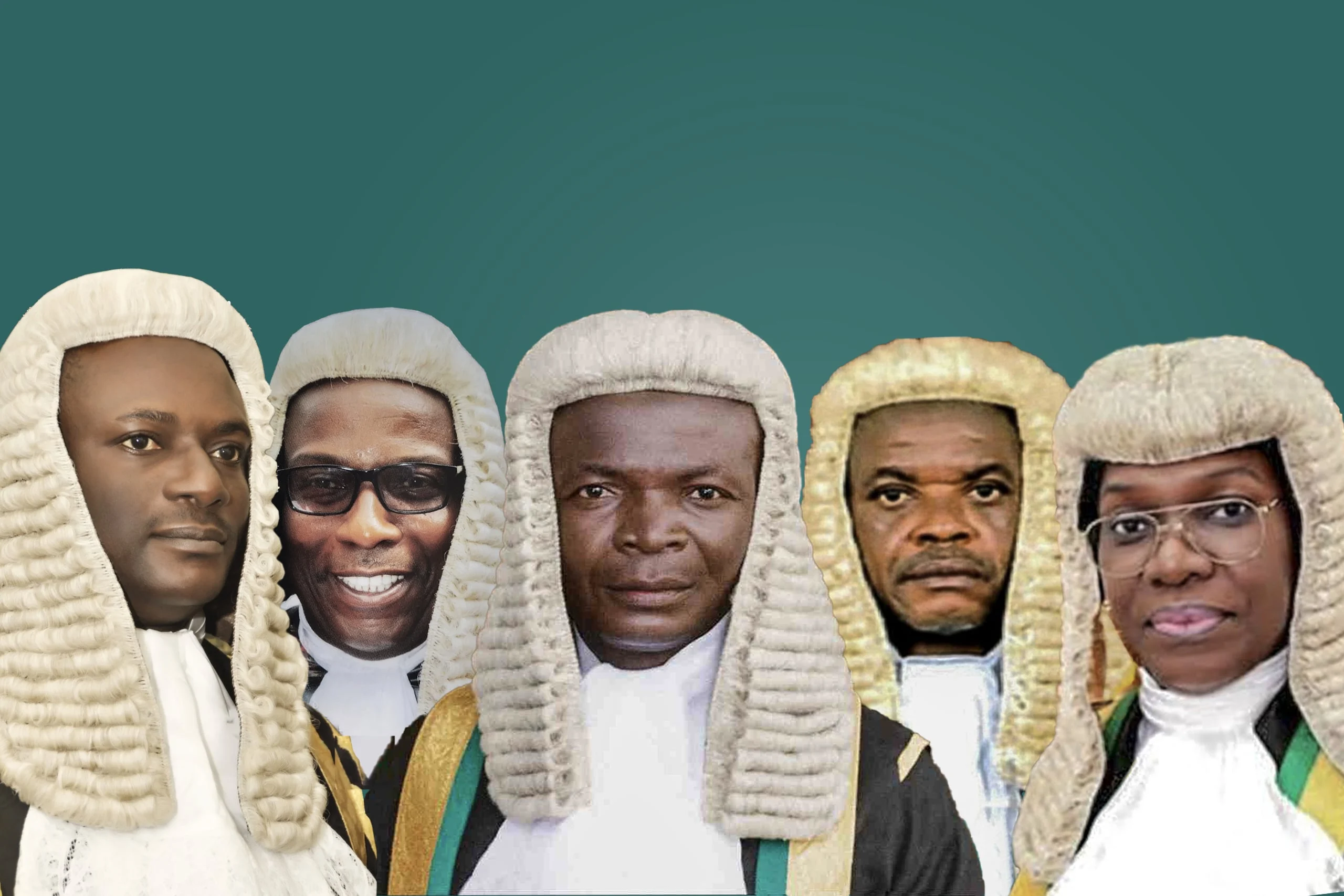
Behind those rulings is a cast of judges whose decisions are shaping the terrain on which the 2027 election may be fought. They are not candidates. They do not lead factions. But their orders can determine which factions are recognised, which conventions survive, which leaders appear on INEC records and which opposition platforms remain viable.
1. Justice James Omotosho: The order that became the foundation stone
Few Federal High Court judges have become as visible in Nigeria’s pre-2027 party litigation as Justice Omotosho. Sitting in Abuja, where the most sensitive political cases often land, he has become central to the PDP’s pre-2027 crisis.
His most consequential ruling came in the litigation over the PDP’s November 2025 national convention in Ibadan. On 31 October 2025, Omotosho stopped the party from proceeding with the convention, holding that it had not complied with statutory requirements, INEC guidelines and its own constitution. The case had been filed by aggrieved PDP figures, including Austin Nwachukwu, Amah Abraham Nnanna and Turnah Alabh George.
The PDP went ahead with the Ibadan convention. That decision proved costly. The Court of Appeal later upheld Omotosho’s judgment, and the Supreme Court has now voided the convention in a 3-2 split decision.
The result is that the Turaki-led faction has been badly weakened, while the camp aligned with Nyesom Wike, the Federal Capital Territory minister and a Tinubu ally, has emerged stronger.
The ruling had clear consequences for the balance of power within the PDP.
Wike worked against the PDP presidential ticket in 2023, helped deliver Rivers State to Tinubu and then joined Tinubu’s cabinet. Ahead of 2027, Wike has made clear that he supports the president’s reelection. For Tinubu’s opponents, the fear is not simply that the PDP is divided, but that its internal legal fights could neutralise it before the campaign even begins.
Omotosho’s rulings have also fed a wider complaint inside the PDP about the assignment of sensitive party cases. In November 2025, a PDP faction petitioned the Chief Judge of the Federal High Court, raising concern that cases involving the party had repeatedly gone before Justices Omotosho, Peter Lifu and Joyce Abdulmalik. The PDP petition alleged a troubling pattern – under which political cases were allocated to the same narrow group of judges. But no public finding of misconduct has been made against the judges.
- Why the ruling matters: His ruling became the legal base on which the Ibadan convention was later invalidated.
- Immediate political effect: The ruling strengthened the position of the Wike-aligned camp in the PDP.
- What to watch: Whether future PDP disputes continue to cluster around the same Abuja courtrooms.
2. Justice Peter Lifu: The convention stopper
Justice Lifu, also of the Federal High Court in Abuja, has emerged as another judge whose rulings have been critical in the PDP’s legal crisis. Like Omotosho, he has handled cases that go to the heart of whether the party can hold a recognised national convention before 2027.
In November 2025, Lifu stopped the PDP from proceeding with its Ibadan convention and barred INEC from monitoring, supervising or recognising its outcome. The suit was linked to former Jigawa State governor Sule Lamido, who argued that he had been denied the chance to obtain nomination forms and contest the national chairmanship.
The Supreme Court later treated the party’s decision to proceed with the convention, rather than first dealing with the lower-court order, as a fatal problem. In that sense, Lifu’s ruling did not merely delay the PDP. It became part of the chain of decisions that the Supreme Court later treated as to the legal standing of the Turaki-led convention.
Lifu’s name had already been politically sensitive because of Rivers State litigation. It also featured in complaints about inducements being offered in cases about the state’s political crisis. The National Judicial Council (NJC) said the petitions were unsubstantiated and found no proof of misconduct in relation to the ex parte orders at issue.
This episode explains why Lifu’s rulings have attracted so much political attention, although the NJC made no finding of misconduct.
- Immediate political effect: The ruling reinforced the legal challenge to the Turaki-led convention.
- What to watch: Whether fresh PDP leadership disputes return to the question of internal party rights versus court intervention.
3. Justice Joyce Abdulmalik: The judge testing party autonomy
Justice Abdulmalik sits at the intersection of two of Nigeria’s most explosive political-legal questions: how far courts can go in internal party disputes, and how quickly a party can reorganise itself before an election.
Her latest major ruling came in the ADC crisis. On 29 April 2026, she barred INEC from recognising or participating in congresses organised by the disputed Mark-led leadership. She also restrained Mark and other party figures from interfering with the functions and tenure of elected state executives.
That ruling threatened the ADC’s attempt to present itself as a serious 2027 opposition platform. The Supreme Court has now given Mark’s camp temporary relief by setting aside the Court of Appeal’s status quo order and sending the case back to the Federal High Court. But the central dispute remains unresolved.
Abdulmalik is not new to politically explosive cases. In 2024, she ruled against the release of federal allocations to Rivers State after finding that Governor Siminalayi Fubara’s budget process, based on a four-member assembly, was constitutionally defective. The Supreme Court later ordered the Central Bank of Nigeria (CBN) and the Accountant-General to stop further release of allocations to the state until the constitutional breach was corrected.
Her ADC ruling also raises a wider statutory question. Section 83 of the Electoral Act 2026 has been read by some lawyers and commentators as limiting judicial interference in the internal affairs of political parties. But the courts continue to hear cases where litigants frame party disputes as breaches of statutory rules, party constitutions or INEC-recognised processes.
- Why the ruling matters: Her ADC ruling put the opposition’s alternative platform under fresh legal pressure.
- Immediate political effect: ADC factions opposed to Mark’s caretaker leadership.
- What to watch: Whether courts treat Section 83 as a real shield for party autonomy or a limited protection that gives way when statutory compliance is alleged.
4. Justice Emeka Nwite: The judge holding the ADC timetable
Justice Nwite may now be the most important judge for the ADC’s immediate future. The Supreme Court did not finally settle the party’s leadership battle. Instead, it sent the matter back to the Federal High Court, where Nwite’s court is expected to conduct the substantive hearing.
That means the ADC has not won the war. It has won time.
Earlier, Nwite declined an immediate request by a factional ADC figure, Nafiu Bello, to stop Mark from parading himself as chairman. Instead, he directed Mark to appear and show cause why Bello’s request should not be granted. The matter then moved up the appellate chain, where the Court of Appeal issued a status quo order. INEC relied on that order to alter its treatment of the Mark-led leadership.
The Supreme Court has now said the Court of Appeal overstepped by issuing that preservatory order after dismissing the appeal. It held that control of the proceedings belonged to the trial court once the matter returned there.
For the ADC, speed now matters almost as much as substance. A delayed ruling could leave the party in limbo as politicians decide whether to stay, defect or build another platform. A clear ruling could either stabilise the Mark-led project or force another round of opposition realignment.
- Why the ruling matters: The ADC dispute is back in Nwite’s court for the hearing that may decide who controls the party.
- Immediate political effect: Temporarily, Mark’s camp gained – but only because the Supreme Court cleared a procedural obstacle.
- What to watch: Whether the Federal High Court moves quickly enough for the ADC to remain useful before 2027.
5. Justice A. L. Akintola: The contradictory-order problem
Justice Akintola of the Oyo State High Court became central to the PDP crisis because he did the opposite of what the Abuja courts had done. While Federal High Court orders in Abuja had moved against the Ibadan convention, Akintola authorised the Turaki faction to proceed.
That contradiction revived one of Nigeria’s oldest election-season anxieties: competing orders from courts of coordinate or overlapping jurisdiction. As the Nigerian Bar Association warned in April, political actors move through courts “to secure undemocratic political advantage”. By the time appellate courts intervene, the political facts on the ground may already have shifted.
Akintola’s order gave the Turaki faction temporary oxygen. It allowed the convention to proceed and enabled the faction to claim a leadership mandate. But the Supreme Court has now nullified the Ibadan convention, setting aside the legal basis on which that claim rested.
The episode matters beyond the PDP. As 2027 approaches, the temptation to use state and federal courts to produce rival orders will grow. Unless higher courts impose discipline early, party primaries and leadership fights may be shaped as much by jurisdictional manoeuvre as by internal votes.
- Why the ruling matters: Akintola’s ruling showed how rival court orders can become political weapons.
- Immediate political effect: Temporary gains for the Turaki faction.
- What to watch: Whether the NJC and appellate courts crack down harder on contradictory political orders before 2027.
6. Justice Biobele Georgewill: The conciliator
Not every judicial intervention in the PDP crisis has been coercive. In March, Court of Appeal Justice Georgewill urged PDP factions to resolve their differences through dialogue, describing the dispute as a family affair.
That intervention briefly suggested a less destructive path. The PDP could have treated the courts as a warning and negotiated a political settlement before the litigation hardened. Instead, the talks collapsed and the cases continued towards the Supreme Court.
Georgewill’s role is useful because it shows the limits of judicial diplomacy. Courts can urge settlement, but they cannot make rival factions trust one another. In the PDP, the incentives point towards litigation because each side believes a favourable order could unlock INEC recognition, party assets and the 2027 ticket machinery.
- Why the ruling matters: Georgewill’s approach represents the road not taken – judicial pressure towards settlement rather than winner-takes-all litigation.
- Immediate political effect: The conciliatory opening closed quickly.
- What to watch: Whether appellate judges try similar mediation in future party disputes, or move faster to final orders.
7. Court of Appeal panels: The appellate that shaped the disputes
The Court of Appeal has played a crucial middle role in both the PDP and ADC disputes. It has not merely reviewed lower-court rulings. It has often determined whether a faction’s legal position survives long enough to become politically meaningful.
In the PDP dispute, appeal panels including Justices Mohammed Ambi-Usi Danjuma, Uchechukwu Onyemenam and Muhammed Mustapha heard multiple appeals arising from the leadership crisis. Their rulings upheld the legal obstacles to the Turaki-led convention and strengthened the effect of the Federal High Court decisions.
In the ADC dispute, a Court of Appeal panel involving Justices Onyemenam, Mustapha and Okon Abang ordered parties to maintain the status quo. INEC relied on that order in its treatment of the Mark-led leadership. The Supreme Court has now set that order aside, holding that it was unnecessary and improper once the appeal itself had been dismissed.
That reversal is important. It reminds political actors that interim or preservatory orders can have enormous political effects even when they are later overturned. In election-season litigation, timing can be decisive.
- Why the rulings matter: Their rulings translated trial-court orders into wider political consequences.
- Immediate political effect: In the PDP, the anti-Turaki camp; in the ADC, temporarily, those challenging Mark’s leadership.
- What to watch: Whether appellate courts become more cautious about orders that affect INEC recognition before final hearings.
8. Supreme Court five: The final arbiters, but not the end of politics
The Supreme Court is the final legal stop, but its latest rulings show that finality in law does not always mean closure in politics.
In the PDP case, a five-member panel – including Justices Mohammed Lawal Garba, Chioma Nwosu-Iheme, Simon Tsammani, Sadiq Umar and Stephen Jonah Adah – delivered a split ruling. The majority voided the Ibadan convention, while the minority treated the dispute as an internal party affair outside the proper reach of the courts.
That split matters. It shows that even at the apex court, there is tension over how far judges should go in policing party affairs. The majority emphasised compliance with court orders and statutory rules. The minority view, as reported, leaned towards party autonomy.
In the ADC case, the Supreme Court gave Mark’s camp breathing space by setting aside the Court of Appeal’s status quo order. But it did not finally declare victory for either side. The substantive case must still be heard at the Federal High Court. TheCable’s analysis of the ruling makes the point clearly: the judgment does not mean the Mark-led faction has won the leadership dispute.
For Tinubu’s opponents, the message is sobering. The courts may rescue one faction today and bury another tomorrow. But the broader effect is delay, uncertainty and fragmentation. Every week spent fighting over recognition is a week not spent building a national campaign.
- Why the rulings matter: Their rulings define the legal boundaries for opposition organisation before 2027.
- Immediate political effect: Wike’s PDP camp gained more clearly; Mark’s ADC camp gained only temporary relief.
- What to watch: Whether the Supreme Court’s split reasoning in the PDP case becomes the template for future fights over party autonomy.
(The Africa Report)
-

 News18 hours ago
Lakurawa terrorists kill four soldiers in Sokoto
-
Politics18 hours ago
Osun poll: APC, Accord wage N20,000-per-vote war
-
Sports18 hours ago
Gala reject £111m, insist Osimhen not for sale
-
World News18 hours ago
Ex-Cambridge professor accused of plagiarism found dead
-
Politics18 hours ago
Atiku, Obi, others’ summit shifted to August 31
-
Metro17 hours ago
Man Allegedly Beheads Woman In Adamawa Hotel
-
News18 hours ago
Helpless! Borno families sell houses to pay ransom
-
Metro18 hours ago
Family, friends celebrate Wigwe