Business
Dangote imported 1.46bn litres blended gasoline – NMDPRA

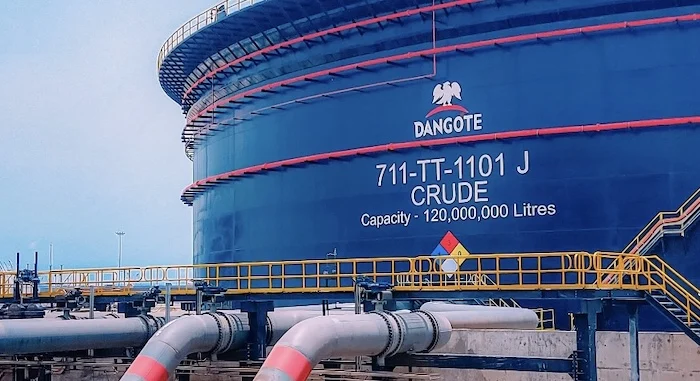
The Nigerian Midstream and Downstream Petroleum Regulatory Authority has revealed a growing reliance by Dangote Petroleum Refinery on imported gasoline blendstock, mainly to boost its refined fuel production, The PUNCH reports.
Latest industry data obtained from the NMDPRA’s Midstream and Downstream Petroleum Statistics for May 2026 and analysed by our correspondent on Sunday showed that the 650,000 barrels-per-day refinery imported about 1.46 billion litres of intermediates and gasoline blendstock between January and May this year, despite receiving volumes of domestic and imported crude oil.
The industry report showed that the refinery continued to supplement crude oil processing with imported intermediates, helping it sustain daily petrol production of 44.7 million litres and achieve an average capacity utilisation of 101.25 per cent in May.
It also indicates that the refinery continued to rely on imported intermediates and gasoline blendstock to optimise production of Premium Motor Spirit despite increased access to crude oil supplies.

The PUNCH reports that gasoline blendstock refers to intermediate petroleum products used in refining operations to produce finished petrol that meets required quality and environmental specifications.
The product, rather than being sold directly to consumers, serves as an intermediate feedstock that is blended with other refinery streams and additives to produce Premium Motor Spirit that meets required quality, octane and environmental specifications.
The blendstocks can be mixed with products generated from crude oil refining to increase petrol output, improve fuel quality and enhance refining flexibility. Common gasoline blendstocks include reformate, alkylate, naphtha and other high-octane blending components.
By introducing gasoline blendstocks into the refining process, a refinery can increase the volume of finished petrol produced without relying solely on crude oil inputs. This can be particularly useful when domestic demand is strong or when refiners seek to maximise returns from specific products.
In the case of Dangote Refinery, the NMDPRA data suggest that imported blendstocks may be helping the facility sustain high petrol output and reach its nameplate capacity of 650,000 barrels per day.
An analysis of the report by our correspondent showed that Dangote Refinery imported 658.31 million litres of gasoline blendstock in January, 306.89 million litres in February, 102.35 million litres in March, 147.37 million litres in April and 240.59 million litres in May.
The cumulative volume imported during the five-month period stood at approximately 1.46 billion litres. The latest data showed that after three consecutive months of decline between January and March, the refinery increased its blendstock intake in April and May, signalling stronger feedstock purchases as production activities expanded.
The May volume of 240.59 million litres represented a 63.3 per cent increase from the 147.37 million litres imported in April. The development comes as the refinery sustained high utilisation rates and continued to dominate Nigeria’s domestic fuel supply market.
According to the NMDPRA report, the refinery operated at an average capacity utilisation of 101.25 per cent in May, underscoring strong operational performance at the facility.
The report further showed that the refinery produced an average of 44.7 million litres of Premium Motor Spirit per day during the month. Out of the total PMS produced, about 41.5 million litres per day were supplied to the domestic market, while closing stock stood at 9.4 million litres.
The refinery also produced 24.5 million litres of Automotive Gas Oil, commonly known as diesel, daily. Of this volume, 18.2 million litres were supplied locally while 6.5 million litres were exported. For aviation fuel, the refinery recorded daily production of 21.9 million litres. Domestic supply stood at 2.8 million litres per day, while exports reached 17.5 million litres daily.
Further analysis of the NMDPRA data showed that the refinery continued to receive a combination of domestic and imported crude oil feedstock. In May, domestic crude supplied to refineries stood at 15.84 million barrels, while imported crude accounted for 2.08 million barrels, bringing total crude receipts to 17.92 million barrels.
This compares with total crude receipts of 18.37 million barrels in April, made up of 17.96 million barrels of domestic crude and 410,000 barrels of imported crude. The figures suggest that despite improvements in local crude supply, imported feedstocks and intermediates remain an important component of the refinery’s operations.
On a comparison of imported gasoline feedstock and capacity output, the data suggests that Dangote Petroleum Refinery is increasingly deploying imported gasoline blendstock as a strategic feedstock to maximise petrol production and sustain operations at levels close to, and even above, its installed refining capacity.
Total crude receipts increased from 9.53 million barrels in January to a peak of 20.92 million barrels in March before moderating to 17.92 million barrels in May.
In January, when crude receipts stood at 9.53 million barrels, Dangote recorded its highest gasoline blendstock import volume of the year at 658.31 million litres. The high level of imports during the period likely reflected efforts by the refinery to supplement feedstock availability and maintain product output as crude supply arrangements were still being stabilised.
As crude supplies improved in February and March, the refinery’s dependence on imported blendstock declined sharply. Total crude intake rose to 13.11 million barrels in February and further to 20.92 million barrels in March, while gasoline blendstock imports dropped from 306.89 million litres in February to just 102.35 million litres in March, the lowest level recorded during the five-month period.
The pattern suggested that increased access to crude oil reduced the refinery’s immediate need for imported gasoline components, allowing more products to be generated directly from refining operations.
However, the trend changed again in April and May. Despite maintaining strong crude receipts of 18.37 million barrels in April and 17.92 million barrels in May, the refinery increased its intake of gasoline blendstock from 147.37 million litres in April to 240.59 million litres in May, representing a 63.3 per cent rise within one month.
The increase coincided with some of the refinery’s strongest operational performance indicators since the commencement of production.
According to the NMDPRA report, Dangote Refinery achieved an average capacity utilisation rate of 101.25 per cent in May, surpassing its installed nameplate capacity. The refinery also produced 44.7 million litres of Premium Motor Spirit daily during the month, while supplying 41.5 million litres per day to the domestic market.
With a nameplate processing capacity of 650,000 barrels per day, the refinery would require about 20.15 million barrels of crude to operate at full capacity throughout a 31-day month. However, total crude receipts in May stood at 17.92 million barrels, below that threshold.
Yet, despite receiving less crude than the volume theoretically required for full-capacity operations, the refinery still reported utilisation above 100 per cent, suggesting that imported intermediates and gasoline blendstock played a complementary role in boosting finished product output.
The latest statistics also highlighted the continued absence of contributions from state-owned refineries. According to the report, the Port Harcourt Refining Company, Warri Refining and Petrochemical Company and Kaduna Refining and Petrochemical Company were all classified as being under shutdown status as of May 2026.
Their inactivity leaves Dangote Refinery as the country’s major operational refining hub and the largest supplier of locally refined petroleum products.
The refinery’s growing reliance on gasoline blendstock imports comes amid ongoing efforts by the Federal Government to achieve energy security, reduce dependence on imported refined products, and increase domestic refining capacity.
Since commencing large-scale operations, the Dangote Refinery has significantly altered Nigeria’s fuel supply landscape by reducing petrol imports and increasing local production, although the latest figures indicate that imported intermediates continue to play a strategic role in sustaining output levels.
With PMS production remaining above 44 million litres daily and blendstock imports rising again in May, the refinery appears to be strengthening its feedstock position as it seeks to consolidate its role in supplying Nigeria’s fuel requirements and expanding exports to regional markets.
Commenting, a Professor of Energy at the University of Lagos, Dayo Ayoade, explained that gasoline blendstocks are unfinished petroleum streams imported by refineries to enhance fuel quality, optimise operations and increase output.
Ayoade, speaking in an interview on Sunday, noted that the importation of blendstocks could help refineries produce higher-quality fuel that complies with modern environmental standards.
He further explained that the strategy also enables refineries to maximise the efficiency of their processing units and sustain production levels.
He said, “Gasoline feedstocks are unfinished petroleum streams such as straight run naphtha, butane, reformate, fluid catalytic gasoline and different types of streams that are basically combined and blended eventually to meet the regulatory standards of Premium motor spirit, which the Petroleum Industry Act alludes to.
“This is actually common practice all over the world; there is no issue. It is not cheating or any problems. Like all refineries in the world, blended gasoline feedstock will allow a refinery to improve the quality of its petroleum products, e.g., Euro V quality fuel that has low sulphur, which is the acceptable type of fuel we need in the market now.”
The energy expert added that the feedstocks provide flexibility for refiners to adjust output in response to market demand.
He added, “It is also used to optimise the operational base of the refinery because they use it to maximise the output of the refinery units like the catalytic crackers or hydrocarbon crackers to ensure that they are producing.
“The refinery also wants the secondary unit to work at full capacity so when they import the kind of blends, it will allow the refinery to continue to work, especially where crude supply is not as stable as you would want it to be.”
However, Ayoade said the key concern should be the economic implications of continued importation, particularly its impact on foreign exchange. He warned that the development could also fuel misconceptions about the refinery’s operations.
“Basically, that feedstock gives the refinery the option of flexibility too. They keep adjusting the mixtures to produce different products which are needed for the domestic and international markets.
“It is not a bad thing. The only issue is what is likely the production impact. There are larger consequences of costs. The refinery is now at capacity, but the importation means we are leaking foreign exchange.
“So money is leaving Nigeria to buy things from international markets and then being exposed to the risks of the international market. The importation also allows detractors or enemies of the refinery to say that the refinery is importing finished PMS, which is not true.” (Punch)
-

 Metro17 hours ago
Child trafficking suspect admits receiving ₦250,000 per child
-
News17 hours ago
Ebola: Uganda seeks Nigerian woman’s travel history from FG
-
Politics17 hours ago
2027: Tinubu campaign council creates new directorate, reshuffles teams
-
Business17 hours ago
Transport, petrol prices soar in S’East amid fuel discount
-
News17 hours ago
Abuja bizman arrested over alleged $120m fraud
-
Politics17 hours ago
Ebola case: Atiku urges calm, backs contact tracing
-
Metro15 hours ago
Otedola Bridge rapidly becoming Nigeria’s deadliest accident spot
-
Business17 hours ago
Senate Summons Olam Nigeria, MD, Eight Other Executives Over Alleged $15Billion Forex Transactions