News
Coastal states wary as floods disrupt Lagos economy amid disease fears

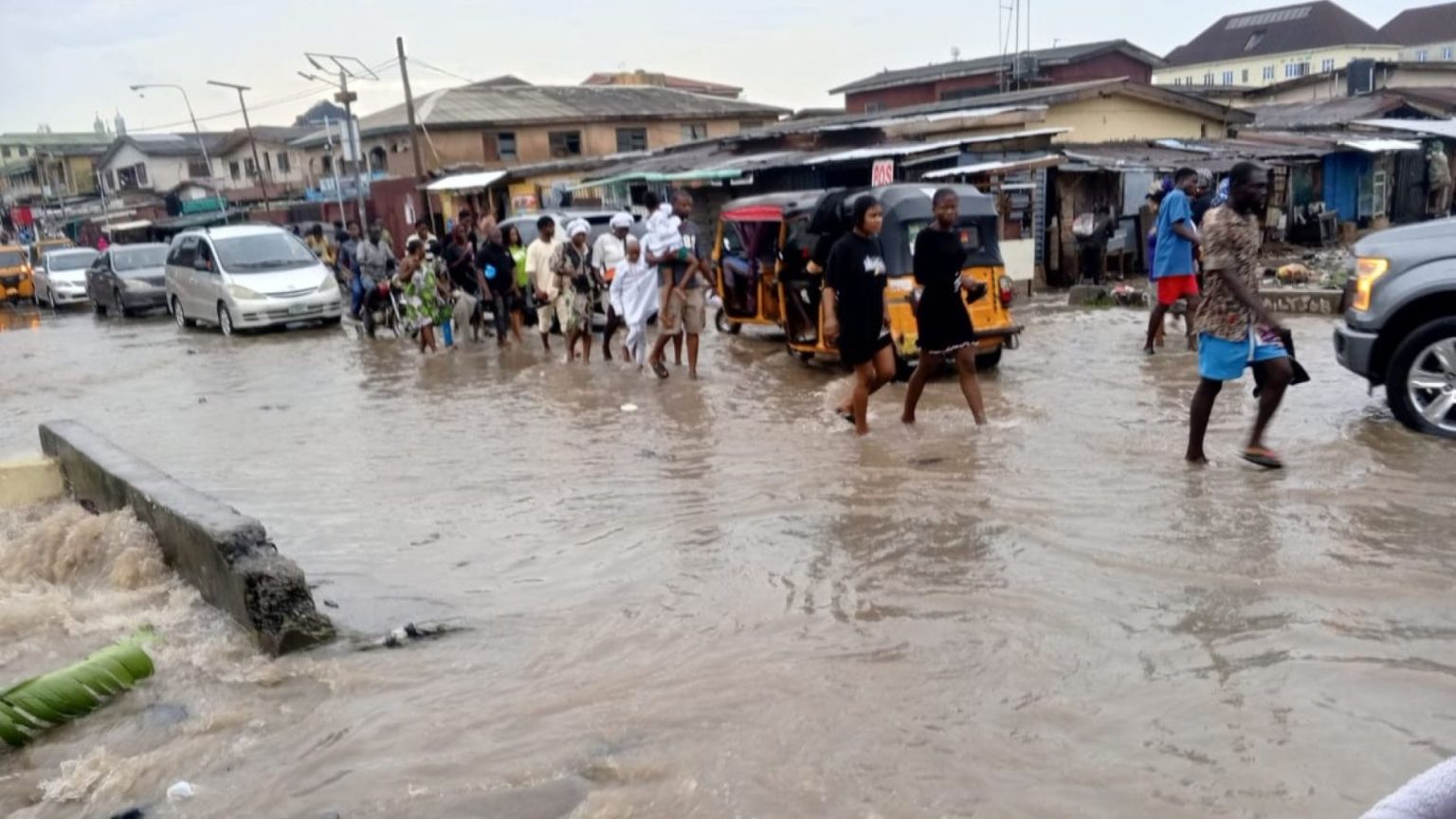
As heavy rainfall persists as predicted by the Nigerian Meteorological Agency (NiMet), health experts yesterday warned that floodwaters sweeping through Lagos could trigger cholera, malaria and typhoid outbreaks as the state grapples with mounting property damage, huge economic losses, renewed scrutiny of flood-control measures and forecasts of more heavy rainfall.
Heavy rainfall that has battered Lagos since Sunday submerged roads and homes, stranded commuters and motorists, disrupted businesses and commercial activities, and left communities across the state counting their losses as floodwaters overwhelmed drainage channels.
Public health expert, Dr Godswill Iboma, warned that the widespread flooding across Lagos and other parts of the country could trigger outbreaks of cholera, typhoid, malaria and other waterborne and vector-borne diseases, urging residents to take extra precautions with food, drinking water and personal hygiene.
Speaking with The Guardian, Iboma said contaminated floodwaters and stagnant pools created by the heavy rainfall provide conditions for the spread of infections. He explained that flooding increases the risk of diarrhoea, cholera and typhoid fever because floodwaters often contaminate drinking water sources, while stagnant water provides breeding grounds for mosquitoes, increasing the likelihood of malaria outbreaks.

He attributed the worsening flooding in many communities to environmental degradation, particularly indiscriminate waste disposal, which blocks drainage channels and exacerbates flooding.
Iboma advised residents, especially those in flood-prone communities, to boil water before drinking or using it where its safety cannot be guaranteed, keep food properly covered to prevent contamination, and sleep under insecticide-treated mosquito nets or use mosquito repellents to reduce the risk of malaria.
The public health expert also cautioned residents to remain vigilant, warning that flooding could force reptiles and other dangerous animals from their natural habitats into residential areas.
Similarly, physician Dr Babatunde, who posts on X via the handle @enodamade, advised Lagos residents to avoid eating or drinking outside their homes until conditions improve.
“Lagos should be thinking cholera! If you’re in Lagos, you should not eat or drink outside your home for a while. Make your own food. Wash your hands regularly. That flood and rubbish in the flood and the amount of sewage that has been washed around is plenty,” he wrote.
NiMet warns Lagos, coastal states of flash floods, heavy rainfall today
MEANWHILE, NiMet has warned residents of Lagos and other coastal states to brace for possible flash floods today as it forecast continued rainfall across southern Nigeria.
The warning follows the agency’s earlier prediction that 2026 would witness above-normal rainfall, with Lagos expected to be among the hardest-hit states because of its coastal location and low-lying terrain.
In its latest weather outlook issued yesterday, NiMet said light rainfall and thunderstorms are expected in the morning across Lagos, Ogun, Ondo, Edo, Rivers, Delta, Bayelsa, Cross River and Akwa Ibom states.
It added that rainfall would intensify later in the day, with moderate rain forecast across the southern region.
According to the agency, Lagos, Ogun, Ondo, Rivers, Bayelsa, Delta, Cross River and Akwa Ibom face a high risk of flash flooding.
NiMet also forecast thunderstorms and moderate rainfall across parts of Borno, Adamawa, Taraba, Bauchi, Kano, Jigawa, Katsina, Zamfara, Kaduna, Sokoto, Yobe, Gombe and Kebbi states in the North.
For the North Central region, including the Federal Capital Territory (FCT), Nasarawa and Benue states, the agency predicted cloudy conditions in the morning, followed by thunderstorms and moderate rainfall later in the day.
NiMet advised residents to remain vigilant, warning that strong winds could precede thunderstorms. It urged motorists to drive cautiously during heavy rainfall and poor visibility and warned residents against walking or driving through floodwaters.
The agency also advised members of the public to avoid taking shelter under tall trees during thunderstorms because of the risk of lightning strikes.
It further urged airline operators to obtain airport-specific weather reports to ensure safe flight operations.
Lagos spent N106.6b on drainage projects as flooding persists
LAGOS State spent more than N106.6 billion on drainage construction, dredging and rehabilitation projects between 2025 and the first quarter of 2026, yet widespread flooding has continued to disrupt lives and businesses across the state.
The findings emerged from an analysis of the Lagos State Budget Implementation Reports for the fourth quarter of 2025 and the first quarter of 2026, following heavy rainfall that began on Sunday and submerged major roads, stranded commuters, disrupted commercial activities and renewed concerns over the effectiveness of the state’s flood control measures.
The reports show that the state committed about N106.59 billion to flood control and drainage infrastructure through multiple capital projects aimed at improving stormwater management.
The largest expenditure was recorded under the Drainage Construction and Dredging Statewide project, which received N48.63 billion out of a revised budget of N59.26 billion, representing an implementation rate of 82.1 per cent.
The state also spent N13.90 billion on the rehabilitation of drainage infrastructure across local government areas, amounting to 55.1 per cent of the revised allocation of N25.22 billion.
Another N13.38 billion was expended on the Dredging and Construction of Drainages Across the State project, representing 73.9 per cent of its revised budget of N18.10 billion.
In addition, N24.69 billion was paid towards outstanding liabilities for drainage construction projects, accounting for 74.1 per cent of the revised allocation of N33.32 billion.
The four drainage-related projects accounted for about N100.59 billion in expenditure during 2025.
The investment continued in 2026, with the first-quarter budget implementation report showing an additional N6 billion spent on drainage construction and dredging projects.
According to the report, N27.15 billion was budgeted for the projects in 2026, with first-quarter spending representing 22.1 per cent of the allocation, leaving N21.15 billion available for the remainder of the fiscal year.
Despite the sustained investment in drainage construction, rehabilitation and dredging to improve flood resilience and protect critical infrastructure, the recurrence of flooding across Lagos has continued to raise questions about the effectiveness of the interventions as residents count the cost of each episode of heavy rainfall.
Experts estimate N500b economic losses as flooding disrupts Lagos businesses
ECONOMIC and investment experts have warned that the widespread flooding in Lagos could inflict massive losses on businesses, infrastructure and livelihoods, urging governments to strengthen flood mitigation measures.
The Chief Executive Officer of the Centre for the Promotion of Private Enterprise (CPPE), Muda Yusuf, said the flooding had severely disrupted economic activities in Nigeria’s commercial hub, paralysing transportation, manufacturing, construction, port operations and informal trade.
According to him, the impact extends beyond the immediate disruption of businesses to extensive damage to infrastructure, which will require substantial resources to repair after the floodwaters recede.
Yusuf attributed Lagos’ vulnerability to its low-lying coastal terrain, noting that the state’s geography significantly increases the risk of flooding.
He estimated the Lagos economy at about N200 billion daily and projected that the current flooding could result in economic losses of between N50 billion and N100 billion in a single day.
“The Lagos economy is estimated at N200 billion daily and this kind of severe flooding will lead to losses of nothing less than between N50 billion and N100 billion in a day. This does not even consider the damage caused by the flooding itself. We are also seeing losses to businesses, agricultural produce, livestock, poultry and fish. At the end of the day, the economic losses could be close to an estimated N500 billion,” he said.
Yusuf described the situation as alarming and called for stronger government intervention to reduce the impact of flooding.
Also, economist and investment specialist, Vincent Nwani, projected that Nigeria could record at least a 15 per cent loss in Gross Domestic Product (GDP) by the end of the rainy season.
He said businesses had already suffered significant setbacks, with many shops forced to close and warehouses inundated by floodwaters, resulting in losses running into billions of naira for affected owners.
Homeowners, businesses face mounting repair bills, property value decline
FOR homeowners and property investors, the consequences extend beyond immediate losses. Repeated flooding could reduce property values in flood-prone neighbourhoods, accelerate structural deterioration through prolonged dampness and weakened foundations, increase maintenance and repair costs, encourage mould growth that poses health risks to occupants, and raise insurance premiums where flood cover is available.
The Guardian learnt that many affected homeowners will face costly repairs to damaged foundations, walls, electrical systems, plumbing, roofs and interior finishes. Those without insurance or adequate savings may struggle to restore their properties, forcing some to sell below market value. Others may default on mortgage repayments or construction loans as the financial burden increases.
Developers with unsold housing estates in flood-prone locations could also face declining demand as prospective buyers become increasingly cautious. Investors may redirect capital to neighbourhoods with lower flood risk, leaving some completed developments vacant for longer periods and increasing financial pressure on developers.
Environmental experts have consistently warned that poor solid waste management is a major contributor to Lagos’ flooding challenge. While climate change is increasing the intensity of rainfall, human activities, particularly the dumping of refuse into drains, canals and wetlands, continue to worsen the impact.
The flooding has also raised questions about the effectiveness of enforcement against illegal waste disposal, drainage maintenance, urban planning and development approvals in flood-prone areas. With forecasts indicating another season of above-normal rainfall, urban planners said government intervention must extend beyond emergency response to include regular desilting of drains, stricter enforcement of environmental laws, restoration of natural waterways, improved waste collection and sustained public awareness campaigns.
An environmentalist and former president of theAssociation of Town Planning Consultants of Nigeria (ATOPCON), Moses Ogunleye, told The Guardian that adequate preventive measures were not taken despite many of the affected locations having previously been identified as flood-prone.
He noted that areas such as Lekki Peninsula, Gbagada and Victoria Island had experienced similar stormwater incidents in the past, adding that effective flood mitigation measures could have reduced the impact.
“If those hotspots were deflooded and proper drainage channels were constructed, it would have reduced the crisis,” he said.
Former Chairman of the Nigerian Institution of Estate Surveyors and Valuers (NIESV), Gbenga Ismail, said property owners and landlords would bear significant financial costs arising from repairs and restoration of damaged buildings.
He, however, predicted a gradual movement of residents away from some flood-prone parts of Lekki Peninsula to mainland locations, including Surulere and Apapa. According to him, the shift may not be immediately noticeable because of the housing shortage and sustained demand for accommodation in Lagos, but prolonged flooding could influence future residential choices and property investment decisions.
Sanwo-Olu approves dredging of 28 drainage channels to tackle Lagos floods
LAGOS State Governor Babajide Sanwo-Olu has approved the dredging of 28 additional primary drainage channels following flooding in parts of the state.
The move came as the state urged residents to remain calm, assuring that the government was closely monitoring drainage infrastructure, flood-prone locations and major water channels, adding that emergency response agencies remained on the ground to support affected communities.
The Commissioner for the Environment and Water Resources, Tokunbo Wahab, disclosed this in a statement signed by the ministry’s spokesperson, Kunle Adeshina, yesterday.
According to the statement, Wahab said the recent heavy rainfall was an extreme weather event that overwhelmed drainage infrastructure in several parts of the state.
He said the downpours triggered temporary flooding in communities including Victoria Island, Lekki, Ikeja, Gbagada, Mushin and Mafoluku.
He noted that the incident was not peculiar to Lagos, explaining that similar heavy rainfall also affected other African countries and parts of North America on the same day.
According to the commissioner, Lagos faces a more complex hydrological challenge because of its extensive network of lagoons, rivers, creeks and tidal water bodies.
He explained that the interaction between the Atlantic Ocean, Lagos Lagoon and other water bodies, particularly during high tide, naturally slows the discharge of stormwater into the sea, resulting in temporary flooding in low-lying areas after exceptionally heavy rainfall.
Atiku sympathises with Lagos flood victims, urges solidarity
REACTING, the presidential candidate of the African Democratic Congress (ADC) for the 2027 election, Atiku Abubakar, expressed sympathy with residents affected by flooding in Lagos State.
In a statement posted on his X handle yesterday, Atiku said his thoughts were with families, commuters, motorists, business owners and others whose lives and livelihoods were disrupted by the flooding.
“I extend my heartfelt sympathy to the people of Lagos who have been affected by the ongoing flooding. My thoughts are with the families, motorists, commuters, business owners and everyone whose lives and livelihoods were disrupted by this unfortunate event,” he said.
The former vice president said the incident underscored the need for solidarity during difficult times, adding that Nigerians should continue to support one another.
“At moments like this, we are reminded of the strength of our shared humanity and the importance of standing together in support of one another.
“I pray for the safety of all, and for a swift return to normalcy,” he added.
Doherty seeks compensation for victims, probe of environmental safeguards
ALSO, the Lagos State governorship candidate of the National Democratic Congress (NDC), Funso Doherty, called on the Lagos State Government to compensate residents and business owners affected by the recent flooding across the state and institute an independent investigation into whether environmental failures associated with major infrastructure projects contributed to the disaster.
Doherty, in a post on X yesterday, made the call following widespread flooding triggered by heavy rainfall that submerged roads, stranded motorists and disrupted commercial activities across Lagos.
He argued that while indiscriminate waste disposal may have contributed to the flooding, it did not fully explain the scale of the devastation.
“Lagos is once again being ravaged by floodwaters. Homes flooded, businesses shut, with widespread damage to lives and property. Yet again, this is being attributed to flash flooding and, predictably, fingers are being pointed at residents disposing of waste irresponsibly. This, however, does not tell the whole story,” he said.
Doherty attributed the situation to what he described as long-standing failures in environmental governance at both the state and federal levels. He cited documents his legal team obtained from the Bureau of Public Procurement (BPP) concerning the Lagos Coastal Road project.
According to him, the documents showed that no Environmental Impact Assessment (EIA) was made available to the BPP when it reviewed the contract, despite a N400 million provision for the assessment being included in the N1.1 trillion contract awarded to Hi-Tech Construction for Section One of the project.
“It shows that the road contract was specified, designed, costed and awarded, and subsequently commenced, without an EIA having first been properly conducted to assess and incorporate environmental concerns,” he said.
He also criticised the arrangement under which the contractor was responsible for procuring the Environmental Impact Assessment, arguing that it created an obvious conflict of interest that could undermine the independence of the assessment and the objectivity of its findings.
Doherty said the flooding experienced by communities adjoining the coastal road should not have come as a surprise, calling for an independent investigation, prompt remediation measures and fair compensation for affected residents and property owners where any breach of environmental laws is found to have contributed to the flooding.
He further urged governments at all levels to ensure that infrastructure projects comply fully with environmental regulations.
“A compassionate and responsible government will ensure that no contract, federal or state, however large or politically connected, is awarded and executed without complying with the environmental safeguards that our laws provide to protect the welfare and well-being of our people,” he said.
Floods kill 25 in Ghana, Côte d’Ivoire as heavy rain hits West Africa
RELATEDLY, severe flooding triggered by torrential rainfall claimed at least 25 lives across parts of West Africa, with Ghana and Côte d’Ivoire recording fatalities as heavy downpours inundated cities and forced emergency agencies into rescue operations.
In Ghana, at least 13 people died after torrential rain caused widespread flooding in the capital, Accra, according to the Ghana National Fire Service (GNF), which warned that the death toll could rise as search and recovery efforts continue.
The government urged residents to remain indoors or move to higher ground, while the country’s meteorological agency warned that more rainfall was expected, with a major storm approaching from the east.
Much of the floodwater from Sunday night’s downpour had begun to recede, but low-lying communities remained badly affected. Homes and vehicles were submerged, while several buildings sustained damage.
Emergency response teams comprising the police, fire service, the military and the National Disaster Management Organisation were deployed to affected areas to support rescue operations and protect lives and property.
In neighbouring Togo, persistent rainfall also caused widespread flooding in parts of the capital, Lomé, although no fatalities were immediately reported.
Meanwhile, in Côte d’Ivoire, at least 12 people were killed and five others injured after heavy downpours inundated the commercial capital, Abidjan, adding to the region’s growing toll from extreme weather. (Guardian)
-

 Politics18 hours ago
Atiku’s Lobbyist Deletes Post On Purported Trump Commission Appointment
-
News17 hours ago
Lab test showed my wife’s fresh orange juice unfit for consumption – Osinbajo
-
Politics18 hours ago
World Igbo Congress warns politicians against threatening Igbos over support for Obi
-
Politics18 hours ago
I am confident I will become Lagos governor next year – NDC gov candidate, Doherty
-
Business17 hours ago
Nigeria’s syndicated loans jump 21-fold to $2.86bn
-
Politics17 hours ago
Tinubu’s policies improving student welfare, says NANS
-
Metro18 hours ago
Nigerian-British businessman dies after penis enlargement procedure in Thailand
-
Metro17 hours ago
Kogi chief allegedly impregnates teen, damages womb