Politics
Referendum On APC And Other Factors That Triggered Oyebamiji’s Fall

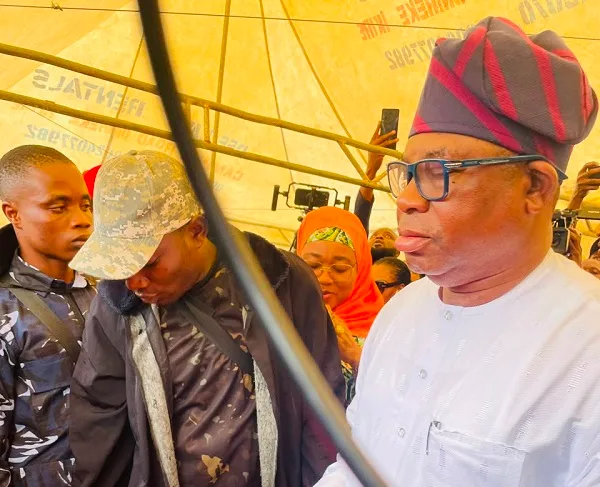
For the All Progressives Congress (APC), the 2026 Osun governorship election was supposed to be a carefully prepared rematch. Four years after losing the state to Ademola Adeleke, the party returned with a new candidate, Bola Oyebamiji.
His candidature had the backing of the federal government and a campaign that connected heavily on the influence of President Bola Ahmed Tinubu who many claimed originally hailed from the state and the APC’s national political structure.
But when the Independent National Electoral Commission (INEC) concluded the collation on Sunday, Adeleke had not only retained the state but widened the gap.
The Accord Party candidate polled 511,067 votes against Oyebamiji’s 444,815, winning by 66,252 votes. Adeleke won 19 of the state’s 30 local government areas, while Oyebamiji won 11.

The result raises a question that goes beyond the performance of the APC candidate. It questioned why the ruling party fail to convert its considerable political advantages into victory?
The answer appears to lie in a combination of internal party dynamics, the politics of federal intervention, Adeleke’s incumbency, his campaign strategy and the peculiar political character of Osun voters among several other factors.
EFCC’s own goal
Perhaps the most politically consequential development in the final stretch of the campaign was the freezing of accounts belonging to the Osun State Government by the Economic and Financial Crimes Commission (EFCC).
The commission said the action was connected to an investigation into alleged financial irregularities and denied that it was politically motivated. From a purely institutional perspective, the EFCC had the right to investigate suspected financial wrongdoing. But elections are rarely fought on institutional explanations alone. They are fought on perceptions. Politically, the optics were damaging. The timing of the action gave Adeleke a potent campaign narrative that his administration was being targeted by the federal establishment controlled by the APC. The directive by President Tinubu to the EFCC to unfreeze the account did little to change the perception.
APC’s unresolved primary wounds
The party also carried the baggage of its governorship selection process.
In December 2025, APC disqualified several aspirants. The party spent a significant part of the campaign period managing tensions created by the process through which its candidate emerged. The question is whether the eventual reconciliation was enough to restore the kind of deep grassroots cohesion required to defeat an incumbent. However the election result suggests that APC’s reconciliation, while visible at the leadership level, did not translate into sufficient statewide advantage.
The federal might paradox
The APC also faced an unexpected problem with one of its biggest assets, federal power. The party’s national campaign structure brought prominent politicians into Osun, underlining the importance attached to the election. Its campaign was backed by the political weight of the Tinubu administration. Ordinarily, such backing should strengthen a governorship candidate. But in Osun, it created a counter narrative. Adeleke had spent considerable time portraying the election as a contest in which the state must resist external pressure. The more the contest became associated with Abuja and national APC figures, the easier it became for the incumbent to personalise the election as a battle between himself and the federal establishment. This was particularly potent when combined with the EFCC controversy.
Adeleke also entered the contest with something Oyebamiji could not manufacture, which is a four year record in office. He had projects to commission, policies to defend and relationships with communities and traditional institutions to showcase. In the months leading to the election, the governor commissioned and flagged off several infrastructure projects.
The Adeleke political machine
Aside from government projects, Adeleke benefited from a political structure that predates his current administration. His family has been a major force in Osun politics for years, while Adeleke himself had already contested the governorship in 2018 before winning in 2022. The 2026 election therefore represented his third serious statewide governorship contest. He was thus familiar with the state’s political geography, knew the strengths of his opponents and had spent years building relationships with political actors and voters. Adeleke did not simply win his traditional Ede base. He won 19 LGAs, including major centres such as Osogbo, Ede North, Ede South, Iwo, Ife East and Ife Central.
In Ede North, his home base, Adeleke scored 35,427 votes against Oyebamiji’s 10,283. He also secured 36,480 votes in Osogbo, compared with Oyebamiji’s 30,474.
Davido amplified the Adeleke brand
Davido’s involvement was another unusual advantage. The global music star’s participation gave Adeleke’s campaign enormous visibility, particularly among younger voters. He amplified the cause and added celebrity reach, social media visibility and youth appeal to it including drawing international attention calling on the US government to focus on the election. The governor himself had also turned his dancing and informal public persona into a recognisable political brand. What APC opponents sometimes treated as evidence that Adeleke was unserious became, for his supporters, part of his appeal.
Rather than running away from the image, the Adeleke campaign embraced it.
The economic argument
The wider economic mood also created a difficult environment for APC. The party was asking voters to elect its candidate while controlling the federal government. Adeleke’s campaign repeatedly sought to draw a contrast between his administration and the previous APC administration, particularly around workers’ welfare, infrastructure and the state’s finances. The APC candidate’s own background made this argument particularly relevant because Oyebamiji had served as Commissioner for Finance under Oyetola. Adeleke’s campaign therefore tried to make the election a referendum not only on the incumbent’s record but also on the APC’s previous stewardship of the state. For Nigerians dealing with high food prices, reduced purchasing power and economic pressures, the party controlling the federal government can become the natural target of public frustration.
That creates a difficult environment for a ruling party’s candidate.
Oyebamiji therefore had to sell himself as a state level alternative while carrying the political baggage of a federal government whose economic record was already a major subject of public debate.
ADC’s Najeem Salaam factor
The ADC’s Najeem Salaam finished third with 17,180 votes. That number was nowhere near enough to challenge the two leading candidates, but the third force still mattered in the campaign. The election was initially widely described as a three way contest involving Adeleke, Oyebamiji and Salaam.
The ADC ultimately failed to win an LGA, but its presence gave voters an alternative to the two dominant parties. While there is limited inferences to claim that the ADC caused APC’s defeat, in a race decided by 66,252 votes, the existence of a third political option was certainly part of the electoral equation.
Adeleke’s incumbency advantage
Adeleke also had something APC could not manufacture, four years in office. His administration used the period before the election to showcase infrastructure and other government projects across the state. The commissioning of projects also provided political visibility.
Each commissioning offered the governor an opportunity to interact with communities, traditional rulers and local political actors while physically demonstrating what his administration claimed to have achieved.
The debate
The governorship debate was another potentially important moment. Adeleke had previously faced criticism over his public speaking and perceived lack of sophistication compared with more conventional politicians. But if his debate performance exceeded expectations, it could have helped neutralise one of the main arguments against him. Rather than being defined majorly by his dancing, public appearances and informal style, the debate offered him an opportunity to demonstrate knowledge of governance and present himself as an incumbent defending his record.
The voters
Ultimately, however, the decisive actors were the voters. The election demonstrated that Osun voters were prepared to make their own calculations despite the presence of powerful politicians, national party structures and federal influence. Reports of voters resisting attempts to disrupt voting further underline the determination of the electorate to protect the integrity of the process. There were instances where angry youths allegedly chased away suspected vote buyers and seized bags containing wads of naira notes at some polling units. A viral video seen by Daily Trust showed one of them displaying a nylon bag said to have been abandoned by the alleged vote buyers.
-

 Politics18 hours ago
Osun: Nigerians have paid APC in advance, balance due in 2027 — PDP
-
World News17 hours ago
Iran Offers $30,000 For Capturing, killing of US Soldiers
-
News4 hours ago
Concession of King’s College: Parents mobilise for protest
-
Politics21 hours ago
‘A reflection of the people’s will’ — Tinubu congratulates Adeleke on re-election as Osun governor
-
News17 hours ago
El-Rufai Accuses ICPC Of Isolating Him From Family, Files N10bn Suit
-
News5 hours ago
Leadership Failure Is A Sin Against God, Humans – Obasanjo
-
News5 hours ago
Bandits Invade Sokoto Community, Kill 32
-
Business3 hours ago
EFCC transfers $60m recovered from Nestoil to creditor banks