Politics
Atiku’s Fuel Subsidy Pledge Sparks Debate

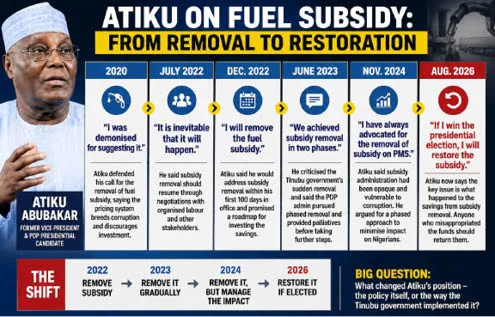
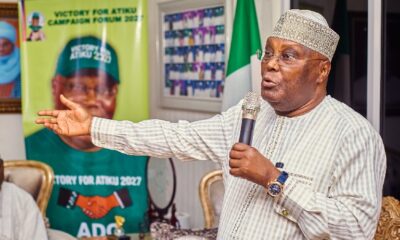
Former Vice President and African Democratic Congress (ADC) presidential candidate, Atiku Abubakar, has rekindled fresh conversations on petrol subsidy following his pledge to restore it if elected president in the 2027 general elections, reversing his earlier position that he did not oppose the removal of the subsidy.
Atiku made the pledge during an interview session streamed on Facebook live with some select Hausa language news platforms on Wednesday, where he criticised the economic consequences of the subsidy removal and questioned how the savings announced by the federal government had been utilised.
His proposal comes amid a broader debate among economists over whether Nigeria should return to a universal petrol subsidy or maintain market-based pricing while directing savings towards targeted assistance.
Supporters of subsidy removal argue that the policy frees the government from a costly obligation and allows market forces to determine fuel prices. They also contend that government resources can be redirected towards infrastructure, healthcare, education and social protection.

But beyond this, analysts are raising questions about the practicability of the suggestion given the current circumstances in the downstream market, with fuel prices now determined by happenings in the international market.
Meanwhile, Atiku promised to investigate the management of subsidy funds and recover money allegedly stolen under previous subsidy regimes.
President Bola Ahmed Tinubu had announced the end of petrol subsidy during his inauguration on May 29, 2023, declaring that “subsidy is gone.”
The decision immediately changed the structure of Nigeria’s downstream petroleum market, with petrol prices rising substantially.
The Tinubu administration had argued that the subsidy had become financially unsustainable, consuming a large share of government resources while creating opportunities for fraud, smuggling and inefficiency.
The government had also maintained that removing the subsidy was necessary to free resources for infrastructure, social programmes and other development priorities.
On Wednesday, the government said the combined reforms involving petrol subsidy removal and naira liberalisation generated N15.8 trillion in savings for the federation between June 2023 and December 2025.
But Atiku said the decision had not delivered the expected benefits to ordinary Nigerians, arguing that the cost of living continues to rise while public services have not improved significantly to justify the hardship associated with the policy.
“I initially did not oppose the removal of the fuel subsidy. But now that it has been removed, where is the money?
“If I win the presidential election, I will restore the subsidy. And anyone who stole Nigeria’s subsidy funds must return the money,” Atiku said.
He said that the savings from subsidy removal should have translated into improvements in healthcare, education, security and youth employment.
“Now it has been removed. Where is the money? If the funds were used to improve healthcare, education, insecurity, security and youth empowerment, things would have been better,” he stated.
The statement marks a departure from Atiku’s position during the 2023 electioneering, when he, alongside other major presidential candidates, supported the removal of petrol subsidy, describing the regime as unsustainable.
In 2022, Atiku, then presidential candidate of the Peoples Democratic Party (PDP), described petrol subsidy as a “fraud” and vowed to scrap it.
Speaking then at the Lagos Business School 2022 Alumni Day, he had said: “I was the chairman for the removal of the fuel subsidy committee and I recall how we removed phase 1 and phase 2 of the fuel subsidy. I will continue from where we stopped, remove fuel subsidy totally and channel the subsidy funds back into the economy. In other words, it’s just a fraud.”
Atiku also said he would reform the oil and gas sector by ensuring that the right investors are engaged, such that Nigeria’s crude production increases while ensuring the privatisation of the three refineries in the country.
Atiku proposes fuel subsidy reform
Atiku has however unveiled details of his proposed petroleum subsidy reform, declaring that if elected, he would replace Nigeria’s old import-subsidy regime with a targeted, capped, transparently budgeted and independently audited production subsidy designed to lower energy costs while accelerating domestic refining.
Atiku, in a statement yesterday by his Senior Special Assistant on Public Communication, Phrank Shaibu, said the Atiku Economic Recovery Plan (AERP) 2027 recognises that the choice before Nigeria is not simply between subsidy and no subsidy, but between an opaque intervention that breeds waste and a disciplined economic instrument that delivers measurable benefits to citizens.
“My proposal is not to resurrect the old subsidy regime. We will move subsidy from importation to production, from middlemen to Nigerian refineries, and from unverifiable claims to verifiable barrels. The principle is simple: the subsidy will follow the barrel.
“Under the AERP, qualifying public and private Nigerian refineries would receive domestic crude at a preferential price, subject to strict production, efficiency, transparency and domestic-supply conditions.”
Atiku acknowledged that supplying crude below its market-equivalent value represents a real opportunity cost to the Federation and said his plan would account for that cost openly rather than pretend it does not exist.
“The cost will be known. The ceiling will be known. The beneficiaries will be known. And, most importantly, the benefit delivered to Nigerians will be measurable.
“We will determine what Nigeria can afford before we subsidise. We will not subsidise first and discover the bill afterwards,” he added.
Atiku said the AERP would specifically prevent refinery owners from pocketing the benefit of preferential crude without passing it to consumers.
“No refinery would receive subsidised crude without a corresponding, independently verified quantity of petroleum products being supplied to the Nigerian market under a transparent pricing formula reflecting the benefit of the preferential crude price.
“Crude allocation, refinery intake, production yields, inventories and domestic deliveries would be reconciled, ensuring that every subsidised barrel can be followed from allocation through refining to the Nigerian consumer.
“No phantom cargoes. No fictitious imports. No unverifiable under-recoveries. No retrospective claims. If you receive subsidised Nigerian crude, you must refine it in Nigeria, supply the agreed products to Nigerians and pass the benefit to Nigerians. Otherwise, you do not qualify.”
Atiku said eligibility would be open and rules-based for all qualifying public and private refineries, thereby preventing the programme from becoming a vehicle for enriching any particular refinery or politically connected operator.
Allocation would be based on independently verified capacity, efficiency, domestic supply and compliance rather than political discretion.
The programme would also contain strict safeguards against arbitrage. Subsidised crude and products benefiting from the intervention could not simply be diverted to more profitable foreign markets while Nigerian consumers bear the fiscal cost.
“Any operator that diverts subsidised crude or products, manipulates production records, violates domestic-supply obligations or fails to pass the prescribed benefit to consumers would lose eligibility, refund the subsidy benefit and face applicable regulatory and legal sanctions.
“Nigeria will not subsidise anybody’s private profit. Public support must produce a measurable public benefit,” he said.
Atiku stressed that the AERP intervention would carry statutory sunset and periodic review provisions.
As domestic refining capacity expands, utilisation improves, competition increases and production costs decline, support per barrel would progressively reduce according to predetermined benchmarks.
“Our objective is not permanent subsidy. It is to use temporary and disciplined support to build a refining industry strong enough eventually not to need subsidy. We will measure the fiscal cost against refinery output, domestic prices, jobs, investment and benefits delivered to consumers. If the policy is not delivering value greater than its cost, it must be adjusted or terminated,” he stated.
Atiku said this approach would reduce petrol and diesel costs and transmit the benefits throughout the economy, adding that the transparency built into his proposal stands in stark contrast to President Tinubu’s handling of subsidy removal.
“President Tinubu stood at Eagle Square on May 29, 2023, and declared that ‘subsidy is gone.’ Nigerians were immediately handed the bill.
“Petrol prices exploded, transportation costs multiplied, food prices soared and households were told that their suffering was the necessary price of reform.
“But after Nigerians paid that price, the government’s own accounts created questions that President Tinubu has still not satisfactorily answered.”
Atiku cited NNPCL’s audited financial statements recording approximately N4.84 trillion in Energy Security Expenses in 2023 and N7.13 trillion in 2024, saying Nigerians deserve a precise explanation of the economic substance of those expenses and the extent to which they incorporate under-recoveries, pricing differentials or other costs associated with petroleum supply.
“We are not interested in playing games with accounting terminology. If government continued absorbing differences between the economic cost of petroleum products and what was recovered from the market, then Nigerians are entitled to ask how that differs economically from the subsidy they were told had disappeared.
“You cannot abolish subsidy at Eagle Square and allow subsidy-like costs to resurface in government accounts without explaining the contradiction,” he said.
Atiku showing desperation for power – Presidency
The Presidency, in a swift reaction yesterday, accused Atiku of exhibiting desperation for power. Bayo Onanuga, Special Adviser to the President on Information and Strategy, in a statement, said against expectations that Atiku would announce a more creative alternative to the programme of the present administration, he “behaved like a man from an archaic past.”
Onanuga alleged that Atiku lacks comprehension of the present economic dynamics for suggesting that he would “restore the much-abused, wasteful, pillaged, corruption-ridden fuel subsidy regime, which the Petroleum Industry Act made illegal from the end of June, 2023.”
He said even though Atiku used to believe that the subsidy regime must be eliminated, a point he canvassed in the run-up to the 2023 election, he has “now opportunistically recanted the major plank of his economic doctrine and turned a renegade.
“It is not difficult to explain why Atiku has latched onto the abandoned subsidy regime, five months to the election. Desperate for power, he needed to make a promise that he knew, if he were candid with our people, does not make fiscal sense, is retrogressive, and is against the genuine interest of the people.
“But before his suggestion hoodwinks the people, we must quickly subject the promise to a serious examination, especially in the context of Nigeria’s present economic and petroleum realities,” the President’s spokesperson noted.
He said said while the Presidency respects Atiku’s constitutional right to propose alternative policies, to seek the support of Nigerians and recant a major policy prescription, Nigerians also deserve to understand what the proposed restoration of subsidy would actually mean, how it would be funded, and whether it is compatible with the legal and structural changes that have taken place in the petroleum sector.
The statement explained that subsidy is not money sitting in the treasury to be disbursed to offer cheap fuel to Nigerians.
“It is the massive discount the NNPC offered the Nigerian government: selling fuel it bought at N100 at N50 at the pump, leading to under-recovery of costs and massive losses.
“Somewhere in the NNPC books are still trillions of Naira in subsidy costs that the Nigerian government has not paid. Contrary to Atiku’s claim in his interview, no N30 trillion subsidy windfall or savings exists anywhere except in his imagination.
“The petrol subsidy regime that Nigerians knew before May 2023 was dismantled as part of the country’s petroleum-sector reforms. The Petroleum Industry Act established a new framework for the downstream petroleum market. It removed the subsidy, as was previously done for diesel, kerosene and aviation fuel, ending a system that had placed a substantial and often unpredictable burden on public finances,” it added.
The PIA, the statement said, scheduled the subsidy removal by the end of June 2023, adding that President Tinubu only accelerated it by weeks to stop further bleeding before the due date.
Onanuga said restoring the old arrangement therefore cannot simply be presented as a matter of announcing that the government will once again pay part of the cost of petrol. “It would require a clear legal, fiscal and administrative framework, including identifying the source of the funds and determining how such a policy would be implemented under the present petroleum-market structure.
“More importantly, Nigeria’s petroleum landscape has changed significantly since May 2023. For many years, the country relied heavily on imported petrol, with the government bearing the consequences of the gap between the regulated pump price and the cost of supplying the product.
“Today, the emergence of substantial domestic refining capacity has fundamentally altered that equation. The Dangote Refinery has become a major source of locally refined petrol. Indeed, the Dangote Refinery would not have kickstarted production for local consumption were the subsidy regime operative. This is an important point that Atiku deceptively ignored.”
The statement further argued that Atiku’s proposal portends a reversal of current local production, and it will spell bankruptcy for smaller local refineries like Aradel’s, causing attendant job losses and a loss of foreign exchange.
The Presidency said the petroleum sector is now market-driven, because Nigeria now exports refined products to Europe, Asia, and the United States, restoring national pride, adding that the “development is a sharp contrast to when Obasanjo and Atiku were in power.”
Part of the statement said the subsidy debate must be grounded in the realities of today’s market rather than treated as though Nigeria’s petroleum sector has remained unchanged.
“In practical terms, therefore, Nigerians should ask a straightforward question: If the subsidy is restored, who pays for it? What will the new pump price be? N200 or N500? If petrol is sold below its economic cost, which is about N1,200 to N1,300, someone must absorb the difference.
“There is no disagreement that the cost of petrol places enormous pressure on Nigerian households and businesses. The hardship created by higher energy and transportation costs is real, and the government will continue to pursue policies that reduce the burden on citizens.
“Political promises must be backed by fiscal arithmetic. Alhaji Atiku Abubakar is entitled to propose a different economic direction. Specific answers should accompany any promise to restore fuel subsidy.”
Why subsidy removal became contentious
Daily Trust reports that fuel subsidy has been one of Nigeria’s most politically sensitive economic policies for decades.
Under the previous system, the government effectively paid the difference between the regulated pump price of petrol and the higher market or import cost.
The arrangement was intended to make petrol affordable to consumers and reduce the impact of high transportation and energy costs.
However, the subsidy bill expanded significantly as petrol consumption, international crude prices and exchange-rate pressures increased.
The system also became associated with allegations of fraudulent fuel importation, inflated claims, smuggling and weak verification mechanisms.
Successive administrations attempted to reduce or eliminate the subsidy but faced strong public resistance because of the immediate effect on transport fares, food prices, household expenses and business operating costs.
Tinubu eventually removed the subsidy without a prolonged transition, making it one of the most consequential economic decisions of his administration.
The immediate consequence was a sharp increase in petrol prices and transportation costs. From N190 per litre in 2023, prior to the removal of the fuel subsidy, petrol is now sold at over N1,200 and N1,400 per litre as the deregulation took effect.
The price hike was further worsened by the US-Iran war, which has disrupted the fuel supply chain globally, with no end in sight.
Businesses also faced higher operating expenses as generators became more expensive to run, particularly in an environment where electricity supply remained unreliable.
A former chairman of the National Association of Small and Medium Enterprises (NASME), Prof. Adebayo Adam, recently told our correspondent that there was the need for the federal government to reconsider returning subsidies to ease the pains of Nigerians.
According to him, the SMEs have been the biggest victims of the cost of living crisis triggered by the high cost of Petroleum products even as it is also reflected in higher food and transportation.
Local refining will end subsidy – Expert
An oil and gas industry analyst and economist, Dr Marcel Okeke, said Nigeria’s long-term solution to high petrol prices is the development of a competitive domestic refining industry.
Okeke explained that fuel subsidy essentially involves the government absorbing part or all of the difference between the cost of importing Premium Motor Spirit (PMS) and the price paid by consumers.
“What is fuel subsidy? It is the government trying to settle, in part or in full, the high cost of PMS that is imported from outside,” he said.
According to him, when imported petrol is sold at its landing cost, the price reflects international market conditions, including crude oil prices, foreign exchange costs, freight and other expenses.
He stated that government intervention through subsidy reduces the amount ultimately paid by consumers.
He, however, argued that the subsidy debate would become less relevant if Nigeria succeeds in producing sufficient refined petroleum products locally.
“If through liberalisation or reforms, the government succeeds in stopping importation, and we have sufficient production here, and Nigeria becomes a net exporter of those products, subsidy will not arise again,” Okeke said.
He noted that Nigeria continues to debate subsidy largely because the country remains dependent on imported refined products, despite the emergence of the Dangote Petroleum Refinery.
Okeke said several structural and regulatory challenges in the downstream petroleum sector have prevented domestic refining from operating at its full potential.
“Even with the Dangote refinery, a whole lot of issues, both man-made and natural, in the sector are not making Dangote operate the way it wanted,” he said, noting that the company’s disputes with government agencies were linked partly to the broader challenges surrounding the liberalisation of the refining sector.
The economist said Nigeria should focus on creating conditions that allow several refineries to operate and compete, rather than returning to large-scale petrol importation.
“What should be good for Nigeria is local refining, meaning that you have competition,” he said.
‘Restoring petrol subsidy possible, but costly’
Restoring petrol subsidy in Nigeria is possible, but it would be significantly more difficult, expensive and legally complicated than it was before the policy was removed in 2023, according to an energy lawyer and analyst, Dr Ayodele Oni.
Oni said the legal framework governing the downstream petroleum sector has fundamentally changed, making deregulation a statutory requirement rather than simply a policy choice of the federal government.
He cited Section 205 of the Petroleum Industry Act (PIA) 2021, which provides that wholesale and retail prices of petroleum products should be determined under unrestricted free-market conditions.
“Restoring petrol subsidy is not impossible. It is simply far harder, far more expensive and far more legally exposed than it was in 2023,” Oni said.
According to him, any attempt to reintroduce a broad-based subsidy would require either an amendment of the PIA by the National Assembly or the introduction of an appropriately funded price-support mechanism.
He warned that any arrangement involving deductions from petroleum revenues before remittance into the Federation Account could trigger constitutional disputes involving the states.
“Anything else, particularly deductions at source before remittance to the Federation Account, offends sections 80 and 162 of the Constitution and invites immediate litigation from state governments whose FAAC allocations would shrink,” he said.
Oni also noted that the structure of Nigeria’s petrol market has changed considerably since 2023.
At the time, he said, subsidy administration was relatively straightforward because one entity was responsible for importing most of the country’s petrol. The situation is now different, with supply coming from the Dangote refinery, modular refineries and private importers.
He said petrol prices were around N1,210 to N1,275 per litre, while the spot landing cost was approximately N1,218 per litre in mid-August.
Under such circumstances, restoring the subsidy would require the government to compensate private commercial operators for the difference between market prices and any government-approved pump price.
“To subsidise today, the government must pay a differential to private commercial parties on volumes it cannot independently verify,” Oni said.
He warned that the return of a subsidy regime could also create opportunities for fraudulent claims, diversion and smuggling into neighbouring countries where subsidised Nigerian petrol could be sold at higher prices.
The analyst further warned that Nigeria’s floating exchange-rate regime makes a universal petrol subsidy particularly risky for government finances.
Under such a system, he said, government would effectively assume both crude oil price risk and foreign exchange risk.
“The liability is open-ended and uncapped,” Oni said, adding that subsidy payments could compete with funding for healthcare, education, security and other essential public services.
He also cautioned that policy reversal could undermine investor confidence in Nigeria’s petroleum industry.
According to him, investors have made decisions based on the assumption that downstream deregulation will remain credible and predictable.
“Nigeria has just priced deepwater incentives and a refining investment case on the credibility of deregulation,” he said.
He added that uncertainty over whether the government could reverse the policy would increase the risk premium attached to investments in the sector.
Oni acknowledged that the economic hardship following subsidy removal remains a major concern for Nigerians.
He said the government must provide greater transparency on the savings generated from subsidy removal and demonstrate how those resources are being deployed.
“The grievance is real. Many Nigerians will argue that they have not felt the benefit of removal, and the government must be made to account for it, publicly and line by line,” he said.
Why Atiku’s plan won’t work – Economist
A professor of Economics at the Olabisi Onabanjo University, Ogun State, Professor Sheriffdeen Tella, who spoke on Trust TV last night, said the development of the Dangote Refinery and the emergence of other refineries had changed the circumstances that previously made fuel importation and subsidy a major policy issue.
He said returning to subsidy would require the government to divert funds meant for critical sectors such as infrastructure, education, healthcare and other social services to support fuel imports.
“Actually, Nigeria has gone beyond that subsidy issue because subsidy was actually tied to importation of fuel. The Dangote refinery has actually changed that,” he said.
“What you should be thinking of is how the Dangote Refinery can produce at full capacity and many other refineries coming up.”
The professor said the government should increase crude oil production and ensure adequate supply to domestic refineries rather than return to fuel importation.
“Returning to subsidy simply means that we are going to drain the money we have from some other sectors. We now have to use the money that should be used for infrastructure, for social activities, including education and health, divert it to importation of fuel. And we cannot be going back there,” he said.
He argued that Atiku’s previous position on subsidy should be viewed in the context of the circumstances at the time, saying the situation had changed significantly.
“His former position was based on what happened at that time. As I said, three years down the line, things have changed. The environment has changed,” he said.
The economist, however, suggested that the government could consider temporarily managing pump prices within a certain range to cushion the impact of inflation while domestic production and supply improve.
“In some countries, governments actually deliberately reduce the price of fuel or energy generally to contain inflation,” he said.
He added that increased domestic production and competition among refineries would eventually help moderate prices.
“When you have output increase, when fuel is available from many sources, not just the equity, price will naturally come down,” he said. (Daily trust)
-

 Politics21 hours ago
Atiku unveils new Subsidy Model
-
Politics22 hours ago
Ex-Imo Governor Okorocha Drags INEC To Court Over Governor Uzodimma’s 2027 Senatorial Ambition
-
News21 hours ago
State Police: Working group on track with 7-week timeline – Gbajabiamila
-
World News21 hours ago
‘I will be fired’ – Academic who accused Jason Arday of plagiarism suspended by university
-
World News21 hours ago
Forty-five Reapers lost as Iran’s defenses expose a costly weakness
-
Politics21 hours ago
Insecurity: What I’ll Do In My First 100 Days If Elected President – Atiku
-
Politics21 hours ago
PHOTOS: Adeleke Presents Certificate Of Return To Tinubu
-
Politics21 hours ago
Atiku’s Subsidy Pledge Shows Demonstration Of Ignorance – Tinubu