Politics
Mixed Signals: Tinubu cheered in the stadium, jeered on the streets as battle for Nigeria’s North heats up

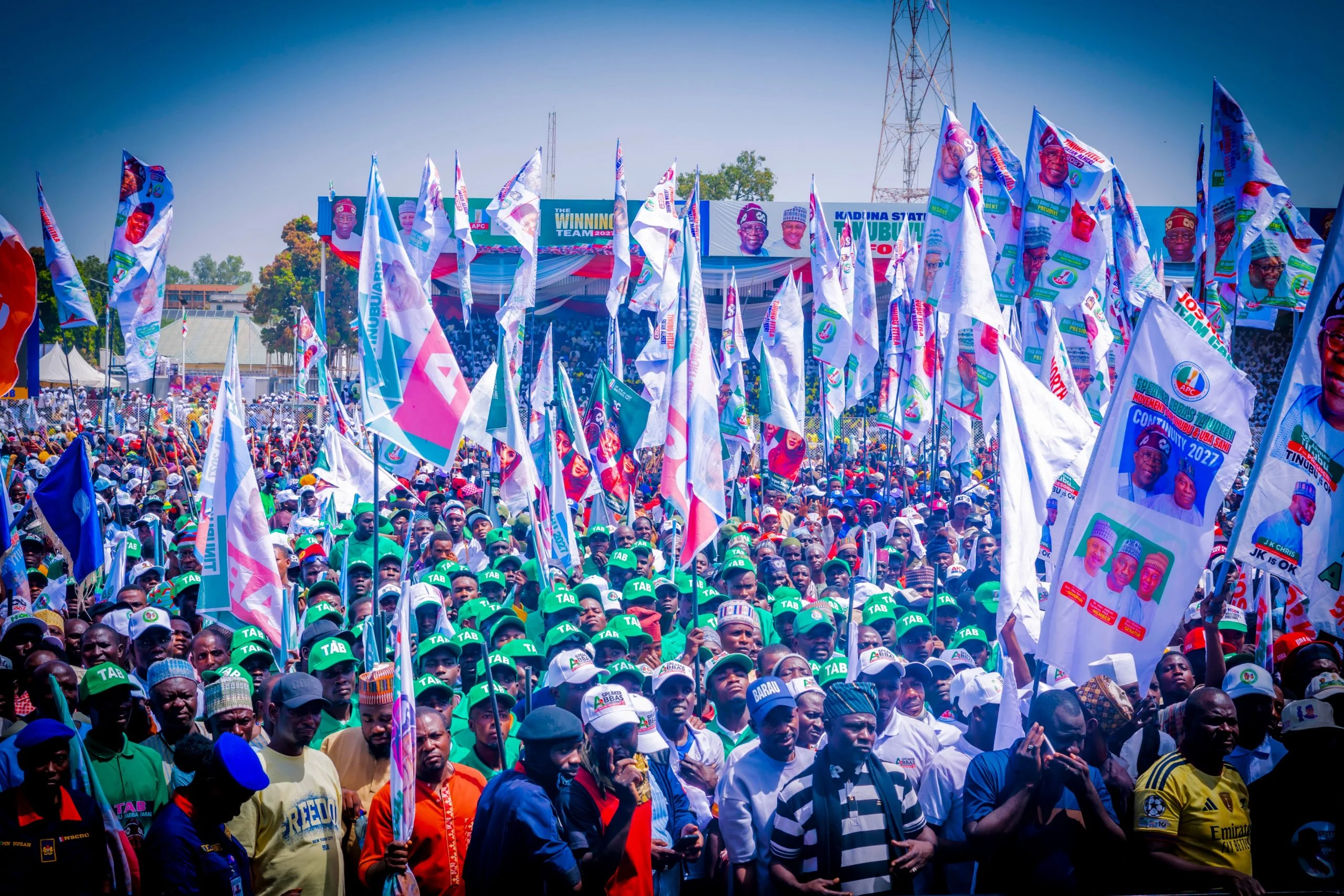
President Bola Tinubu chose Kaduna to launch his 2027 reelection campaign and test his popularity in northern Nigeria, home to more than half of the country’s registered voters.
On Saturday, thousands of party loyalists packed the 5,000-capacity Kaduna Township Stadium to cheer him on. Outside, however, protesters chanted “Bamu yi” (“We’ve had enough” in Hausa), a cry that was also heard during the president’s speech before order was restored.
The competing scenes have sparked a fierce argument between the ruling All Progressives Congress (APC) and the opposition over who truly speaks for the North: the cheering crowds inside the stadium or the angry protesters on the streets.
With the presidential election set for 16 January 2027, the answer could prove crucial to Tinubu’s bid for a second term.

Tinubu’s northern loyalty test
Presidential spokesman Abdulaziz Abdulaziz hailed the Kaduna turnout as “Arewa saying, without apology: we still stand with our friend”.
But opposition candidate Atiku Abubakar pointed to images of police guarding Tinubu’s campaign billboards against vandalism as evidence of growing anger towards the president.
We don’t have anything against him personally, except that he has failed in leadership. Nigeria has never been in this kind of hardship; there is a cost-of-living crisis, people are hungry, all because of his maladministration. So, he must go
Northern Nigeria accounted for 64% of the votes that secured Tinubu’s victory in 2023. Of the 103 million voters registered by the Independent National Electoral Commission (INEC) ahead of January’s election, 56 million are in the North.
Dele Alake, minister of solid minerals and spokesman for Tinubu’s campaign, tells The Africa Report that the president’s support remains strong, dismissing footage of protesters as showing “a rented crowd or AI-generated” images.
But Tinubu faces discontent over economic reformsthat have pushed more Nigerians into poverty, despite his insistence that the measures were necessary to avert fiscal collapse. The opposition hopes to exploit the hardship, particularly in the North, where poverty is most widespread, and communities also face jihadist attacks and kidnappings by bandits.
Colliding agitations
Recent weeks have seen a rise in northern voices opposing Tinubu’s reelection. The Arewa Consultative Forum (ACF), a prominent regional organisation, has criticised the government’s performance. A gathering of Islamic clerics called on the president to quit office, while a professor launched a book titled Tinubu: From Renewed Hope to Despair.
Last week, the Emir of Katsina made headlines after confronting Tinubu’s campaign director-general, Abdulaziz Yari, during a palace visit to seek his support. Meanwhile, a youth-led ‘Tinubu Must Go Movement’ has emerged from Kano, mobilising opposition to the president across the North.
The movement’s convener, human rights lawyer Abba Hikima, who commands a large following, tells The Africa Report that the campaign is not motivated by personal hostility towards Tinubu.
“We don’t have anything against him personally, except that he has failed in leadership,” he says. “Nigeria has never been in this kind of hardship; there is a cost-of-living crisis, people are hungry, all because of his maladministration. So, he must go.”
The threat is not lost on the APC. Five people wearing ‘Tinubu Must Go’ vests were arrested in Maiduguri, Borno State, while police barricaded a Kano hotel booked for the movement’s gathering.
In a further effort to drown out dissent, powerful groups such as ‘Tinubu Must Stay’, ‘Tinubu Must Go Again’ and Arewa 4 Asiwaju have emerged, holding massive pro-Tinubu rallies across the North.
Temitope Ajayi, presidential spokesman, says the pro-Tinubu movements are not a response to any perceived threat.
“There is nothing unusual about the support groups,” he tells The Africa Report. “In other climes, they call it endorsement, and every politician welcomes endorsements.”
Is the North with Tinubu?
From Vice President Kashim Shettima to APC national chairman Nentawe Yilwatda, his predecessor Abdullahi Ganduje, Tinubu’s campaign director-general Yari and many others, northern APC leaders argue that the region owes Tinubu a reelection victory.
Presidential spokesman Abdulaziz says Saturday’s crowd is evidence that the APC is winning the argument.
“The gathering was beyond a rented crowd; it was organic, massive, and emotional,” he said, pointing to photos of people “waving so happily at their president who wound down the window to greet them”.
“Many people kept vigil at the venue so they could get a good spot to witness history, and the excited young men and women spent the whole day under the sun waving flags and chanting praises.”
But a large rally, by itself, cannot settle the question of how the North will vote.
North-based political scientist Cliff Stanley says such gatherings can reflect genuine support while also serving as “a curated political performance, shaped by logistics and incentives the party has invested in the campaign”.
He cautions against dismissing the dissenters as mere opposition theatre.
“The more honest answer is that the chanting group represents the lived, material experience of many ordinary northerners more directly, because it expresses discontent with security, food prices, poverty and economic policy,” he says.
“Public protest at a ruling-party rally is politically costly and difficult to dismiss as mere opposition theatre; it signals that grievance has entered the space normally controlled by party mobilisation.”
The more honest answer is that the chanting group represents the lived, material experience of many ordinary northerners more directly, because it expresses discontent with security, food prices, poverty and economic policy
Political analyst Bishir Dauda, however, argues that voter apathy remains a major obstacle for opposition parties hoping to capitalise on economic hardship to unseat Tinubu.
“I don’t think many people will come out, leaving the traditional voters, who are mostly party loyalists and card-carrying members of political parties, to decide the poll,” he tells The Africa Report.
Dauda also argues that opposition parties risk overlooking northern women, whom he describes as a substantial voting bloc, by relying too heavily on social media campaigning.
“The problem with the opposition, as far as the next election is concerned, is that they lack presence in the rural areas,” he says. “You can travel for distance without seeing a poster of the ADC opposition in many places in the North.
They are capitalising on economic hardship to make people come out and vote against Tinubu, but I doubt if that will work. The results of the recent by-elections will tell you the behaviour of voters.”(The Africa Report)
-

 Politics17 hours ago
‘₦70,000 Can Just Buy 50 Litres Of Fuel’ – Atiku Mocks Tinubu’s Relief To Workers
-
News5 hours ago
Tinubu Addressing Longstanding Challenges – Barau Replies Osinbajo
-
News5 hours ago
States hold N264bn UBEC funds as schools struggle
-
News5 hours ago
TUC Rejects N70,000 Transport Allowance For Workers
-
Politics5 hours ago
Omission: INEC decides Pantami, Adebutu’s fate today
-
News5 hours ago
FG defends $21bn borrowing plan, cites infrastructure needs
-
Politics5 hours ago
No ministers paid billions for appointments – APC insists
-
Politics5 hours ago
Alleged plot to shift poll: it’s fake news, we’re unaware — Presidency