
Politics
2027: Between Soludo and Obi, who has Anambra voters’ ears?

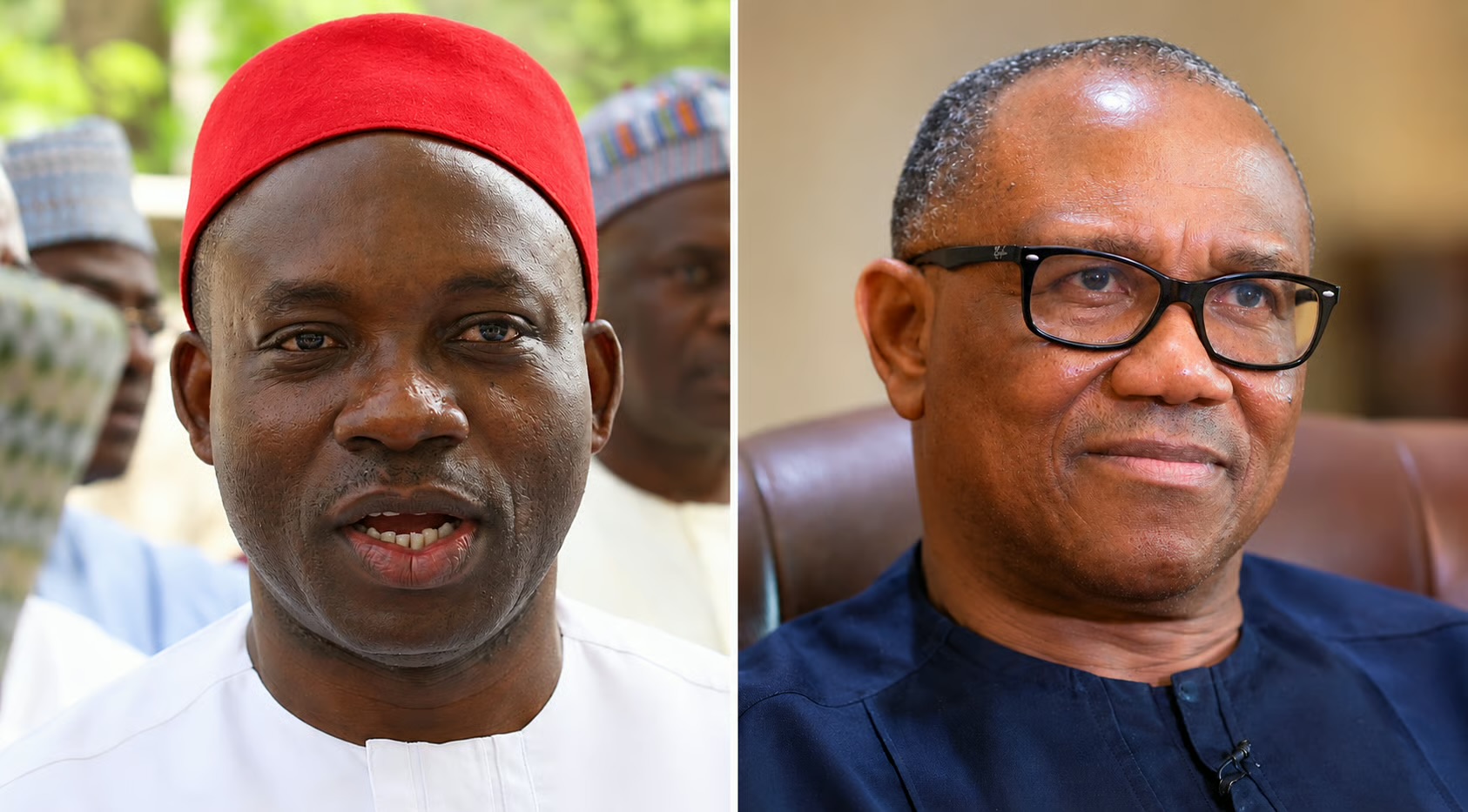
Anambra State Governor Charles Soludo has made President Bola Tinubu a bold promise, that he will deliver over 50% of the state’s votes in Nigeria’s January 2027 presidential election. It is a formidable undertaking, even for a sitting governor with control of the state’s political machinery.
Anambra is the home state and political stronghold of opposition presidential candidate Peter Obi, whose popularity there has proved remarkably resilient, including when Soludo openly opposed his presidential ambition in 2023.
In that election, Obi secured 584,621 votes in Anambra, representing 95.24% of valid ballots cast. Former vice-president Atiku Abubakar finished a distant second with 9,036 votes (1.47%), while Tinubu came fourth with just 5,111 votes (0.83%), behind Peter Umeadi of Soludo’s All Progressives Grand Alliance (APGA), who received 7,388 votes.
Across Nigeria, Obi finished third with about 6.1 million votes. Anambra alone contributed nearly 10% of that total.

Four years later, Soludo wants to rewrite that political equation, turning a state that overwhelmingly rejected Tinubu into one that gives him a majority.
Ejimofor Opara, APGA’s publicity secretary, acknowledges the scale of the challenge but insists the governor’s camp is prepared for it.
“If it is easy, then it is not worth it,” he tells The Africa Report. “In 2023, Anambra wasn’t the only state Obi won, he even defeated Asiwaju [Tinubu] in Lagos. If you are asking how APGA is going to keep that promise, maybe you should also ask Lagos APC the same question.
From brothers to political rivals
Soludo’s promise positions him for a popularity contest with Obi, who was also governor of Anambra from 2006 to 2014. The two men haven’t always been rivals and Soludo has disclosed they once called each other ‘brother’. They were both members of APGA. Their relationship deteriorated after Obi left in 2014 to join the Peoples Democratic Party (PDP), and subsequently moved across other political platforms.
Soludo insists Obi should have remained in APGA to pursue his presidential ambition. In 2023, he published an article openly opposing Obi’s candidacy on the platform of the Labour Party.
“Let’s be clear: Peter Obi knows that he can’t and won’t win,” Soludo said in the article. “He knows the game he is playing, and we know too; and he knows that we know. The game he is playing is the main reason he didn’t return to APGA.”
Still, Obi secured an overwhelming victory in Anambra.
Oseloka Zikora, a political analyst, says the result demonstrates the limits of Soludo’s influence over voters.
“In the 2023 presidential election, Peter Obi got nearly 600,000 votes in Anambra State. By 2027, he will get much more than that number because the people of Anambra have seen, from the result of 2023, that Obi has a good chance to win the presidency. That is a motivating factor for them,” he tells The Africa Report.
The 2027 calculations
But the political landscape has shifted since 2023. Under Soludo’s leadership, APGA has formally adopted Tinubu as its 2027 presidential candidateand is combining forces with the ruling All Progressives Congress (APC) to deliver the state to the president. Tinubu has also appointed Soludo to coordinate his campaign in the state, potentially giving the president’s campaign access to greater resources and an established grassroots mobilisation network.
Opara argues that the political dynamics that propelled Obi’s candidacy in 2023 have changed. He believes the Obidient Movement has weakened, partly because of the imprisonment of Nnamdi Kanu, leader of the separatist Indigenous People of Biafra (IPOB).
“That Obidient wave of 2023 has lost momentum,” he says. “It’s only on social media and by our brothers who don’t even live in Nigeria. The man they call the supreme leader is now in prison.”
He says APGA has developed an “evidence-based campaign to market Tinubu to Anambra voters”, with particular emphasis on federal infrastructure projects in the region.
“In 2023, Asiwaju got 5,111 votes in Anambra, that’s about 0.8% of the total vote count. And in spite of this, the Enugu-Onitsha Expressway is almost completed. The Second Niger Bridge link road is at an advanced stage, our students here enjoy NELFUND [student loan]; when you talk about the stabilisation of the exchange rate, naira-to-dollar, who do you think benefits the most? It is the Igbo traders who import goods,” he says.
Zikora, however, disputes the assumption that federal projects and the president’s economic policies will translate into electoral support. He points instead to the hardship associated with Tinubu’s reforms and what he describes as widespread dissatisfaction with the administration.
“I don’t see where and how Governor Soludo will be able to deliver 50% of Anambra votes for Tinubu, a president that people perceive as detached and uncaring and who has thrown millions of citizens into poverty,” he says. “Even in Soludo’s family, I wouldn’t be surprised if his son votes for Peter Obi. People are tired of the Tinubu government, they are tired of hunger.”
He also questions Soludo’s capacity to deliver votes for Tinubu on a scale that he could not achieve for himself in previous elections.
The limits of incumbency
Zikora’s argument draws partly on Soludo’s performance in the November 2025 governorship election, in which the incumbent secured 422,664 votes to win a second term. Although a substantial improvement on the 112,229 votes he received in 2022, the result also highlights the limits of electoral mobilisation in a state with a large registered electorate.
Anambra had 2,788,864 registered voters in the 2025 governorship election, but only 598,229 were accredited. Soludo’s votes represented about 72.4% of the valid votes cast, but just 15.2% of registered voters.
“In the last governorship election, Soludo was only able to scrape a fraction of the votes in the state,” Zikora says. “So, I can’t see where he wants to get all the votes from.”
According to him, there is no pathway to victory for Tinubu, through Soludo, unless “the federal government sends an army or Soludo deploys the local vigilantes to harass voters”.
But Anambra’s registered voting population has risen to 2.9 million ahead of the 2027 election, up from 2.65 million in 2023. For both camps, the number offers an opportunity. Converting it to votes, however, remains the real challenge.
In the 2023 presidential election, voter turnout in Anambra was only 24.7%.
But APGA is projecting improved turnout in 2027. Opara believes Kanu’s imprisonment has removed one of the factors that previously discouraged voters’ turnout in the South-East.
“If Nnamdi Kanu [was] not in prison, by now, what you would be hearing is: no election in Biafra land,” he says.
Damian Okeke-Ogene, a former vice-chairman of Ohanaeze Ndigbo, says the contest has become a battle of ideas.
“The sound of bitter kola in the mouth is not a measure of its sweetness,” he says. “The most important thing is that both camps are on the campaign trail, trying to market their ideas.” (The Africa Report)
-

 African News11 hours ago
Fani-Kayode’s confession to being cured of madness circulates across South Africa
-
World News23 hours ago
US proposed ceding Ukraine territory in exchange for joining NATO
-
Politics23 hours ago
ADC: Atiku hasn’t reached out to me despite coming from the same zone – Nafiu Bala
-
Metro23 hours ago
Zainab, Kwankwaso’s daughter, files for divorce from Gov Yusuf, offers to return dowry
-
Politics7 hours ago
Tinubu, Aregbesola met three times despite rift – APC chieftain, Prof Adeyeye
-
News23 hours ago
Clashes between gangs, vigilantes kill over 50 in Zamfara – Report
-
Opinion10 hours ago
Why Nigerians vote the way they do
-
African News6 hours ago
Nigeria’s mission in S/Africa urges calm in row over Ramaphosa spokesman’s remarks