News
US, UK, Germany… IMF says Nigeria’s economic growth will outpace eight countries by 2027

The International Monetary Fund (IMF) says Nigeria’s economic growth rate will hit 4.3 percent by 2027, outpacing estimates for eight advanced economies.
The forecast suggests a rebound from a recent downgrade to 4.1 percent in 2026 and the 2025 rate of 4 percent.
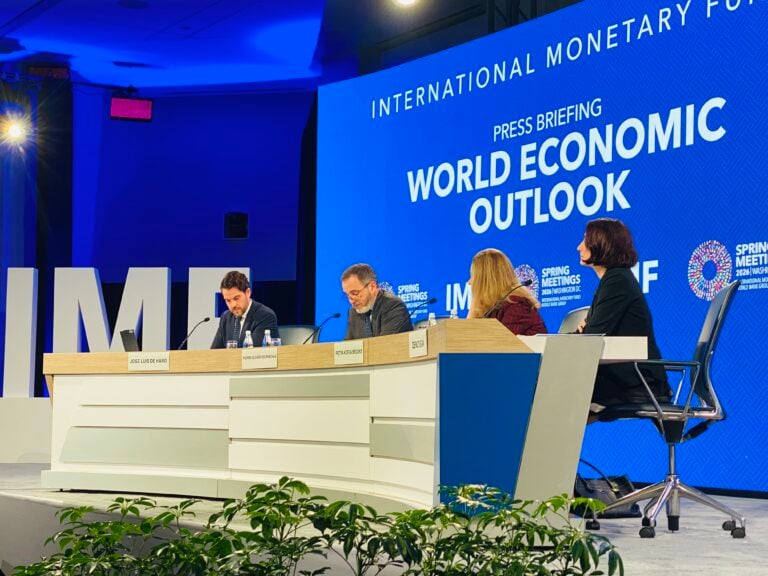
The projection was announced in the fund’s World Economic Outlook (WEO) report launched on Wednesday during a news conference at the ongoing IMF-World Bank spring meetings in Washington DC.
At 4.3 percent, the multilateral said Nigeria’s economy will grow faster than eight advanced economies, including the United States (US) with a growth rate of 2.1 percent, Canada (1.9 percent), Spain (1.8 percent), United Kingdom (UK) (1.3 percent).

Others are Germany (1.2 percent), France (0.9 percent), Japan (0.6 percent), and Italy (0.5 percent).
While this signals some positive prospects for the West African giant, the forecast does not mean that Nigeria’s economy will be larger in size than that of the eight nations.
Speaking on Nigeria’s economic outlook at the media briefing, Deniz Igan, division chief in the IMF’s research department, said the country’s downgrade reflected a balance of two forces: war-related higher fuel and fertiliser prices and shipping costs.
“We have revised Nigerian growth as well by 0.3 percentage point to 4.1 in 2026, and that is reflecting a balance of two forces. One is that the war-related higher fuel and fertilizer prices and higher shipping costs that I mentioned are going to weigh on oil activity in Nigeria,” Igan said.
“There’s some offset coming from higher oil prices, but at the end of the day, the balance is for weighing growth in 2026 with some recovery built in 2027.”
Nigeria’s central bank had disclosed plans to bring inflation down to a single-digit range of between 6 percent to 9 percent as part of its medium-term objectives in efforts to transition to an inflation-targeting monetary policy framework.
Addressing inflation movements in the country, Igan said tight monetary policy remains data dependent and “watching very carefully both exchange rate movements and inflation expectations is going to be crucial to achieve the inflation target of the central bank”.
GLOBAL GROWTH TO CONTRACT BY 3.1 PERCENT IN 2026
In the WEO report, the IMF said global growth will contract by 3.1 percent in 2026 and 3.2 percent in 2027 — slower than its recent pace of about 3.4 percent in 2024 and 2025.
The forecast for 2026, according to the multilateral, is revised downward by 0.2 percentage point “and that for 2027 is unchanged, compared with those in the January 2026 WEO Update”.
“Global headline inflation is expected to increase to 4.4 percent in 2026 and decline to 3.7 percent in 2027, marking upward revisions for both years,” the report reads.
“Absent the war, global growth would have been revised upward. Indeed, forecasts based on preconflict assumptions would have shown a slight upward revision of 2026 growth relative to that forecasted in the January WEO Update, by 0.1 percentage point to 3.4 percent.
“Hence, the downward revision for 2026 largely reflects the disruptions from the conflict in the Middle East, partly offset by carryover from recent strong data and reduced tariff rates.”
HOW GLOBAL GROWTH REDUCTION IS AFFECTING SUB-SAHARAN AFRICA
Speaking on growth in sub-Saharan Africa, Igan said 2025 was a strong year.
She said before the war began, global growth prospects were resilient, non-oil commodity prices were strong, and external financial conditions were supportive, helping a lot of countries in the region.
The IMF chief said with the war, the fund has reduced global growth, and prices for non-oil commodities have softened, “and also worse in terms of trade for oil importers, and that’s an important aspect for variation within the region as well”.
“And on top of that, the region is also facing significant challenges, from headwinds, from a decline in foreign aid, which bilateral aid cuts range from 16 to 28% in 2025, and we project that trend to continue now,” she said.
“How is that affecting the economy? As said, we have a downgrade on growth by 0.4 percentage point cumulatively for 26 and 27 and at the same time, median inflation in sub-Saharan Africa is projected to go up from 3.4% in 2025 to 5% in 2026, and that’s all reflecting the high oil and fertiliser prices, fuel shortages.”
Igan said rising environmental costs and fertiliser prices are a concern for the region because of its dependence on agricultural products as well and existing level of food insecurity.
On his part, Pierre-Olivier Gourinchas, chief economist, said the fund is following up with a number of countries on what their needs might be in the current environment in order to provide support.
He said the organisation is calling for an end to the Middle East conflict.
“We’re certainly coordinating as well as our Managing Director has started a coordination group with the IEA and the World Bank. So, we’re following developments in energy markets very, very closely. And of course, we’re calling for a very swift end to the hostilities and normalization in energy markets,” he added.
The International Energy Agency (IEA) had warned that countries would suffer if the Middle East conflict and the closure of the Strait of Hormuz persisted.(TheCable)
-

 Opinion14 hours ago
Obafemi Hamzat: Voice of the street, made for Lagos
-
Politics14 hours ago
2027: New strategy in place to checkmate Atiku, Obi – Wike
-
Sports14 hours ago
To make money for ‘generations of my family’— Reijnders explains Saudi move
-
News14 hours ago
Why Nigeria, Ghana-trained teachers were removed from UK qualification list
-
World News14 hours ago
US imposes new visa restrictions on birth tourism operators
-
News14 hours ago
Detention: El-Rufai Speaks On Silence Of Friends He Stood By In The Past
-
Business13 hours ago
TotalEnergies, AMNI approve $800m Ima Gas project
-
Sports14 hours ago
Ex-Super Eagles Captain William Troost-Ekong Converts To Islam