Business
Nigeria’s biggest firms pay record N2.3trn in income taxes

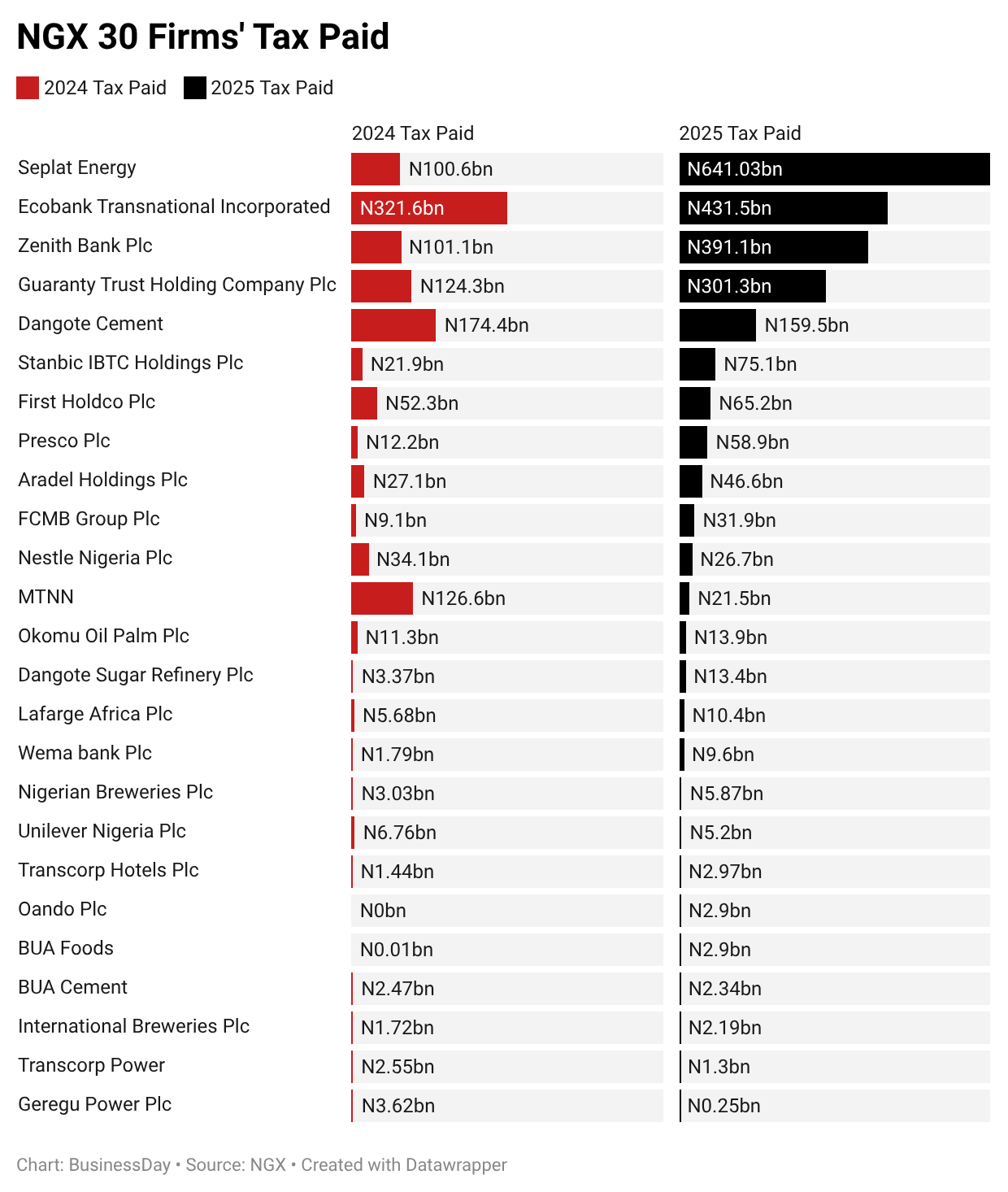
In 2025, Nigeria’s 30 biggest firms collectively paid N2.32 trillion in income taxes, reflecting an 86 percent increase from the N1.14 trillion remitted in 2024.
This amount represents about 12.9 percent of the Nigeria Revenue Service (NRS) total tax revenue for the year. The NRS disclosed that it generated N17.8 trillion in tax revenue in 2025, of which 51.7 percent (N9.21 trillion) came from company income taxes (CIT).
In other words, Nigeria’s biggest companies on the NGX were responsible for about 25 percent of company income taxes paid in 2025. This shows that while they make an important contribution to Nigeria’s tax revenue, there is a high dependence on the corporate base.
Out of the NGX ’30 firms, 25 firms generated the total amount of the taxes remitted above, while five firms are yet to upload their full-year financial statement for the period covered.

It’s also important to note that the N2.32 trillion figure reflects taxes actually paid, not just what companies recorded as tax expenses. The data was drawn from cash flow statements, which show real payments made, rather than income statements, which may include taxes owed but not yet paid.
Seplat emerges as the highest taxpayer
At the company level, Seplat Energy, the second most capitalised oil and gas firm on NGX, remitted N641.03 billion to the federal government in taxes last year.
Under Nigeria’s 30 percent corporate income tax framework, Seplat calculated CIT stood at N226 billion. However, additional charges such as the education tax and unrecognised deferred tax assets pushed its effective income tax expense to N513 billion. Despite these significant outflows, the company still reported a current tax liability of N307 billion at year-end, showing the scale of its ongoing obligations.
Banks remained top payers in 2025
Commercial banks were particularly prominent among the largest contributors, reflecting the sector’s profitability in 2025. Out of the eight most capitalised banks on NGX, seven paid N1.3 trillion in income taxes, a 105 percent increase from N632 billion paid in 2024.
Ecobank Transnational Incorporated paid N431.5 billion, the highest across the banks. Zenith Bank Plc followed closely with N391.1 billion, a 286 percent increase from N101.1 billion paid last year, and Guaranty Trust Holding Company Plc paid N301.3 billion from N124.3 billion.
Others include Stanbic IBTC Holdings Plc (N75.1 billion), First Holdco Plc (N65.2 billion), and FCMB Group Plc (N31.9 billion), while Wema Bank Plc’s tax liability fell to N9.6 billion from N1.79 billion.
The consumer goods are not left out. Collectively, they remitted N56.2 billion in 2025, a 14.9 percent increase from the N48.9 billion paid in 2024. Among the manufacturers, Nestle Nigeria paid the highest tax, amounting to N26.7 billion, followed by Nigerian Breweries Plc (N5.8 billion), and Unilever Nigeria paid N2.2 billion.
The agriculture sector also contributed significantly, with Presco Plc and Okomu Oil Palm Plc reporting N72 billion in taxes during the period. The cement sector, on the other hand, paid less taxes, with a combined tax remitted amounting to N172.24 billion, down from N182.55 billion.
For the telcos, MTN paid N21.5 billion in 2025, down by 83 percent from N126 billion declared in 2024.
The company closed 2025 with a profit before tax of N1.7 trillion, a 408.2 per cent increase over the N550.33 billion loss in 2024.
Karl Toriola, the company’s chief executive officer, expressed that the company’s rehabilitation of the 110-km Enugu–Onitsha Expressway under the Road Infrastructure Tax Credit Scheme continues to advance, with additional tax credits secured to offset tax liabilities from 2026.
“During the period, we paid N878.7 billion in taxes and levies to the government and were recognised by the Nigeria Revenue Service for tax compliance and transparency, demonstrating our track record of sound governance,” he said.
Analysts view
Yvonne Afolabi, a principal consultant at Techpoint Finance Consults, said that the fact that Nigeria’s largest firms paid over N2.3 trillion in CIT out of a total N9.21 trillion generated in 2025 means that a relatively small group of highly capitalised, high-compliance firms now bear a disproportionately large share of the formal sector’s tax burden.
“This exposes a structural concentration risk: the government’s CIT revenue is becoming heavily dependent on a handful of NGX-listed giants, while the vast majority of other registered companies, many of which operate informally or under-declare, contribute far less relative to their economic footprint.”
She added that while it may appear as a sign of improved corporate compliance among top-tier firms, it also signals that the broader tax base remains shallow and fragmented.
“This concentration leaves fiscal stability vulnerable to sector-specific shocks, such as a downturn in banking, telecoms, or manufacturing, where these largest payers are clustered,” Afolabi said.
According to a report on PricewaterhouseCoopers (PwC) on Corporate – Taxes on corporate income, listed companies in Nigeria contribute heavily to CIT because they are high-turnover entities (>N100 million) subject to a standard 30 percent tax rate, high regulatory compliance, and minimum tax obligations even in loss-making years.
“As formal entities, they are easier for tax authorities to monitor compared to the informal sector, making them primary tax drivers,” the report added.
What the new tax reforms mean for companies
Under the Nigerian Tax Act, 2025, companies pay 30 percent of their profits as CIT. However, the federal government may soon ease the burden.
Taiwo Oyedele, the minister of Fnance and Coordinating Minister of the Economy of Nigeria during his reign as the chairman of the Presidential Committee on Fiscal Policy and Tax Reforms, disclosed that a proposal to reduce the rate to 25 percent is in the works.
“We had written the CIT review for 25 percent into the law, but the governors refused it, so we found a way to add it to the law with a condition to get approval of the governors under the National Economic Council (NEC).
“We have written to NEC and are hoping we can put all of this behind us by the time we finalise the tax law by early 2026, before people have to start paying this tax,” Oyedele said.(BusinessDay)
-

 Politics14 hours ago
‘Weapon fashioned against APC’ — outrage as youth leader gifts 2026 Prados to party officials, then deletes post
-
News14 hours ago
Ebola: NCDC to pay contacts N100,000 weekly
-
Politics14 hours ago
We’ll Soon Expose Those Plotting To Scuttle My Guber Ambition – Pantami
-
Politics14 hours ago
We Won’t Allow Repeat Of 2023 Defeat – Lagos APC
-
News14 hours ago
Zamfara Steps Up Ebola Containment Measures After Passenger With 38°C Fever Arrives Airport
-
Metro14 hours ago
Okonjo-Iweala’s mother dies at 96
-
News14 hours ago
States’ six-month debt servicing bill hits N800bn
-
Politics14 hours ago
2027: NDC slams Tinubu, APC over ₦1bn worth of Prado SUVs for youth leaders